Increase Over Four Years Since 2019, Decline Starting Last Year
Fire, Rescue, and Emergency Calls Similar to Previous Years
Medical Consultation Guidance Down 24% Following End of COVID-19
Last year in the Gwangju area, 119 emergency calls were received every 98.6 seconds.
According to the “2023 Gwangju Area Firefighting Activity Analysis” released by the Gwangju Metropolitan Fire Safety Headquarters on the 11th, a total of 319,971 119 calls were received in the Gwangju area last year, averaging 876.6 calls per day.
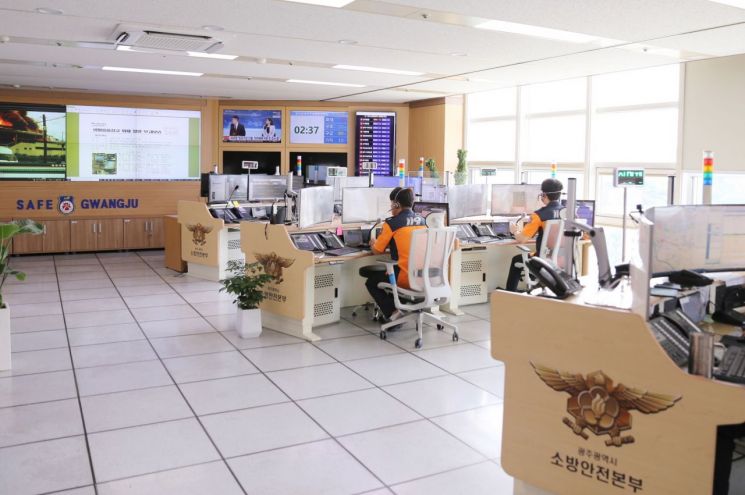
Analyzed by hour, the emergency call bell rang every 98.6 seconds. This is a decrease of 6,863 calls (2.1%) compared to the previous year.
119 calls had steadily increased for four years since 2019 but turned to a decline last year for the first time. While calls related to fire, rescue, and emergency medical services remained at similar levels to previous years, the end of COVID-19 led to a decrease of 12,408 calls (24.3%) for medical consultation guidance, which influenced the overall decline.
By type of on-site activity, there were 4,839 fire dispatches, 9,479 rescue dispatches, 77,693 emergency medical dispatches, and 13,331 daily safety dispatches.
Fire dispatches occurred at an average of 13 times per day, with a total number of calls increasing by 222 (4.8%) compared to the previous year. Among these, 732 fires (an average of 2 per day) occurred, which is 29 fewer (3.8%) than the 761 fires in 2022. There were 33 casualties, an increase of 5 people (17.9%) from the previous year, and property damage amounted to approximately 5.454 billion KRW, an increase of about 2.069 billion KRW (61.1%).
The main causes of fire were carelessness with 327 cases (44.7%), electrical factors with 146 cases (19.9%), and mechanical factors with 111 cases (15.2%). The locations of fire occurrences were mostly non-residential places such as restaurants and industrial facilities, accounting for 279 cases (38.1%), indicating the need for safety education on fire use and user caution.
Rescue dispatches totaled 9,479 cases (an average of 26 per day), an increase of 494 cases (5.5%) from the previous year, with 7,167 actual rescues. The causes of rescue dispatches were water rescues due to concentrated summer heavy rains and personal safety confirmation dispatches.
By type of rescue activity, fires accounted for 1,856 cases (25.9%), location confirmations 1,110 cases (15.5%), elevator rescues 1,042 cases (14.5%), and trapped persons 946 cases (13.2%).
Emergency medical activities totaled 77,693 cases (an average of 213 per day), a decrease of 5,935 cases (7.1%) from the previous year. Among these, 51,010 patients were transported to hospitals. The decrease in emergency medical activities was due to a reduction in emergency transports for respiratory diseases, symptoms of COVID-19.
By type of patient occurrence, diseases (pain, decreased consciousness, etc.) accounted for 35,521 cases (70.9%), accident injuries (falls, slips, etc.) 9,261 cases (18.5%), traffic accidents 3,933 cases (7.8%), and others (simple intoxication, pregnant women, etc.) 1,395 cases.
Daily safety activities totaled 13,331 cases (an average of 36.5 per day), an increase of 1,295 cases (10.8%) from the previous year. Activities were especially concentrated in the summer months of July to September (47.5%). This was attributed to increased safety measure dispatches due to facility damage and safety accident risks caused by concentrated heavy rains.
By type, bee (nest) removal accounted for 3,908 cases (32.1%), non-fire alarm handling 3,671 cases (30.1%), and animal handling 2,309 cases (18.9%).
Kim Mun-yong, head of the Gwangju Fire Safety Headquarters, said, “Although firefighting activities slightly decreased in 2023 compared to 2022 due to the end of COVID-19, the fire and rescue sectors remained similar to previous years. We will do our best to promote various safety measures to strengthen citizen safety through meticulous analysis of firefighting activity statistics.”
© The Asia Business Daily(www.asiae.co.kr). All rights reserved.

















