The Bank of Korea Holds Base Rate at 3.50%
Inflation Rate in the 3% Range Still a Concern
Market Expects Rate Cut in the Second Half of the Year
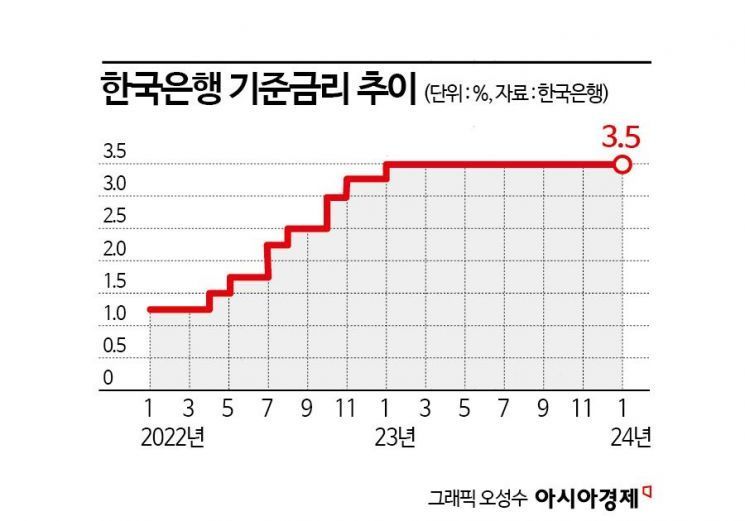
The Bank of Korea has kept the base interest rate steady at 3.50% for the eighth consecutive time. Since February last year, the base rate has neither been raised nor lowered throughout the entire year.
The Bank of Korea stated that it will change its tightening stance only when the inflation trend is clearly under control. The market expects that inflation will ease in the second half of this year, prompting the Bank of Korea to start lowering the base interest rate.
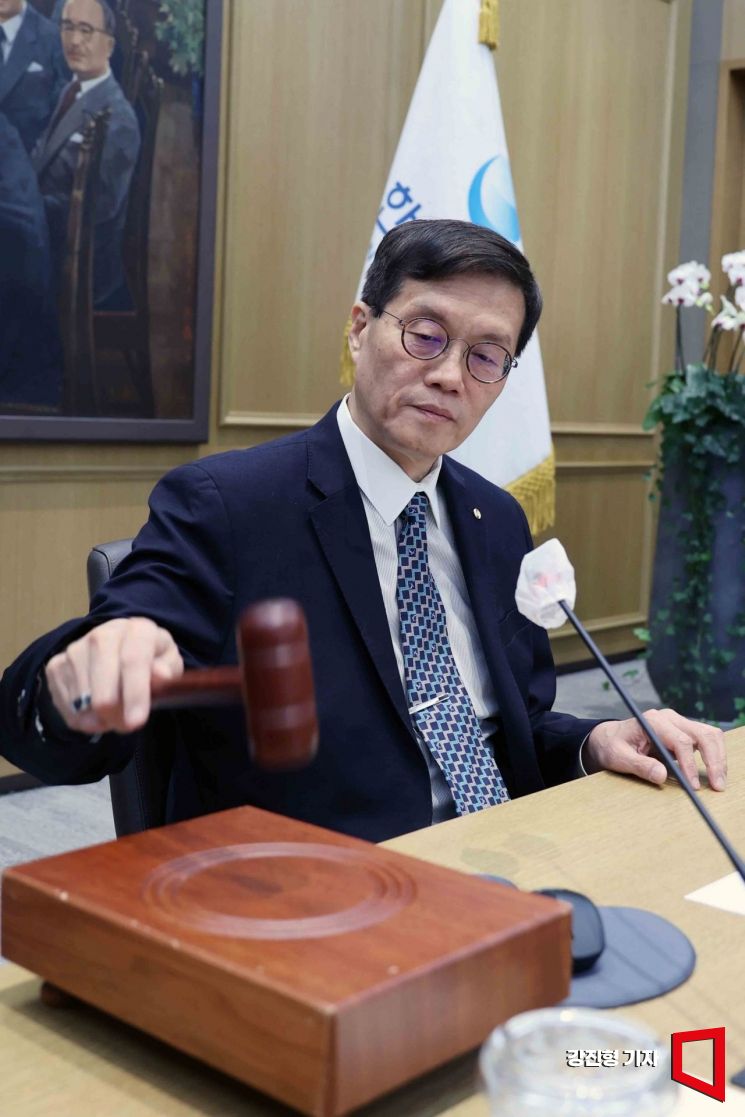 Lee Chang-yong, Governor of the Bank of Korea, is attending the first Monetary Policy Committee plenary meeting of the new year held at the Bank of Korea in Jung-gu, Seoul, on the morning of the 11th, and is striking the gavel. Photo by Joint Press Corps
The Monetary Policy Committee (MPC) of the Bank of Korea held a meeting on the morning of the 11th at the Bank’s headquarters in Jung-gu, Seoul, and decided to keep the current base interest rate (3.50% per annum) unchanged. The MPC has kept the base rate steady for eight consecutive times since February last year, marking a full year.
The reason the Bank of Korea has kept the base rate unchanged for a year is that the consumer price inflation rate still remains in the 3% range, falling short of the Bank’s target of 2%. The consumer price inflation rate has stayed in the 3% range for five consecutive months from August last year (3.4%) through December (3.2%).
At the beginning of the year, the Bank of Korea announced in its monetary and credit policy operation direction that it would maintain a sufficiently long tightening stance until it is confident that the inflation rate will stabilize at the target level of 2% this year.
The Bank expects the inflation rate to continue slowing down this year but to fall to the target level only after the fourth quarter. It judges that inflationary pressures remain due to ongoing geopolitical risks in the Middle East and Europe, as well as increased risks from climate change. Bank of Korea Governor Lee Chang-yong said in his New Year’s address, "It is important to successfully conclude the fight against inflation."
Professor Ha Jun-kyung of Hanyang University’s Department of Economics said, "Since the inflation rate is still in the 3% range and there is upward pressure on public utility charges, it will take time to settle at the 2% range," adding, "It is premature for the Bank of Korea to lower the base interest rate."
Household Debt Levels Remain High; Real Estate PF Not Addressed by Rate Cuts
Another factor sustaining the tightening stance is the persistently high level of household debt. According to the Bank of Korea, total household loans across all financial sectors increased by 10.1 trillion won compared to a year earlier. The household debt-to-GDP ratio reached 100.8%.
As of the end of last year, the outstanding household loans in the banking sector stood at 1,095 trillion won, the largest ever. Although the increase in household debt slowed after the Bank of Korea raised the base rate, concerns have been raised that debt could rise again due to the government’s continued easing of real estate regulations.
Yoon Seok-jin, a researcher at Hana Financial Management Research Institute, explained, "Although the inflation rate is slowing, it still records an upward trend exceeding the target," adding, "Considering financial stability goals such as household debt risks, it is necessary to maintain the current base interest rate level for the time being."
Although concerns about a real estate project financing (PF) crisis triggered by Taeyoung Construction have spread in the market, the decision reflects the judgment that it is not yet time to respond with rate cuts. The Bank of Korea believes that addressing the real estate PF issue requires corporate self-help efforts and fiscal support from the government and financial authorities rather than lowering the base interest rate.
Researcher Kim Ji-na of Eugene Investment & Securities said, "Since the real estate PF problem has not escalated into a financial system issue, there is no need for the Bank of Korea to cut the base rate earlier than other countries," adding, "On the contrary, rate cuts could have side effects such as increasing household debt and real estate prices."
Professor Ryu Deok-hyun of Chung-Ang University’s Department of Economics said, "The Bank of Korea is not in a position to lower the base rate because of real estate PF," and added, "The timing of the Bank’s rate cuts will be decided considering the timing of rate cuts by the U.S. Federal Reserve (Fed)."
Whether to Lower the Base Rate Depends on Inflation Stability and Timing of U.S. Rate Cuts
Experts believe that whether Korea lowers its base interest rate depends on inflation stability and the timing of U.S. rate cuts. Currently, market interest rates have fallen to levels partially reflecting expectations of a rate cut.
However, many experts think it will be difficult for the Bank of Korea to lower the base rate prematurely because inflation is unlikely to fall to the desired level in the first half of the year, and the timing of the Fed’s rate cuts must also be considered.
The Fed hinted at the possibility of three rate cuts this year in its outlook announced after last month’s Federal Open Market Committee (FOMC) regular meeting. According to the Chicago Mercantile Exchange (CME) FedWatch, the probability of a rate cut at the May FOMC is 92.3%, and at the June meeting, it is 99.7%.
Researcher Ahn Ye-ha of Kiwoom Securities said, "It is necessary to confirm the inflation slowdown trend and the impact of real estate PF," adding, "After the Fed’s rate cut in June, the Bank of Korea is expected to lower the base rate in July."
Researcher Oh Chang-seop of Hyundai Motor Securities also predicted, "With domestic inflation stabilizing and the start of U.S. rate cuts in the second half of the year, the Bank of Korea is expected to begin lowering the base rate around the second half."
Due to the historically largest inverted interest rate gap between Korea and the U.S. (2 percentage points), there is an assessment that the Bank of Korea has some leeway even if the U.S. cuts rates quickly. The U.S. base rate is currently 5.25?5.5%.
Researcher Kim Sung-soo of Hanwha Investment & Securities explained, "Even if the U.S. cuts rates more aggressively than expected, we need to pay attention to the inverted interest rate gap," adding, "Just as we did not follow the U.S. to the very end during the rate hike cycle, we do not necessarily have to follow the U.S. downwards."
Research Fellow Jo Yong-gu of Shin Young Securities also said, "Depending on the timing and speed of U.S. rate cuts, the Bank of Korea is likely to follow by gradually narrowing the Korea-U.S. interest rate gap."
Earlier, a survey conducted by Asia Economy from the 3rd to the 5th among 21 economists from economic research institutes and analysts from domestic and foreign securities firms showed that 16 out of 21 respondents (76%) expected the base interest rate cut to begin in the third quarter of this year.
© The Asia Business Daily(www.asiae.co.kr). All rights reserved.













