Junggyeonryeon Announces '2024 Mid-sized Companies Export Outlook and Challenges Survey Results'
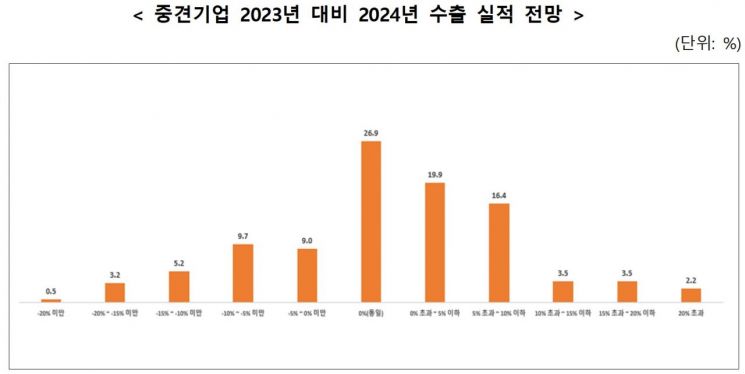
72.4% of mid-sized companies expect their export performance this year to be maintained or improved compared to last year. Only 27.6% of mid-sized companies responded that it would worsen.
The Korea Federation of Mid-sized Enterprises announced the results of the "2024 Mid-sized Enterprises Export Outlook and Difficulties Survey" on the 11th. This survey was conducted from December 5 to December 18 last year, targeting 402 mid-sized export companies.
The survey results showed that 45.5% of mid-sized companies expect their exports to expand compared to last year, and 26.9% expect them to be maintained. The export expansion outlook reflected mid-sized business owners' expectations for "economic recovery" (38.8%) and "sales growth in newly entered regions" (35.0%). By industry, the proportion of mid-sized companies expecting export expansion was highest in the order of automobiles and trailers at 58.8%, chemicals, petroleum, and food and beverages at 50.0%, and wholesale and retail at 43.2%.
Among mid-sized companies that responded that exports would decrease, "continued global economic slowdown" (64.9%) was cited as the biggest risk factor. This was followed by "rising raw material prices" (13.5%), "increased exchange rate volatility" (9.9%), and "rising logistics costs" (3.6%).
To improve export performance, mid-sized companies are making various efforts to enhance their own export competitiveness, such as "cost reduction and productivity improvement" (33.1%), "diversification of export countries" (29.9%), and "increasing the share of domestic sales" (20.8%). Also, mid-sized business owners unanimously agreed that active support policies such as "strengthening tax support including tariffs and value-added tax" (31.6%) and "expanding trade finance such as guarantees" (27.9%) are necessary to revitalize exports. A representative from the Federation explained, "To expand the export market for mid-sized companies, it is necessary to seek effective tax support measures that can back up proactive financial support beyond performance-oriented evaluation and the specific demands of mid-sized companies by industry."
Looking at the export status of mid-sized companies, 75.1% have entered three or more countries. The main export markets were the United States (30.1%), China (22.4%), Japan (11.7%), Vietnam (10.4%), and Europe (7.2%) in that order. Difficulties in exporting were found to be at similar levels for "administrative difficulties such as customs clearance" (25.1%) and "import regulations of the respective countries" (24.9%), followed by "technical regulations such as certification" (18.9%) and "lack of local legal information" (17.9%).
34.3% of mid-sized companies plan to enter new markets, and among them, 81.1% stated that their target period is from the second half of this year to the first half of next year. The target new markets were the United States (21.7%), Vietnam (14.5%), Europe (14.5%), and Indonesia (10.1%) in that order. Reasons for pursuing new market entry included "saturation of existing markets" (31.2%), "expansion of new businesses" (20.3%), "securing strategic positions" (20.3%), and "strengthening cooperation with trading partners" (17.4%). However, more than half of mid-sized companies (51.5%) responded that they lack essential information for entering new markets.
Lee Ho-jun, the full-time vice chairman of the Federation, said, "Despite ongoing economic uncertainties, the survey result that 72.4% of mid-sized companies expect to maintain or improve export performance is a meaningful signal for revitalizing the economy." He added, "As the trade and commerce environment has changed significantly due to supply chain restructuring and the spread of economic nationalism, we will continue close communication with the government and the National Assembly to ensure that government policy support such as export market diversification and supply chain stabilization can back stable export market securing."
© The Asia Business Daily(www.asiae.co.kr). All rights reserved.

















