Various Bond Companies Including Banks, Insurance, Securities, and Pension Funds
Many Financial Institutions as Lead Lenders by PF Project Site
Conflicting Interests Expected Depending on Collateral and Business Situation
"Because the damage would be too great if it goes into court receivership, the likelihood of a workout (corporate financial restructuring) passing is high. However, it will be the most complex workout in the history of the domestic financial market in terms of stakeholders." A senior executive at a domestic financial company made this prediction regarding the creditor-debtor relationships and the vast scope of workout claims that emerged during the workout promotion process.
 Taeyoung Construction, which applied for a workout due to liquidity issues in real estate project financing (PF), has completed a creditors' briefing session. On the 4th, the traffic light in front of Taeyoung Construction's headquarters in Yeouido, Seoul, turned red. Yoon Se-young, the founding chairman of Taeyoung Group, acknowledged management's mistakes during the briefing and requested consent for the workout, but the main creditor bank, the Korea Development Bank, asked for an additional self-rescue plan. Photo by Kang Jin-hyung aymsdream@
The creditors' group will decide on Taeyoung Construction's workout on the 11th. Approximately 600 financial companies holding a total of 21 trillion won in claims, combining direct debt and project financing (PF) guarantee debt, are expected to participate in the vote. Since even projects where Taeyoung Construction only provided completion guarantees are included in the guarantee debt, experts commonly agree that even if the workout passes, it will be the most challenging workout in domestic history.
Taeyoung's Direct Debt of 1.3 Trillion Won... Stakeholder Interests Vary According to Collateral and Repayment Priority
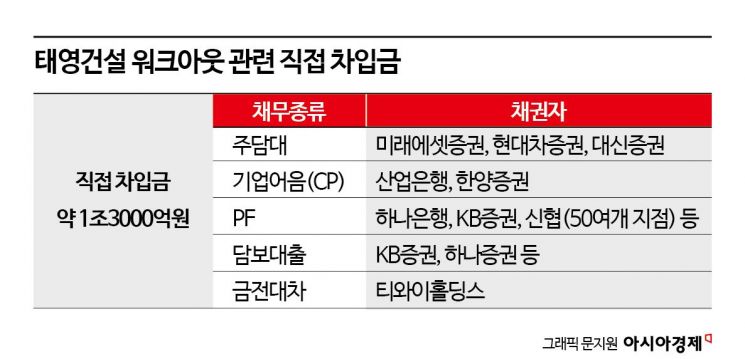
According to the investment banking (IB) industry on the 11th, if the workout passes, the creditors' group will have to resolve the interests related to Taeyoung Construction's direct debt of 1.3 trillion won as well as guarantee debts worth 21 trillion won linked to about 120 PF projects. Taeyoung Construction's direct debt, borrowed directly from financial companies, is classified into general loans, corporate bonds, real estate-secured loans (Yeouido headquarters), stock-secured loans, and commercial paper (CP), among others.
Banks including KDB Industrial Bank, securities firms, asset management companies, and the Construction Mutual Aid Association have lent money directly to Taeyoung. The 400 billion won in private bonds issued by the parent company TY Holdings to Kohlberg Kravis Roberts (KKR) and then lent back to Taeyoung Construction is also included in the direct debt.
Additionally, there are borrowings from projects such as Hwaseong Dongtan 2 New Town, Suwon Dangsu Public Housing, and Changwon Self-Sufficient Complex Administrative Town. Each loan has different maturities and collateral, and in the case of PF projects, the project progress status varies, including some sites not yet started. Furthermore, loans are divided by seniority?senior, mezzanine, and junior?determining the repayment priority among creditors. It is known that creditors for the Hwaseong Dongtan project and Yeouido headquarters collateral loans each exceed ten, with different collateral and repayment priorities per claim.
The number of creditors involved in each loan is also large. For example, the Suwon Dangsu Public Housing project has over 50 credit union (Shinhyup) branches sharing the loan. While consensus might be reached at the Shinhyup Central Association level, various opinions could emerge at each workout stage. This project is at the pre-construction stage, and sales have been indefinitely postponed due to Taeyoung Construction's workout application.
An IB executive at a financial company said, "Once the workout begins, conflicts of interest will frequently arise during debt restructuring processes such as repayment deferrals, principal and interest reductions, equity conversions, or decisions on additional funding by the creditors' group," adding, "The main creditor bank, Industrial Bank, will have to solve a complex equation."
Over 120 Guarantee Debt Projects... Dozens of Creditors per Project
The situation becomes even more complicated when it comes to guarantee debts for PF projects where Taeyoung Construction is the contractor. Joint guarantees, payment guarantees, debt assumption, and even PF projects where completion guarantees were provided are all included in the workout claims. The number of projects is about 120, with 945 guarantee cases and a guarantee scale of 19.84 trillion won. Among these, Taeyoung Construction's contingent liabilities for PF projects that it must resolve amount to 9.5 trillion won.
It is expected that creditors within each project will coordinate opinions through voluntary agreements. PF projects differ in construction progress, sales performance, and collateral value. There are project developers separated from Taeyoung Construction, and some projects are constructed jointly with other construction companies, not solely by Taeyoung. A securities firm PF executive said, "Consensus among PF project creditors is not easy, and the situations of developers and contractors vary," adding, "Differences with financial institutions holding general debts, not guarantee debts, must also be reconciled."
The number of creditor financial companies involved in each guaranteed project mostly exceeds ten. For example, the Gimpo Pungmu Station Area Urban Development project, constructed by Taeyoung Construction, has a creditor group of 18 institutions including banks such as Industrial Bank, KB Kookmin Bank, Woori Bank, Shinhan Bank, and IBK Industrial Bank; insurance companies like Nonghyup Life, KB Insurance, Dongyang Life, Shinhan Life, Mirae Asset Life, and Korean Re; and specialized credit finance companies (credit card and capital companies) such as Lotte Card, San-eun Capital, IBK Capital, and NH Capital.
In the case of mutual finance institutions like Saemaeul Geumgo and Shinhyup, many branches or unit cooperatives have clustered investments in a single project. For instance, the Daejeon Yucheon-dong Residential Complex 3 Block (3BL) PF project has investments from dozens of Saemaeul Geumgo branches or unit cooperatives including Anseong Scholarship, Goyang East, Buk-gu, Munhwa, Daejeon Oncheon, Jinjam, Taepyeong, Daejeon Jeil, Samsong-dong, Woori, Chungmu, Dorim, Yongdu, Mutae, Changsin, Chubu, Shinwoo, and Haengbok. The Dongdaejeon Homeplus Reconstruction project reportedly has PF loans from as many as 35 Saemaeul Geumgo branches and unit cooperatives.
Financial authorities and creditors plan to coordinate the complex interests by applying the 'Guidelines for Improving the Implementation Agreement of Workout Construction Company Management Normalization Plans.' They have established mechanisms to reconcile differences between PF creditors, contractors, and creditor financial institutions and lowered the quorum ratio for decision-making within creditor groups to expedite decisions. Moreover, under these guidelines, decisions made in good faith without intentional or gross negligence can be exempt from liability.
A creditor group official said, "Since Taeyoung Construction is a large construction company ranked 16th domestically, and indirect debts from PF projects overwhelmingly exceed direct debts, coordinating interests is inevitably complex," adding, "If the creditor financial institutions' council follows the guidelines well, the workout could proceed more smoothly than expected."
© The Asia Business Daily(www.asiae.co.kr). All rights reserved.
![Clutching a Stolen Dior Bag, Saying "I Hate Being Poor but Real"... The Grotesque Con of a "Human Knockoff" [Slate]](https://cwcontent.asiae.co.kr/asiaresize/183/2026021902243444107_1771435474.jpg)

















