Operating Profit Falls Below 10 Trillion Won for the First Time in 15 Years
Consensus on Full-Scale Improvement in Q2 Performance
Semiconductor Market Conditions and Interest Rate Cuts as Variables
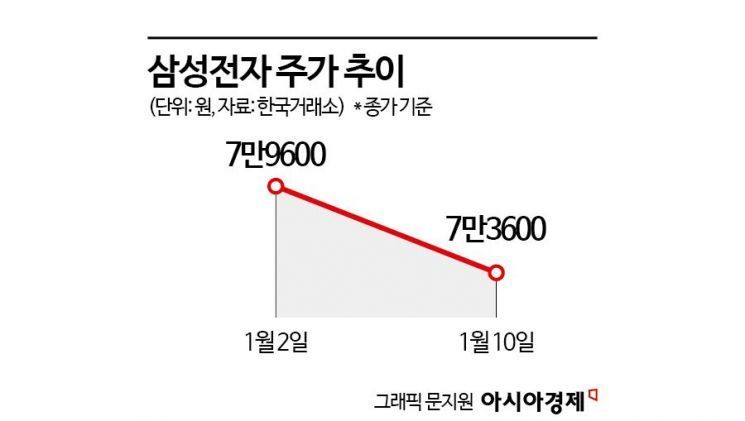
Samsung Electronics' stock price, which was approaching 80,000 won on the first trading day of the new year, plunged sharply after an earnings shock. While there is an assessment that structural earnings improvement is underway amid a recovery trend in the semiconductor market, there are subtle differences in views regarding the timing of the full-scale earnings improvement.
According to the Korea Exchange on the 10th, Samsung Electronics closed at 73,600 won, down 1.47% (1,100 won) from the previous day. It ended lower for three consecutive trading days starting the day before the earnings announcement (on the 9th). Compared to the first closing price of the new year (79,600 won), it fell by 8.1%.
This is interpreted as a contraction in investor sentiment following the earnings announcement the previous day. Samsung Electronics' consolidated operating profit for Q4 last year was 2.8 trillion won, down 35% from the previous year, and sales were 67 trillion won, down 5%. The Digital Experience (DX) division is estimated to have decreased compared to the previous quarter. Generally, smartphone shipments decline in Q4. Additionally, delayed recovery in TV and home appliance demand and intensified competition are believed to have had a negative impact. On the other hand, securities firms expect that losses in the Device Solutions (DS) division were reduced due to the recovery in the memory semiconductor market.
Operating profit for the entire last year was 6.54 trillion won, down 84.92% from the previous year. Sales also decreased by 14.58% to 258.16 trillion won. This is the first time in 15 years that Samsung Electronics' annual operating profit has fallen below 10 trillion won since the global financial crisis in 2008 (6.0319 trillion won). This figure significantly underperformed securities firms' operating profit estimates.
The main player affecting Samsung Electronics' supply and demand was foreigners. Individuals showed a 'buying' trend throughout the year except for the first trading day of the new year, net purchasing 718.7 billion won. Conversely, institutions showed a 'selling' trend throughout the year except for the first trading day, net selling 802.4 billion won. Foreigners showed a slight 'selling' trend on the 5th (-43.5 billion won) and sold 199 billion won worth of shares over two trading days after the earnings announcement.
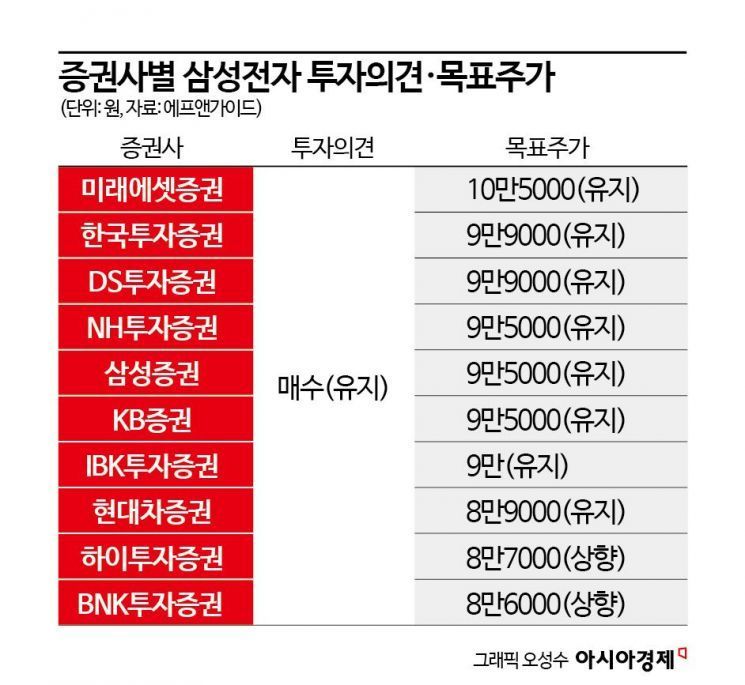
With a conference call related to earnings scheduled for the 31st, opinions differ somewhat on the timing of earnings improvement. The prevailing view is that earnings improvement will begin in earnest from the first half of the year. Kim Sun-woo, a researcher at Meritz Securities, said, "The full-scale earnings improvement is expected in the second quarter," adding, "Structural earnings recovery will continue until the fourth quarter, mainly based on cost efficiency from reduced memory production cuts (fixed cost allocation effect due to recovery in operating rates)."
Park Yoo-ak, a researcher at Kiwoom Securities, also said, "The Q4 earnings shock was due to weakness in non-memory and home appliances," and evaluated, "Since the memory sector's market conditions and earnings turnaround are underway, expectations for a rebound in the memory market and expansion of HBM competitiveness will act as short-term stock price momentum."
Lee Soo-rim, a researcher at DS Investment & Securities, stated, "Although there is a possibility of short-term shipment sluggishness in Q1 due to the traditional off-season, it is necessary to pay attention to the steep recovery speed of memory from Q2 as inventory levels have significantly decreased."
However, there is also a view that the semiconductor market recovery will be delayed, causing earnings improvement to occur later than expected. In particular, Song Myung-seop, a researcher at Hi Investment & Securities, predicted that the semiconductor market is more likely to slow down from the third quarter. He diagnosed, "Samsung Electronics' operating profit forecast for this year has been slightly lowered from 28.2 trillion won to 27 trillion won." However, he raised the target stock price. He explained, "The 'upgrade' does not mean an improved view of the semiconductor market but is due to changing the basis for applying book value per share (BPS) for target price calculation from FY23 to FY24."
Monetary policy is also cited as a factor delaying Samsung Electronics' earnings improvement. Lee Min-hee, a researcher at BNK Investment & Securities, said, "if the U.S. enters a rate-cut cycle in the first half, a full recovery is expected by the end of the year," advising, "It is worth looking for a low-price buying opportunity again around 70,000 won for Samsung Electronics' stock price."
© The Asia Business Daily(www.asiae.co.kr). All rights reserved.
![Clutching a Stolen Dior Bag, Saying "I Hate Being Poor but Real"... The Grotesque Con of a "Human Knockoff" [Slate]](https://cwcontent.asiae.co.kr/asiaresize/183/2026021902243444107_1771435474.jpg)

















