Utilizing Samsung Semiconductors in Hyundai Motor SDV Platform
"Collaboration Between Both Companies Creates Great Synergy for Next-Generation Semiconductors"
Beyond Batteries and Auto Parts, Also Joining Hands in Software
Hyundai Motor Company is expanding its collaboration with Samsung Electronics across the board as it decides to use Samsung’s semiconductors in developing software-defined vehicles (SDVs), which are considered the core of future mobility. As integrating advanced technology into vehicles and other modes of transportation becomes a key trend, the industry views cooperation between these two leading Korean companies as an essential step.
On the 9th (local time), Song Chang-hyun, CEO of FortyTwoDot and head of Hyundai Motor and Kia’s SDV division, and Park Yong-in, President of Samsung Electronics’ System LSI division, signed an agreement reflecting this collaboration at Samsung Electronics’ booth during CES 2024. According to the agreement, Hyundai Motor will use vehicle semiconductors developed by Samsung Electronics to build an SDV platform by next year. They also agreed to showcase the platform concept during this CES event and jointly market and strengthen the ecosystem through next year.
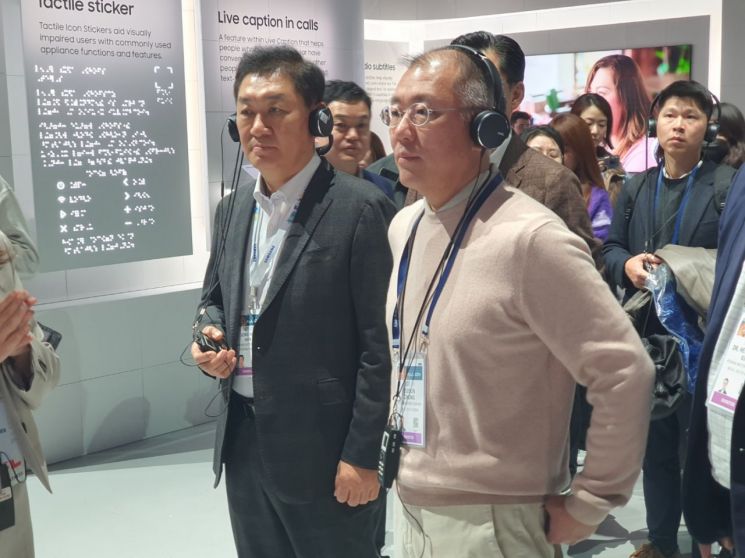 Hyundai Motor Group Chairman Chung Eui-sun is visiting the Samsung Electronics exhibition hall and receiving an explanation at CES 2024, which opened on the 9th (local time).
 [Photo by CES Joint Press Corps]
Samsung’s automotive processor, Exynos Auto, is one of the vehicle semiconductors equipped with a central processing unit and graphics processing unit. It is used to develop features such as real-time driving information for drivers, high-definition maps, and video streaming capabilities.
CEO Song said, “By collaborating with Samsung Electronics, we will provide a safe and enjoyable mobility experience through new services that connect and expand seamlessly, even if users are not familiar with complex technologies.” President Park stated, “The cooperation between the two companies will create great synergy in the next-generation semiconductor field, which is expected to grow significantly. Customers will be able to experience the best in-vehicle infotainment programs.”
This is not the first collaboration between leading domestic manufacturers. Earlier this month, Samsung Electronics’ Internet of Things (IoT) platform SmartThings was extended to Hyundai Motor and Kia’s connected car services through a business partnership. This allows remote control of home appliances from the vehicle’s infotainment system. Conversely, it also enables vehicle control via home appliances. Connected services such as over-the-air (OTA) updates are also considered important areas in future mobility technologies.
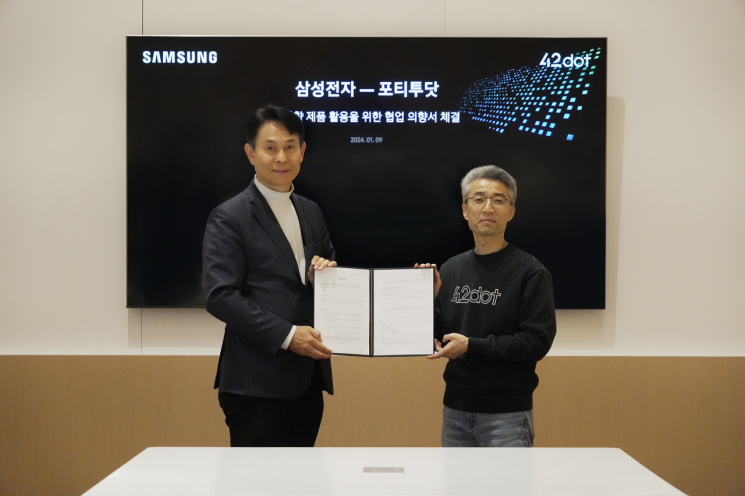 Song Chang-hyun, CEO of FortyTwoDot and President of Hyundai Motor Company?Kia SDV Division (right in the photo), and Park Yong-in, President of Samsung Electronics System LSI, are signing a business agreement for the development of an AI-based SDV platform.
 [Photo by FortyTwoDot]
In October last year, Samsung SDI signed a contract to supply batteries to Hyundai Motor. From 2026, Samsung will supply batteries for electric vehicles sold by Hyundai in Europe for seven years. Until now, Hyundai Motor Group has sourced batteries, a key component of electric vehicles, from LG and SK. Some vehicles also use Chinese CATL batteries. Samsung has supplied batteries to BMW, Stellantis, and Volkswagen, and now Hyundai has become a new customer. Prior to this, Samsung Display supplied vehicle OLEDs for Hyundai electric vehicles, opening the door to cooperation between Samsung and Hyundai Motor.
Collaboration between Samsung and Hyundai Motor has become active only recently. In the past, Samsung operated a finished car business, so there was little direct interaction, and the relationship remained distant. As the proportion of electrical and electronic components in vehicles has increased and software has become more important, the need for cooperation between the two companies has been steadily raised.
Especially amid fierce global competition for leadership in future mobility, alliances between big tech companies and automakers have become more frequent than ever. This is because each party has different competitive strengths in developing and applying advanced technologies such as connected services and autonomous driving. The automotive industry has long been called the flower of manufacturing due to the variety of parts used. Recently, as software has become as important as hardware, the need for close collaboration from the development stage beyond merely supplying parts has grown.
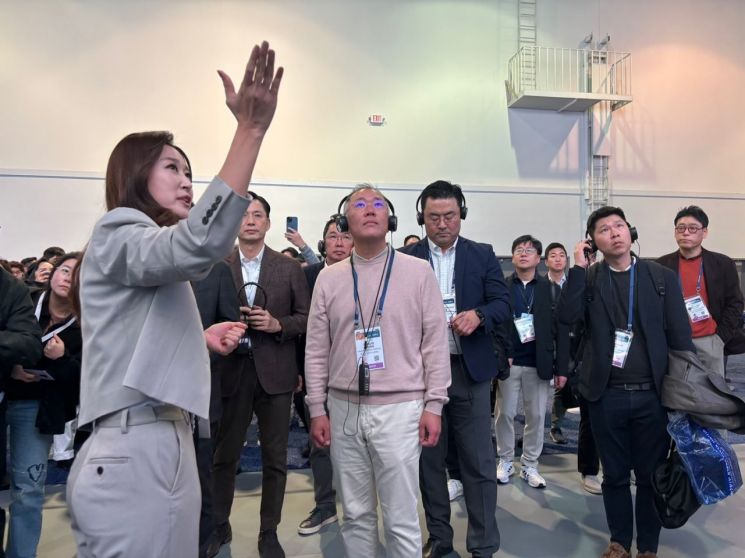 Jung Eui-sun, Chairman of Hyundai Motor Group, is receiving an explanation at the Samsung Electronics exhibition hall at CES 2024.
 [Photo by CES Joint Press Corps]
© The Asia Business Daily(www.asiae.co.kr). All rights reserved.
![Clutching a Stolen Dior Bag, Saying "I Hate Being Poor but Real"... The Grotesque Con of a "Human Knockoff" [Slate]](https://cwcontent.asiae.co.kr/asiaresize/183/2026021902243444107_1771435474.jpg)


















