Starting Next-Generation Hydrogen Sensor Development from 2021
Meets Globally Recognized Standards...Fast and Stable
High Portability Expected to Enable Diverse Applications
Domestic researchers have developed a sensor that detects hydrogen leaks in hydrogen vehicles within 0.6 seconds.
Dr. Minseung Cho from KAIST (Department of Electrical Engineering, Professor Junbo Yoon's team) collaborated with Hyundai Motor Company's Basic Materials Research Center Electronic Energy Materials Research Team and Professor Minho Seo of Pusan National University to develop a high-performance hydrogen sensor.
 Jominseung, Ph.D. in Electrical and Electronic Engineering, KAIST
As the adoption of hydrogen vehicles increases recently, the importance of hydrogen sensors, which are essential for safety, is growing even more.
KAIST, together with Hyundai Motor Company, began developing next-generation hydrogen sensors in 2021 to secure fast and reliable hydrogen detection technology, succeeding after more than two years of development.
In particular, they became the first in the world to develop a fast hydrogen sensor with a detection speed within 0.6 seconds while meeting the performance standards of the U.S. Department of Energy.
Previous hydrogen sensor research mainly focused on the sensing materials, such as catalytic treatment or alloying of palladium (Pd), which is widely used in hydrogen sensors.
However, these studies did not meet all performance indicators and faced limitations in commercialization due to difficulties in batch processing.
To overcome this, the research team developed a sensor that satisfies all performance indicators by applying proprietary micro- and nano-structure design and processing technology based on pure palladium material.
Additionally, considering future mass production, they utilized pure metal materials with fewer material constraints rather than synthetic materials, and developed next-generation hydrogen sensors capable of mass production based on semiconductor batch processing.
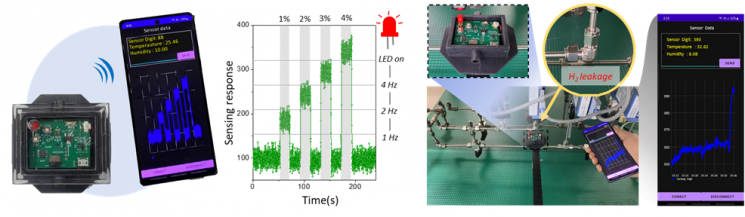
The research team packaged the fabricated device with a Bluetooth module to create an integrated module that wirelessly detects hydrogen leaks within one second and verified its performance. Unlike existing high-performance optical hydrogen sensors, this module is highly portable and is expected to be applicable in various places where hydrogen energy is distributed.
Dr. Minseung Cho, who led the research, stated, "This research result can be utilized in various places such as automobiles, hydrogen charging stations, and homes," adding, "Through the commercialization of this hydrogen sensor technology, we hope to contribute to advancing a safe and eco-friendly hydrogen energy world."
This research has filed three patents in the U.S., Korea, and other countries, and was published in the prestigious international journal ACS Nano.
© The Asia Business Daily(www.asiae.co.kr). All rights reserved.

















