Meeting with Japanese Ambassador including Muhyeop Chairman
Discussion on Establishing Special Exchange Committee
Resumption of Korea-Japan Business Council in Tokyo
Discussion on Fund Management to Strengthen Cooperation
Leading business organizations in Korea are drawing attention as they consecutively engage in close 'skinship' with major Japanese institutions and organizations, building tight cooperative relationships. This is analyzed as an effort to explore cooperation possibilities between Korea and Japan, as the Japanese economy is expected to end 30 years of deflation this year and emerge from a long-term recession.
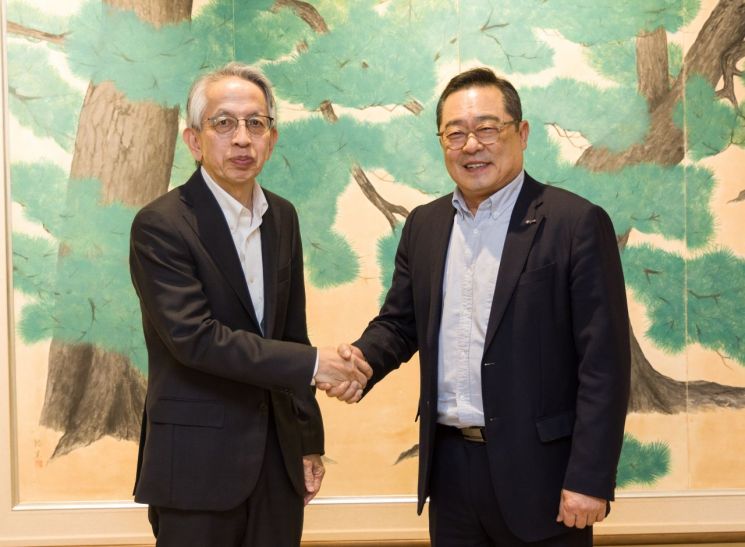 Koo Ja-yeol, Chairman of the Korea International Trade Association (right in the photo), and Koichi Aiboshi, Japanese Ambassador to Korea (left in the photo), held a meeting on the 9th at the Japanese Ambassador's residence in Seongbuk-dong, Seoul, exchanging views on ways to expand Korea-Japan exchanges and private sector economic cooperation. / Photo by Korea International Trade Association
According to the business community on the 10th, Gu Ja-yeol, chairman of the Korea International Trade Association (KITA), and other executives visited the Japanese Ambassador's residence in Seongbuk-dong, Seongbuk-gu, Seoul the previous day, where they held a meeting with Koichi Aiboshi, the Japanese Ambassador to Korea, and staff of the Japanese Embassy in Korea to exchange views on expanding Korea-Japan exchanges and private sector economic cooperation.
At the meeting, Chairman Gu said, "Last year marked a new turning point in Korea-Japan relations, as the two countries restored diplomatic ties and held seven summit meetings, rebuilding trust and normalizing relations." He added, "Going forward, KITA will actively promote private exchanges between Korea and Japan so that companies from both countries can strengthen mutually beneficial cooperation through active exchanges, contributing to the development of economic relations between the two countries."
To this end, KITA decided to establish a 'Korea-Japan Exchange Special Committee' this year to create a platform where businesspeople from both countries can communicate and cooperate. The committee will be composed mainly of leading companies engaged in promising industries in Korea and Japan. Additionally, KITA plans to continue promoting the establishment of a permanent private dialogue channel.
Meanwhile, in Tokyo, Japan, the Korea Economic Association will hold the 'Korea-Japan Business Meeting' with Keidanren. This meeting, resuming after a year and a half since it was last held in Seoul in July 2022, will take place until the 11th. Some members of the Korea Economic Association's leadership, including Chairman Ryu Jin and Executive Vice Chairman Kim Chang-beom, will attend to exchange views on economic trends and prospects between Korea and Japan and discuss joint economic projects through fund management. Previously, the predecessor of the Korea Economic Association, the Federation of Korean Industries (FKI), and Keidanren announced the establishment of a Future Partnership Fund in March last year, each contributing 1 billion KRW and 100 million JPY (approximately 1 billion KRW) respectively to jointly manage the fund. Attention is also focused on whether senior executives from the four major groups, including Samsung, who withdrew during the 2016 political scandal while FKI was active, will attend the meeting. A Korea Economic Association official hinted at the possibility of attendance, saying, "We have been continuously discussing schedules with group representatives."
The business community views the actions of these business organizations as partly influenced by the expectation that the Japanese economy will revive in the new year. Recently, with prices steadily rising, attention is focused on whether the government and the bank will declare 'end of deflation' this year. Since the bubble economy burst in 1991, prices in Japan have barely risen for nearly 30 years, but the atmosphere has recently changed. The Bank of Japan forecasted in its '2024 Economic and Price Outlook' released at the end of last year that the consumer price inflation rate this year will exceed 2%. Domestic and international experts have analyzed that if the government and the bank take measures to stimulate the economy amid rising prices, the Japanese economy will revive. However, this is conditional on wage increases following suit. Reflecting this, the Nikkei 225, Japan's representative stock index, closed at 33,763, up 1.2% from the previous trading day, marking the highest level in 33 years and 10 months since March 1990.
© The Asia Business Daily(www.asiae.co.kr). All rights reserved.

















