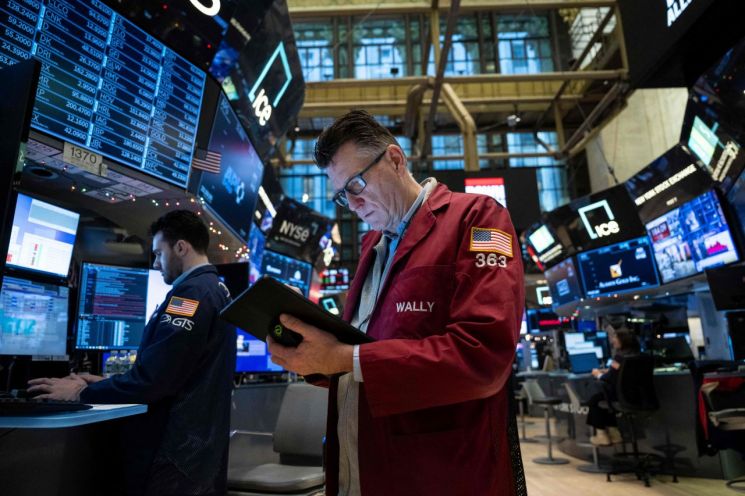
The three major indices of the U.S. New York stock market all showed a decline in the early trading session on the 9th (local time). This is analyzed as a result of the benchmark government bond yields rising back to the 4% range amid weakening expectations for an early rate cut in the market, combined with some profit-taking following the sharp rise the previous day.
At around 10:10 a.m. at the New York Stock Exchange (NYSE), the Dow Jones Industrial Average was trading at around 37,403, down 0.74% from the previous close. The S&P 500, which focuses on large-cap stocks, fell 0.5% to around 4,740, while the tech-heavy Nasdaq index dropped 0.54% to 14,763.
Currently, all 10 sectors of the S&P 500, except for healthcare-related stocks, are declining. The drop in energy and materials sectors exceeds 1%. Boeing's stock showed a decline of more than 1% again amid ongoing investigations into the 737 Max 9 aircraft that previously had a fuselage hole incident. Netflix fell more than 2% after Citigroup downgraded its investment rating. Unity Software, which announced plans to lay off about 25% of its workforce, dropped nearly 7%. Apple, which had rebounded the previous day, fell 1%, and Tesla saw a decline approaching 3%. On the other hand, Juniper Networks surged more than 20% following foreign media reports that Hewlett Packard Enterprise is expected to announce a deal to acquire the company for about $13 billion this week.
Investors are closely watching movements in government bond yields and statements from Federal Reserve (Fed) officials while awaiting this week's scheduled Consumer Price Index (CPI) release and corporate earnings season. Raphael Bostic, president of the Atlanta Fed, emphasized ongoing inflation concerns and indicated that the first rate cut could be possible around the third quarter. Meanwhile, Michelle Bowman, a prominent hawk within the Fed who favors monetary tightening, recently welcomed the disinflation trend and appeared to step back from calls for further rate hikes.
This week, following Michael Barr, New York Fed President John Williams, Richmond Fed President Thomas Barkin, and Minneapolis Fed President Neel Kashkari are also scheduled to speak. Since the employment report for December released late last week showed mixed figures and did not provide clear policy hints, investors are expected to gauge the future direction of monetary policy through inflation indicators such as the CPI and remarks from Fed officials.
The market's focus is on the December CPI, which will be released on the 11th. Wall Street expects the December CPI to rise 0.2% month-over-month and 3.3% year-over-year, indicating a larger increase than the previous month. However, the core CPI, which excludes volatile energy and food prices, is estimated to have increased 0.2% month-over-month and 3.8% year-over-year, showing a slowdown compared to the previous month. On the following day, the Producer Price Index (PPI), a wholesale price gauge, will also be released. If inflation indicators confirm a faster-than-expected slowdown, it could positively impact the stock market. Conversely, if the data disappoints expectations, it could strengthen claims that the market's optimism has been excessive and lead to stock price corrections.
The Federal Open Market Committee (FOMC), which will make the first rate decision of the year, will meet on January 30-31. The market largely expects rates to remain unchanged in January, with a rate cut scenario gaining traction as early as March. According to the Chicago Mercantile Exchange (CME) FedWatch tool, the futures market currently prices in about a 64% chance that the Fed will cut rates by at least 0.25 percentage points in March. Although this is lower than a week ago, the possibility of a March rate cut remains dominant.
Additionally, this week marks the start of the earnings season on Wall Street, with major banks such as JPMorgan, Wells Fargo, and Citigroup set to report results. According to FactSet, the net earnings of S&P 500 companies for the fourth quarter of last year are estimated to have increased 1.3% year-over-year, marking two consecutive quarters of growth. Market attention is currently focused on first-quarter earnings guidance.
In the New York bond market today, the benchmark 10-year U.S. Treasury yield rose slightly to around 4.01%. The 2-year yield, which is sensitive to monetary policy, climbed to 4.36%. The dollar index, which measures the value of the U.S. dollar against six major currencies, is trading near 102.3, up nearly 0.2%. International crude oil prices, which had plunged the previous day, are rebounding. West Texas Intermediate (WTI) crude is trading above $71.7 per barrel, up more than 1% from the previous close.
In November last year, the U.S. trade deficit was $63.2 billion, down 2.0% from the previous month. This deficit was below Wall Street expectations. Exports decreased by $4.8 billion (1.9%) to $253.7 billion, and imports fell by $6.1 billion (1.9%) to $316.9 billion.
The World Bank (WB) released its global economic outlook today, projecting global economic growth of 2.4% this year. This is below last year's estimate of 2.6%, continuing a three-year trend of slowing growth. The WB explained that the slowdown is due to high corporate loan rates and mortgage rates caused by elevated interest rates, escalating geopolitical tensions, and sluggish global trade and investment.
European stock markets are declining within a narrow range. Germany's DAX index fell 0.18%, France's CAC index dropped 0.25%, and the UK's FTSE index showed slight declines.
© The Asia Business Daily(www.asiae.co.kr). All rights reserved.
![Clutching a Stolen Dior Bag, Saying "I Hate Being Poor but Real"... The Grotesque Con of a "Human Knockoff" [Slate]](https://cwcontent.asiae.co.kr/asiaresize/183/2026021902243444107_1771435474.jpg)
















