As Taiwan approaches its presidential election on the 13th, China has announced plans to expand trade sanctions.
A spokesperson for the Chinese Ministry of Commerce stated on the 9th on their website that they are "considering additional measures to suspend tariff reductions on Taiwanese agricultural and fishery products, machinery, automobile parts, textiles, and other items" in relation to the suspension of the Cross-Strait Economic Cooperation Framework Agreement (ECFA).
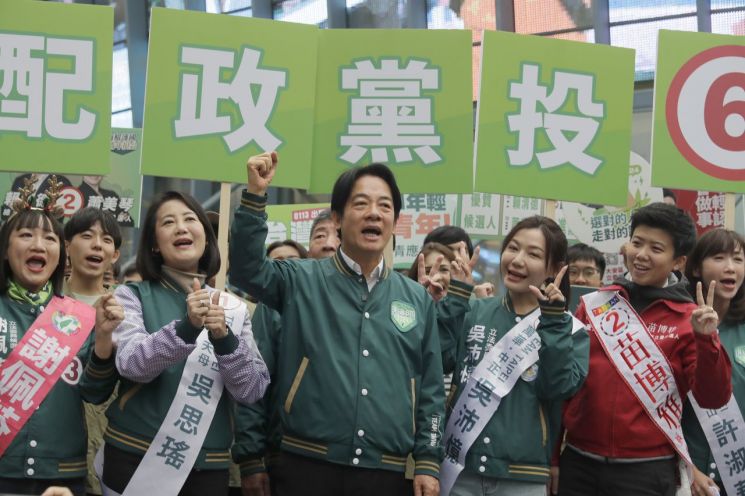 Democratic Progressive Party candidate Lai Ching-te (center), running in the Taiwan presidential election, is campaigning. [Image source=Yonhap News]
Last December, China announced the suspension of tariff reductions under the ECFA on 12 Taiwanese chemical products, including propylene and vinyl chloride, and stated that from January 1 this year, tariffs would be applied according to current regulations. Now, China intends to suspend tariff reductions on additional items.
The spokesperson criticized, "The Democratic Progressive Party (DPP) has not taken any effective measures to lift China's trade restrictions," adding, "Instead, they have engaged in political manipulation to evade responsibility."
Under the ECFA, since January 2013, Taiwan and China have applied tariff exemptions or reduced tariffs on 267 Taiwanese and 539 Chinese products respectively. However, China’s position is that it has decided to suspend tariff reductions because Taiwan insists on independence and does not recognize the '1992 Consensus' (an agreement to acknowledge one China while each side uses its own name).
Earlier, Chen Binhua, spokesperson for the Taiwan Affairs Office of the State Council of China, stated in a briefing last December that the ECFA "is implemented based on the political foundation of the '1992 Consensus'." He also warned of possible additional trade sanctions, saying, "If the DPP continues to uphold the stance of Taiwan independence and refuses to change its mind, we support relevant departments taking further measures according to regulations."
In Taiwan, this is interpreted as an attempt to pressure voters who support the DPP.
Meanwhile, Taiwan is preparing for its presidential election on the 13th. The ruling DPP, which favors Taiwan independence and a pro-US stance, and the main opposition Kuomintang, which is pro-China, are engaged in a fierce contest.
© The Asia Business Daily(www.asiae.co.kr). All rights reserved.

















