SNE Research January-November 2023 Survey Results
2024 US and Europe, Growth Expected for Korea Amid China Containment
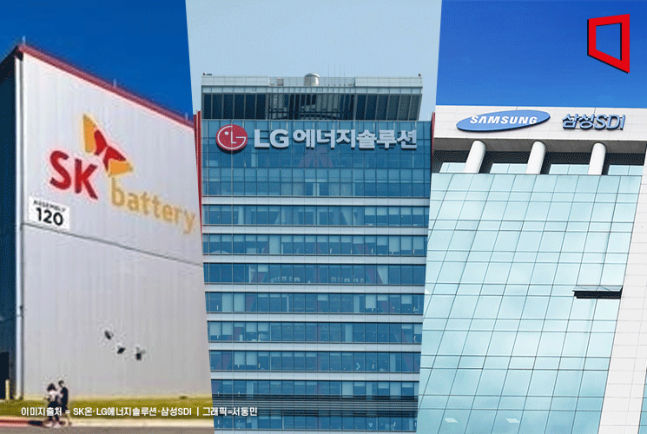
From January to November last year, the market share of the three domestic battery companies in the global electric vehicle battery market was 23.1%, showing a slight decline compared to the same period the previous year. Chinese CATL, which is aggressively expanding its global market, grew nearly twice as much in markets outside China. This year, with the implementation of the U.S. Inflation Reduction Act (IRA) and intensified U.S. and European measures to curb China, the growth of domestic battery companies is expected.
According to market research firm SNE Research on the 9th, the global electric vehicle battery usage from January to November 2023 reached 624.4 gigawatt-hours (GWh), a 41.8% increase compared to the same period last year.
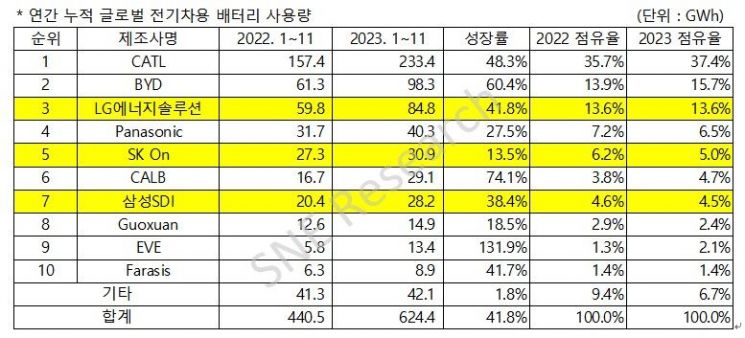
LG Energy Solution recorded 41.8% growth (84.8 GWh) compared to the same period last year, ranking 3rd. SK On showed 13.5% growth (30.9 GWh), and Samsung SDI grew 38.4% (28.2 GWh), ranking 5th and 7th respectively. Despite this growth, the combined market share of the three domestic battery companies fell by 1.3 percentage points (p) to 23.1% compared to the same period last year.
LG Energy Solution achieved the highest growth rate among the three domestic companies, driven by strong sales of popular models such as Tesla Model 3/Y, Volkswagen ID. series, and Ford Mustang Mach-E. Samsung SDI saw increased sales in Europe with BMW i4/i7, Audi Q8 e-tron, and Fiat 500e, while in North America, Rivian R1T/R1S and BMW iX recorded solid sales, sustaining growth. SK On grew due to the global popularity of Hyundai’s Ioniq 5 and Kia EV6, along with steady sales of Ford F-150 Lightning in North America.
The top position was held by China’s CATL, which recorded a 48.3% growth (233.4 GWh) compared to the same period last year. Its market share increased by 1.7 percentage points to 37.4%. SNE Research explained, "CATL nearly doubled its growth outside China across all continents compared to the same period last year, supported by the expanded adoption of lithium iron phosphate (LFP) batteries by original equipment manufacturers (OEMs), starting with Tesla."
CATL’s batteries are installed not only in leading passenger electric vehicle models in the Chinese domestic market but also in major global OEM vehicles such as Tesla Model 3/Y, BMW iX, and Mercedes EQS.
The second place was held by China’s BYD, which accounted for a 15.7% market share and showed a high growth rate of 60.4% (98.3 GWh) compared to the same period last year. BYD is expanding its market share mainly in the Chinese domestic market by establishing a vertically integrated supply chain management (SCM) that combines battery production and automobile manufacturing.
Among Japanese companies, Panasonic was the only one to make the top 10, recording battery usage of 40.3 GWh, a 27.5% increase compared to the same period last year. Panasonic is one of Tesla’s main battery suppliers, with most of its battery usage accounted for by Tesla vehicles in the North American market.
As the global demand for electric vehicles slows down, global automobile OEMs are increasing the adoption of LFP batteries while engaging in price competition. In response, domestic battery companies are continuously unveiling plans for mid-nickel and LFP batteries to be installed in affordable electric vehicles, alongside the development of high-nickel batteries.
SNE Research stated, "Since vehicles eligible for the 2024 IRA subsidies mainly use batteries from the three domestic companies, it is expected that the battery usage of these three companies will grow along with the expansion of the European and U.S. markets."
© The Asia Business Daily(www.asiae.co.kr). All rights reserved.
![Clutching a Stolen Dior Bag, Saying "I Hate Being Poor but Real"... The Grotesque Con of a "Human Knockoff" [Slate]](https://cwcontent.asiae.co.kr/asiaresize/183/2026021902243444107_1771435474.jpg)

















