Controversy Over 'Darkened Snow Crab' in Sokcho
Store Says "Not Spoiled Crab... Due to Blackening Phenomenon"
In Sokcho-si, Gangwon-do, controversy arose over the sale of snow crabs that had turned black due to discoloration, prompting the city to begin guidance for local restaurants starting from the 8th.
Recently, Sokcho-si decided to put full effort into guiding and inspecting local restaurants. Additionally, for the next month, the city plans to focus on guiding and strengthening inspections regarding the handling of ingredients and safe cooking practices at restaurants. This measure appears to have been taken in response to the controversy sparked by a local restaurant selling snow crabs that had turned black, which drew attention on online communities.
The city explained that after consulting experts regarding the blackened snow crab controversy, the discoloration is due to the 'blackening phenomenon' that occurs when snow crabs are left at room temperature and the parts exposed to oxygen turn black, which is a harmless natural occurrence. However, in order to enhance safety in food handling at restaurants, the city plans to jointly conduct guidance with the Sokcho branch of the Korea Foodservice Industry Association to provide safe food to tourists.
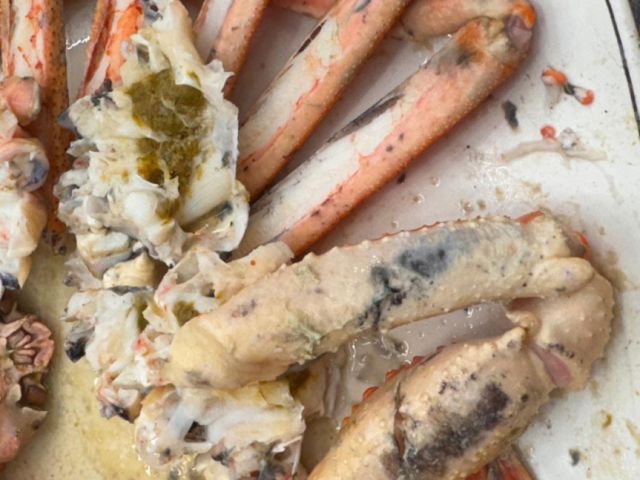 A post claiming that rotten snow crab was served at a restaurant in Sokcho-si, Gangwon-do, sparked controversy. The 'black discoloration phenomenon' was noticed after eating about one-third. [Image source=Online community]
Previously, following the controversy at the Noryangjin Fish Market in Seoul, a similar issue arose in Sokcho-si regarding 'blackened snow crabs.' On the 31st of last month, a post titled "I experienced the Noryangjin snow crab incident here in Sokcho" was uploaded on an online community. The author claimed, "Since the upper part looked fine, I ate about one-third, but when I looked at the back of the snow crab, it was covered with mold," and posted related photos. The photos showed various parts of the snow crab that had turned black. However, it was reported that this was not mold but the 'blackening phenomenon.'
In response to the controversy, the restaurant stated, "We wanted to serve the customer as quickly as possible, but the blackening phenomenon occurred in the snow crab," adding, "We believe the undercooked crab reacted with oxygen at room temperature, causing the discoloration."
They continued, "The blackening phenomenon also occurs partially in live snow crabs in aquariums, and the snow crabs served to customers are definitely not spoiled," emphasizing, "Taking this incident as an opportunity, we will reorganize the menu and strictly adhere to the steaming time for snow crabs, thoroughly revising our manual to prevent the blackening phenomenon from occurring."
Meanwhile, a representative from the Sokcho Public Health Center stated, "With an expected increase in visitors to major tourist spots, we will strengthen inspections of food service establishments near the seaside and enhance preemptive safety management of seafood."
© The Asia Business Daily(www.asiae.co.kr). All rights reserved.
![Clutching a Stolen Dior Bag, Saying "I Hate Being Poor but Real"... The Grotesque Con of a "Human Knockoff" [Slate]](https://cwcontent.asiae.co.kr/asiaresize/183/2026021902243444107_1771435474.jpg)
















