Swedish premium electric vehicle brand Polestar has decided to manufacture the coupe-style sports utility vehicle (SUV) Polestar 4 at Renault Korea Motors' Busan plant starting in the second half of 2025. Until now, production was mainly carried out at a Chinese factory operated by Geely, the major shareholder of its parent company Volvo. As production bases are expanding overseas, Renault Korea's Busan plant has been selected.
Polestar was formerly Volvo's high-performance division. Following the electrification trend, the brand was spun off in 2017 and transformed into an electric vehicle brand. Currently, it produces and sells the mid-size sedan Polestar 2 and the mid-large SUV Polestar 3. Recently, it has been unveiling various new models, including the coupe-style SUV Polestar 4.
Thomas Ingenlath, CEO of Polestar, explained the reason for choosing Renault Korea's Busan plant as the production base for Polestar 4: "The Busan plant has 23 years of rich vehicle manufacturing experience and employs about 2,000 skilled technicians," adding, "Moreover, it has the geographical advantage of being directly connected to an export port."
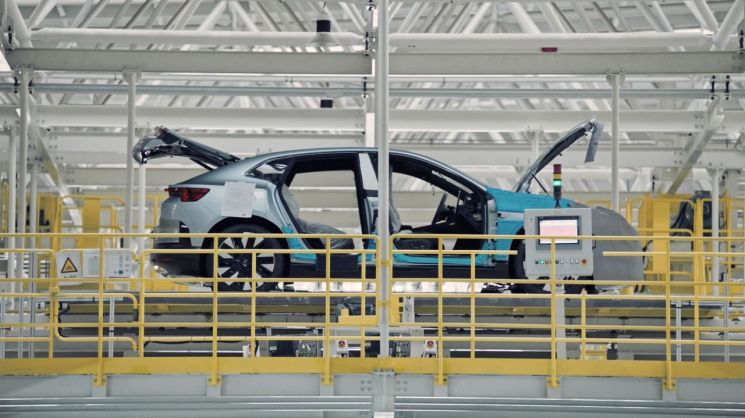
Along with geographical advantages and highly skilled personnel, Renault Korea's competitive manufacturing capabilities are also cited as key reasons from Polestar's perspective. Completed in 1997, Renault Korea's Busan plant has the lowest defect rate among Renault Group's 20 factories worldwide, with only 0.15 defects per vehicle shipped. Quality is rigorously managed through seven inspection lines, earning it a reputation as a top-tier production quality plant within the Renault Group.
From 2014 to 2020, the Busan plant produced Nissan Rogue vehicles for export to North America. Although Nissan initially had concerns about quality issues, these quickly subsided. Subsequently, Nissan requested a 50% increase in additional volume beyond the original contract. This was because the quality of models shipped from the Busan plant was superior to those produced at factories in the United States and Japan producing the same model during that period.
Mixed production is also a distinctive feature and strength of the Busan plant. Renault Korea's Busan plant can produce four platforms and eight models on a single assembly line. It can also manufacture gasoline, diesel, liquefied petroleum gas (LPG), hybrid, and electric vehicles all on the same line. From 2016 to 2019, seven models (SM3, SM5, SM6, SM7, QM6, SM3 ZE, Nissan Rogue) were simultaneously produced on one line. Currently, three models (XM3, SM6, QM6) are produced on a single line.
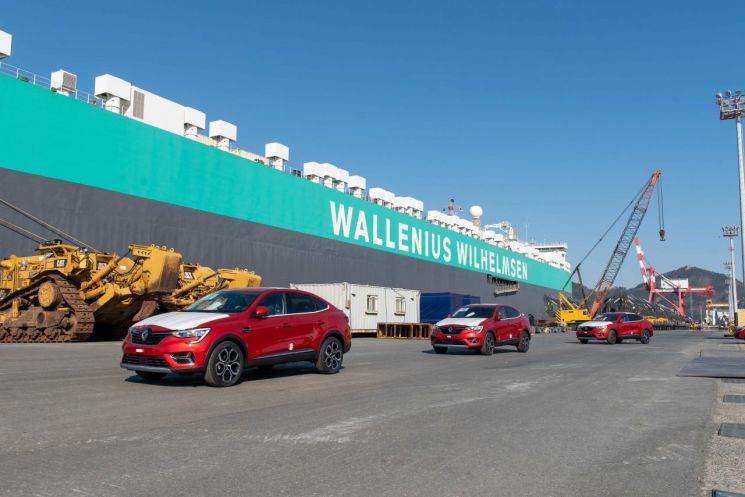 The XM3, developed and manufactured by Renault Korea, is being loaded onto a cargo ship for export to Europe.
 [Photo by Renault Korea Motors]
Renault Korea is expected to start producing hybrid SUVs this year, followed by hybrid sedans, and next-generation electric vehicles at the Busan plant in 2026. As the electrification strategy accelerates, the company anticipates that producing premium brand electric vehicles will allow it to incorporate various experiences and know-how from external companies in eco-friendly technology, policies, strategies, production, and quality management into its own electric vehicle production. This means generating profits while acquiring intangible assets.
Stefan Deblaes, CEO of Renault Korea, said, "Polestar 4 will be a model symbolizing Renault Korea's new launch and future vision," adding, "With the support of Renault Group and Geely Group, Renault Korea will create more business opportunities in the near future."
© The Asia Business Daily(www.asiae.co.kr). All rights reserved.


















