Teen ADHD Patients Prescribed Medication Concentrated in Gangnam 3 Districts
Including Nowon and Yangcheon, Nearly Half (47%) Covered
Disguised as 'Study-Enhancing Drugs,' "Concerns Over Misuse"
In the Gangnam 3 districts (Gangnam, Songpa, Seocho), the proportion of teenage patients prescribed medication for Attention Deficit Hyperactivity Disorder (ADHD) accounts for 34% of all teenage patients with ADHD in Seoul. When the scope is expanded to include Nowon and Yangcheon districts, it reaches half. Recently, ADHD medication has been regarded among students as a "drug that enhances concentration," raising concerns about potential misuse in areas with high educational enthusiasm.
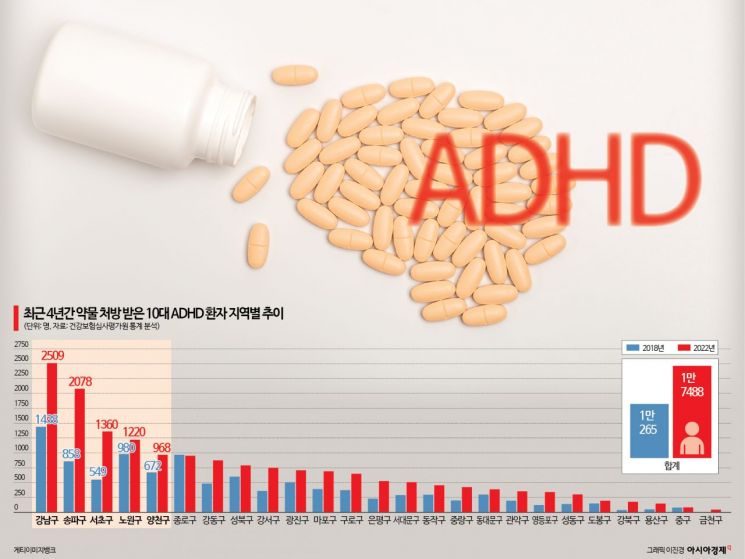
On the 9th, Asia Economy analyzed ADHD incidence statistics over the past four years through the Health Insurance Review & Assessment Service, revealing that the number of children and adolescents aged 10 to 19 treated for ADHD increased by 70.37%, from 10,265 in 2018 to 17,488 in 2022.
There were significant differences in the number of ADHD patients by district. The highest number was in Gangnam-gu, which increased by 74% from 1,438 in 2018 to 2,509 in 2022. Next, Songpa-gu rose by 142%, from 858 to 2,078 during the same period, and Seocho-gu increased by 147%, from 549 to 1,360. As of 2022, the number of teenage ADHD patients in the Gangnam 3 districts alone reached 5,947, accounting for one in three ADHD patients in Seoul. Districts with the fewest ADHD patients (below 200) included Geumcheon-gu (45), Jung-gu (83), Yongsan-gu (147), Gangbuk-gu (177), and Dobong-gu (195).
Outside the Gangnam 3 districts, Nowon-gu, centered around the hagwon (private academy) areas of Junggye and Sanggye-dong, had over 1,000 teenage ADHD patients as of 2022. Nowon-gu increased by 24%, from 980 (765 males, 215 females) in 2018 to 1,220 (876 males, 344 females) in 2022.
Yangcheon-gu, where Mokdong is located, also saw a 44% increase, from 672 (543 males, 129 females) in 2018 to 968 (699 males, 269 females) in 2022.
Various interpretations have been offered regarding the concentration of teenage ADHD patients prescribed medication in the five districts of Gangnam 3, Nowon, and Yangcheon.
First, it is explained by the concentration of child and adolescent psychiatry clinics in the Gangnam 3 districts. Of the 498 child and adolescent psychiatry clinics registered nationwide with the Korean Academy of Child and Adolescent Psychiatry, 11% (56 clinics) are concentrated in the Gangnam 3 districts of Seoul. There is also analysis that awareness of ADHD has expanded due to school violence issues. Some raise the possibility of misuse of ADHD medication, especially in these education-driven areas. Shin Hyun-young, a Democratic Party member of the National Assembly’s Health and Welfare Committee, pointed out that ADHD medications were previously disguised as "drugs that enhance concentration."
Rep. Shin said, "We need to consider the possibility that academic zeal could increase the demand for ADHD medications due to misunderstandings," adding, "It is necessary to raise awareness about the side effects of unnecessary drug use."
The Ministry of Food and Drug Safety has also recognized these concerns and announced an administrative notice to revise the "Standards for Preventing the Misuse of Narcotics," which includes prescription and administration criteria to prevent the misuse of the ADHD medication methylphenidate. The revision was prepared because methylphenidate, a psychotropic drug, is at risk of being misused as a "study-enhancing drug" or "concentration booster." The revision includes restrictions on using methylphenidate for non-therapeutic purposes or prescribing/administering it for more than three months.
© The Asia Business Daily(www.asiae.co.kr). All rights reserved.

















