Lowest Level in 34 Months
Subscribers in Their 40s Decrease for 2 Consecutive Months
"Significant Impact of Population Decline"
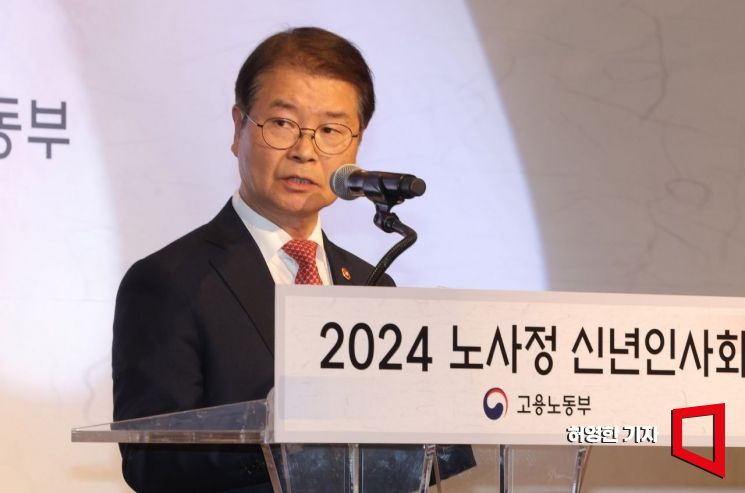 On the 5th, at the 2024 Labor-Management-Government New Year's Meeting held at Seoul Central Post Office, Lee Jeong-sik, Minister of Employment and Labor, is giving a greeting. Photo by Heo Young-han younghan@
The increase in employment insurance subscribers continued to slow down, with last month's growth rate falling to the lowest level in 34 months since the COVID-19 pandemic.
According to the labor market trends announced by the Ministry of Employment and Labor on the 8th, as of the end of last month, the total number of regular employment insurance subscribers was 15,151,000, an increase of 296,000 (2.0%) compared to the same month last year.
This is the first time in 34 months since February 2021 (192,000), during the COVID-19 pandemic, that the increase in the number of regular employment insurance subscribers has fallen below 300,000.
About half of the increase in subscribers, 138,000, were foreign subscribers under the Employment Permit System, while the increase in domestic subscribers excluding foreigners was only 158,000.
By industry, the number of subscribers in manufacturing was 3,836,000, an increase of 108,000 compared to last year. However, excluding foreigners under the Employment Permit System, there was a decrease of 11,000.
Most sectors such as metal processing, food products, automobiles, and other transportation equipment continued to show growth, while electronics and telecommunications, textiles, and clothing and fur sectors declined. The electrical equipment manufacturing industry (7,300) continued steady growth centered on primary and secondary batteries, but the growth rate slightly slowed due to a decline in electric vehicle demand.
The automobile manufacturing industry (9,400) continued to see an increase in subscribers amid strong production and exports, and the other transportation equipment manufacturing industry (10,700) increased for the 16th consecutive month, supported by a recovery in the shipbuilding industry and increased aerospace parts production.
The number of subscribers in the service industry was recorded at 10,393,000, an increase of 182,000 compared to last year. Workers in health and social welfare increased by 89,000 due to increased demand for health and care services, while the real estate industry decreased by 3,200 due to a downturn in the construction market.
The business support services sector is increasing mainly in employment placement and manpower supply, and travel-related services continue to grow, but have not yet reached pre-pandemic levels. The number of subscribers in travel-related services (travel agencies and travel support services) was 23,000, about 75% of the 30,000 recorded before the pandemic in 2019.
By age group, those under 29 and those in their 40s decreased by 42,000 and 10,000 respectively. Those under 29 have shown a decline for 16 consecutive months, and those in their 40s showed a decrease for the first time since statistics began in November last year, with subscribers declining for two consecutive months compared to the previous year.
Cheon Kyung-gi, head of the Future Employment Analysis Division at the Ministry of Employment and Labor, explained, "The impact of population decline was more significant in those under 29 and those in their 40s than in other age groups."
Subscribers increased in other age groups. Specifically, those in their 30s, 50s, and 60 and older increased by 70,000, 116,000, and 162,000 respectively.
New applications for unemployment benefits last month were 93,000, a decrease of 6,000 (6.3%) compared to the same month last year. This is the first decrease in 12 months since December last year. The number of unemployment benefit recipients was 512,000, and the total amount paid was 758.7 billion won, increasing by 1.9% and 1.3% respectively compared to the previous year.
© The Asia Business Daily(www.asiae.co.kr). All rights reserved.

















