Reopening of Vergina Macedonia Archaeological Site in Northern Greece
Ancient Macedonian Capital... Excavated in the 1970s
The palace of Alexander the Great, who built the northern Macedonian region of Greece into a great empire in the 4th century BC, has reopened after 16 years of restoration work.
On the 7th (local time), British daily The Times and other foreign media reported that the ancient Macedonian palace ruins in the Vergina area of northern Greece reopened on the 5th. The site had been closed since 2007 and underwent restoration for 16 years.
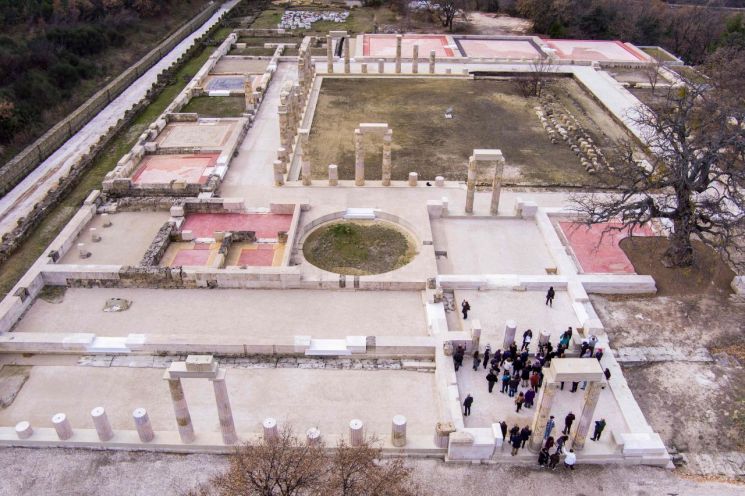 After 16 years of restoration work, part of the Palace of King Alexander in Vergina, Greece, reopened on the 5th (local time).
 [Photo by AFP Yonhap News]
Vergina is the ancient name 'Aidai,' which was the capital of the Macedonian kingdom. This is where Alexander the Great, who destroyed the Persian Empire in the 4th century BC and expanded his power eastward to the Indus River basin in India, earning the title 'the Great,' ascended to the throne.
Alexander the Great was born in Macedonia in 356 BC. He succeeded his assassinated father, Philip II, and ascended the throne at the young age of 20. As king, he led his army on a campaign in Asia Minor. Alexander then conquered Persia and Egypt, founding cities named Alexandria in each conquered territory. It is known that there were about 70 such cities. While preparing for an expedition to the Arabian Peninsula, he died at the young age of 33 in Babylon in 323 BC.
The ruins were destroyed by Rome in the 2nd century BC and were used as a quarry for a long time before being excavated in the 1970s. Considering the historical value and scale of the site, Greece deemed a large-scale restoration project necessary and closed the site in 2007 to begin restoration work.
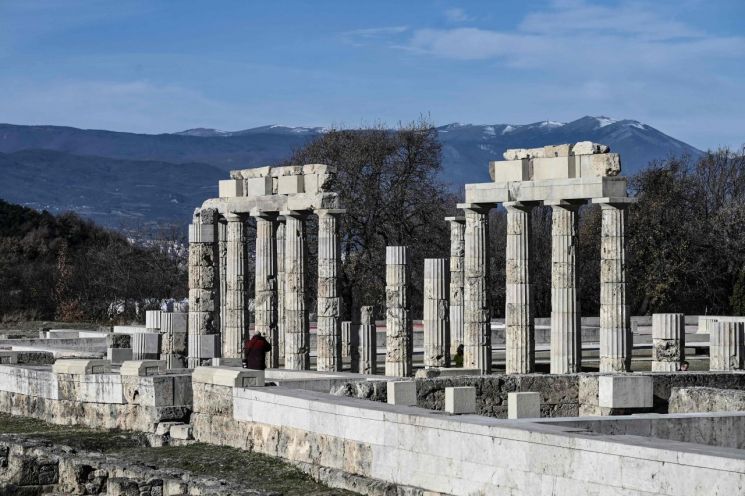 After 16 years of restoration work, the Palace of Alexander the Great has reopened. This is the site where Alexander the Great's coronation ceremony was held.
 [Photo by AFP Yonhap News]
The Times reported that the ruins have been reborn in a magnificent form. The site consists of the palace with a large courtyard, royal tombs, the Polycentric Museum exhibiting various excavated artifacts, and a medieval church built of palace stones. Maria Stamatopoulou, a professor of archaeology at Oxford University, said, "The palace, covering 15,000 square meters, is unprecedented in scale in Greece, being three times larger than the Parthenon," adding, "It is something to be very proud of that the destroyed ruins have been revived."
Greek Government Expects Tourism Revival with Reopening of Ruins
This site also represents Hellenistic culture. Alexander the Great is recognized not only for expanding territory through conquest but also for laying the foundation of Hellenistic civilization, which fused Greek and Eastern cultures. Professor Stamatopoulou explained, "This site proves that the Hellenistic world we know centered around Macedonia," adding, "Elements inspired by this palace have even been found in distant places like Uzbekistan."
After the national bankruptcy crisis following the 2008 global financial crisis, the Greek government supported the restoration work to promote tourism revival. In Greece, tourism, along with agriculture and shipping, forms one of the three major industries. As of 2023, about 17.4 million foreign tourists visited Greece, with estimated tourism revenue exceeding 21 billion euros (about 30 trillion won).
© The Asia Business Daily(www.asiae.co.kr). All rights reserved.


















