PF Loan Balance of 130 Trillion Won with 70 Trillion at Risk
Most Projects to Complete This Year, PF Debt Repayment Focused
"Support Measures Needed to Improve Profitability of Crisis Projects"
An analysis has emerged suggesting that out of the 130 trillion won balance of real estate PF loans, the scale of non-performing loans could reach up to 70 trillion won. It is pointed out that government support is needed to enhance project viability and to clean up non-performing projects in order to prevent the possibility of contagion to the macroeconomy and the chain bankruptcy of multiple construction companies.
On the 6th, the Korea Construction Industry Research Institute (KCI) stated in its 'Construction Trend Briefing' that, based on major credit rating agencies and government announcements, the domestic real estate PF loan balance last year was 130 trillion won, of which bridge loans accounted for 30 trillion won and main PF loans for 100 trillion won.
KCI estimated that the maturity extension rate of PF loans handled by secondary financial institutions such as securities companies in the first half of last year was about 70% for bridge loans and 50% for main PF loans, and the maximum possible scale of PF non-performing loans could exceed 70 trillion won. This estimate is based on an extreme scenario that does not consider recovery amounts such as pre-sale payments or land auctions.
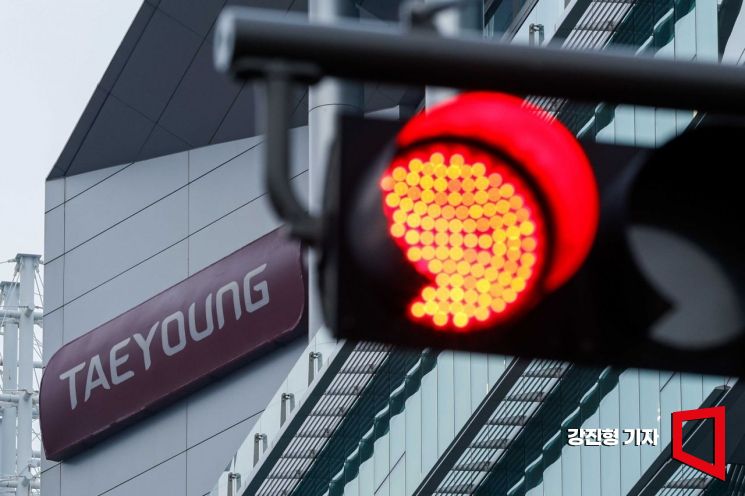 Taeyoung Construction, which applied for a workout due to liquidity issues in real estate project financing (PF), has completed a creditors' briefing session. On the 4th, the traffic light in front of Taeyoung Construction's headquarters in Yeouido, Seoul, turned red. Yoon Se-young, the founding chairman of Taeyoung Group, acknowledged management's mistakes during the briefing and requested consent for the workout, but the main creditor bank, the Korea Development Bank, demanded an additional self-rescue plan. Photo by Kang Jin-hyung aymsdream@
"If the real estate market recovery is delayed, the scale of non-performing loans could be larger than expected"
KCI added, "If the real estate market recovery is delayed, the future scale of non-performing loans could be much larger than expected," and explained, "PF projects with extended maturities may consist of projects whose profitability has decreased due to high interest rates and increased construction costs, and where recovery of profitability is difficult due to market stagnation."
Since the credit crunch triggered by Legoland in the second half of 2022, the real estate market has stagnated, worsening profitability in many projects. As a result, PF supply was not properly provided throughout last year. Around mid-2023, PF supply was partially provided only in some high-quality projects based on credit enhancement from large construction companies, their affiliates, and policy financial institutions.
With the pre-sale market stagnating, new PF loans were almost halted, and with worsening supply conditions, the potential scale of non-performing loans expanded.
Last month, the government hinted at the possibility of cleaning up non-performing projects, which further shrank PF supply, and concerns have grown around construction companies with liquidity risks following Taeyoung Construction’s workout application.
Most PF projects are expected to be completed this year, and the concentration of PF debt repayment claims during this period is also considered a burden.
KCI forecasted, "If loan repayment claims intensify, many construction companies could face bankruptcy," and "As multiple projects involving bankrupt construction companies become non-performing in a chain reaction, a considerable number of financial institutions may also become insolvent."
"Cleanup of non-performing projects needed to reduce non-performing loan scale... Tax and financial support required"
KCI pointed out that to prevent the PF non-performing loan crisis from spreading, project viability must be enhanced and non-performing projects should be promptly cleaned up to reduce the scale of non-performing loans.
After Taeyoung Construction’s workout application at the end of last year, the government announced it would handle some of the 60 PF projects involving Taeyoung Construction through public or private auctions or pre-sale guarantee fulfillment. As a result, the financial sector is inevitably exposed to losses, and there is a possibility of a chain bankruptcy of small and medium-sized construction companies in the future.
KCI emphasized that effective support measures must be prepared to improve the profitability of crisis projects. It stated that market-driven autonomous decisions on project continuation should be encouraged, and government support should be provided to ensure swift cleanup of projects judged to be non-performing.
KCI said, "Projects with extended loan maturities are those that have failed in pre-sale or sales, making it difficult to secure project viability on their own," and added, "Project viability must be enhanced through tax and financial support, as well as changes to district unit plans, to minimize the scale of non-performing loans."
KCI explained that the developer, contractor, and major creditors should be guided to decide on project continuation, and projects without secured viability should be swiftly cleaned up using the PF Normalization Support Fund and the Ministry of Land, Infrastructure and Transport’s 'Land Bank.'
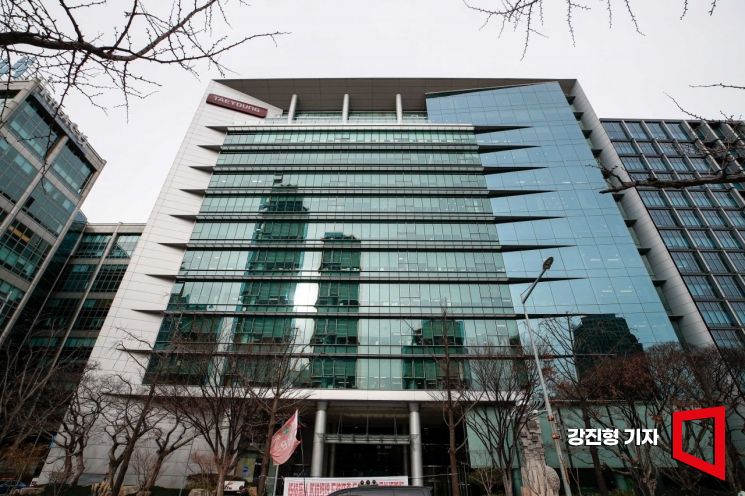 On the 18th, at the Taeyoung Construction headquarters in Yeouido, Seoul. Photo by Jinhyung Kang aymsdream@
Credit rating agencies have repeatedly issued negative outlooks on liquidity risks, warning that some construction companies may face difficulties in raising funds, prompting Lotte Construction and Dongbu Construction to respond with clarifications.
As of the end of September last year, Dongbu Construction’s short-term borrowings amounted to 418.9 billion won, but its cash equivalents were only 58.3 billion won. Dongbu Construction explained, "We secured 300 billion won in liquidity in the fourth quarter of last year through construction payments from overseas sites, collections from completed sites, and loan recoveries," and added, "The decrease in cash equivalents as of the third quarter was a temporary phenomenon due to repayment of high-interest debt securities maturing, aimed at reducing financial costs."
Lotte Construction also explained its financial situation and future plans, stating that it has secured sufficient liquidity and has no issues managing PF contingent liabilities. Lotte Construction said, "Of the 3.2 trillion won in unstarted PF loans maturing in the first quarter, 2.4 trillion won will be extended to a long-term financing structure through commercial banks and financial institution fund formation by this month until the main PF conversion point, and the remaining 800 billion won will be resolved within the first quarter through main PF conversion, etc."
© The Asia Business Daily(www.asiae.co.kr). All rights reserved.
![Clutching a Stolen Dior Bag, Saying "I Hate Being Poor but Real"... The Grotesque Con of a "Human Knockoff" [Slate]](https://cwcontent.asiae.co.kr/asiaresize/183/2026021902243444107_1771435474.jpg)

















