'In&Out Flip' with Reduced Thickness by Folding Inward and Outward
First Reveal of Products Applying Foldable and Sliderable Features
Diverse Range Including Ultra-Thin Displays and XR Products
Samsung Display will hold an exhibition under the theme "All-in Innovative Tech: Paving the new journey" at CES 2024, the world's largest electronics and IT exhibition, held from the 9th to the 12th (local time) in Las Vegas, USA, showcasing various innovative products that will lead the future display industry.
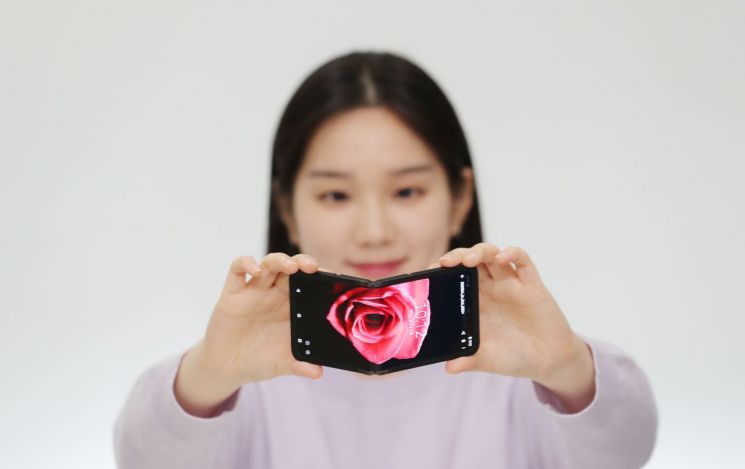 Samsung Display's 'Flex In&Out', unveiled for the first time at CES 2024. It features the ability to fold both inward and outward. /
 [Photo by Samsung Display]
Samsung Display announced on the 7th that it will open its exhibition booth to media and clients from the 8th to the 12th at CES 2024.
At this exhibition, the company plans to unveil the world's first next-generation flip-type foldable product that can fold both inward and outward. It will also introduce various new technologies that innovate user experience by applying foldable and slidable technologies simultaneously to monitor-sized OLEDs. Visitors can also see microdisplays with ultra-high resolution targeting the extended reality (XR) market.
Additionally, Samsung Display plans to emphasize its OLED leadership with products covering both small and large sizes, including QD-OLED monitors boasting the highest pixel density and refresh rate in self-emissive technology, as well as QD-OLED TVs with the brightest brightness currently available.
Folding inward and outward, rolling and unfolding... A new display spectacle
The product that will catch visitors' attention at this exhibition is the "In&Out Flip." The In&Out Flip folds up and down like Samsung Electronics' foldable smartphone Galaxy Z Flip, but its distinctive feature is that it folds both inward and outward. In the case of the existing in-folding form factor that folds only inward, another panel is needed on the outside to check information when folded. In contrast, the In&Out Flip allows users to check information in the folded state with just one display. A lighter and thinner design is also an advantage.
A Samsung Display official said, "The In&Out Flip is a technology that can offer a new alternative to consumers who preferred bar-type smartphones due to the thickness of foldable products being burdensome," adding, "When folded outward, both the front and back of the product can be used as screens, enabling a new user experience."
Extreme durability tests proving foldable technology leadership are also a highlight. At the exhibition, the company plans to conduct tests such as folding the panel at high temperatures of 60 degrees Celsius or low temperatures of minus 20 degrees Celsius, bouncing a basketball on the foldable panel, rubbing the smartphone with sand, and submerging it in water. It is expected that visitors will be able to confirm the durability of Samsung foldables under extreme environmental conditions.
Visitors can also experience various display shapes and innovative products besides foldable products. These include the "Rollable Flex," which can be rolled up and unrolled like toilet paper and expanded up to five times, the "Flex Hybrid," which combines foldable and slidable technologies, and wireless earphone cases equipped with displays.
OLED technology dominates the mobility sector as well
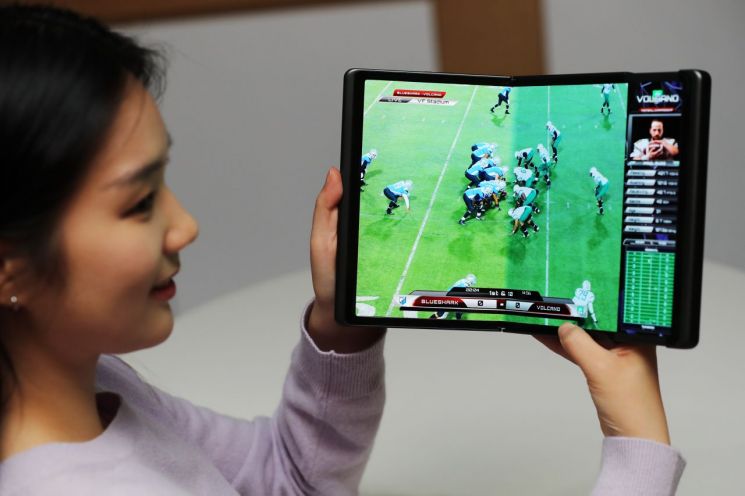
Samsung Display will also showcase OLED products demonstrating its technological prowess in the mobility sector, a hot topic in the electronics industry. The newly unveiled "Flex Note Extendable" features a foldable panel that can be unfolded and then further expanded by sliding. When fully folded, it measures 11 inches; unfolding one side expands it to 13.8 inches (10:9 aspect ratio), and pulling the other side extends it to 17.3 inches (4:3 aspect ratio).
The Flex Note Extendable can be used as a laptop for work inside a car. When fully extended, it can be used to watch movies and more. When not in use, the screen size can be minimized to enhance the vehicle's interior aesthetics.
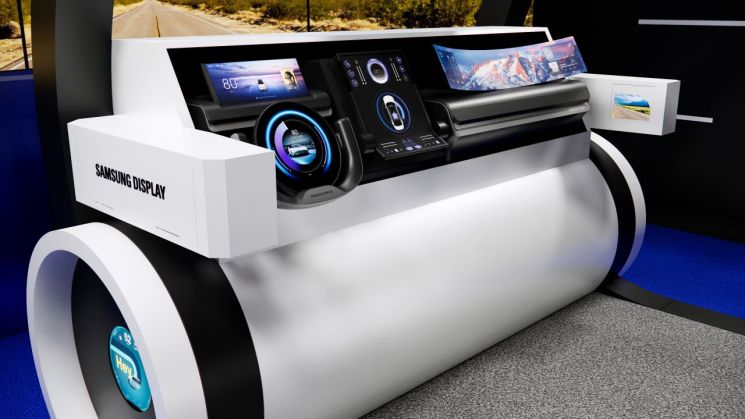
A Samsung Display official explained, "Cars are evolving beyond simple means of transportation into 'Mobile Spaces,' and OLED will lead this transformation in the automotive industry," adding, "Especially OLED products combining foldable and slidable technologies will accelerate this change."
Another notable idea is hiding displays throughout the vehicle interior for use when needed. A representative concept is a tablet PC-sized (12.4 inches) rollable display hidden in the passenger seat headrest position that can be moved up and down for versatile use.
Amazing scale and astonishingly thin thickness
As the transition from LCD to OLED progresses, Samsung Display plans to captivate visitors by installing a glass substrate mother glass nearly 3 meters tall at its booth. Since the company has started investing in the industry's first 8.6-generation IT OLED line, visitors will be able to experience the massive substrate size (2290*2620mm) firsthand.
Noticeably thinner ultra-thin (UT) panels also stand out. Samsung Display's UT OLED panel thickness is about 0.6 mm, similar to a business card, which is about one-third the thickness of an LCD panel of the same size. The weight is also about one-third that of an LCD panel of the same size. A company official explained, "We applied a new module process to reduce thickness while maintaining the same strength."
 A Samsung Display model is showing the thickness difference between its ultra-thin (UT) OLED panel for IT use (left) and the side of the comparison LCD panel. / Photo by Samsung Display
Power consumption reduction technology has evolved thanks to material improvements. Samsung Display newly developed thin-film transistors (TFTs) that control current flow, excluding amorphous silicon (a-Si) and applying 100% oxide. Oxide has about ten times faster electron mobility and less current leakage compared to amorphous silicon.
Reducing current leakage solves the flicker phenomenon, where the screen flickers and slightly shakes when driving the display at low refresh rates. This enables additional power consumption reduction effects through low refresh rates. The new product unveiled by Samsung Display supports a variable refresh rate as low as 1 Hertz (Hz), the first among IT panels.
XR core technology 'OLEDoS' unveiled... Industry's highest pixel density
Samsung Display will also unveil the RGB-type "OLEDoS (OLED on Silicon)" for the first time at the exhibition. OLEDoS is an ultra-high-definition display that deposits organic materials on a silicon wafer to realize pixel sizes at the tens of micrometers (μm) level. It is a key technology for XR headsets, which have recently attracted market attention.
RGB OLEDoS uses a technology method that individually deposits red, green, and blue OLEDs on a silicon wafer to reproduce colors without a separate light source. The RGB OLEDoS introduced by the company boasts the highest resolution among products presented in the industry. Although it is a tiny 1.03-inch size, about the size of a 500-won coin, it has a pixel density of 3500 PPI (Pixels Per Inch), comparable to the resolution of a 4K TV.
Visitors can also see products from Imagine, a U.S. OLEDoS company recently acquired by Samsung Display, at the exhibition. Military helmets and night vision goggles equipped with Imagine OLEDoS will be displayed on-site.
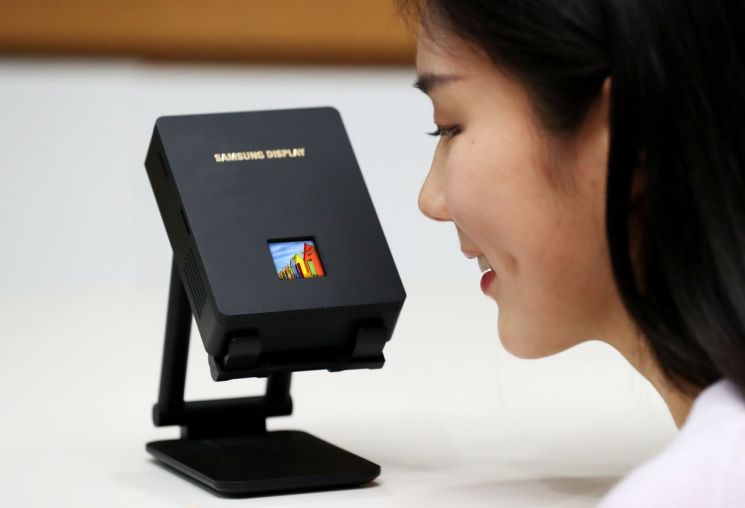 Core technology for implementing extended reality (XR), Samsung Display's RGB OLEDoS /
 [Photo by Samsung Display]
"Samsung QD-OLED to establish itself as the monitor hero"
In the large display sector, Samsung Display will unveil self-emissive UHD OLED monitors with the highest image quality and the world's first 360 Hz OLED monitor. For self-emissive monitors, it will showcase a 31.5-inch UHD (3840*2160) QD-OLED with the highest pixel density and UHD resolution. The pixel density of this product is 140 PPI, equivalent to the image clarity of a 65-inch 8K TV. The refresh rate supports up to 240 Hz.
The company will also reveal a 27-inch panel supporting the highest refresh rate of 360 Hz among released self-emissive monitors. Thanks to the fast response speed characteristic of QD-OLED, the screen transitions quickly, helping to enhance immersion in content such as gaming and sports. A company official said, "This year will be the first year that Samsung Display's QD-OLED proves overwhelming image quality superiority and establishes itself as the 'monitor hero.'"
Under the slogan "Better Performance! More Professional!," Samsung Display will also present exhibition spaces targeting professional markets such as video production and medical use for monitors. This reflects the company's ambition to expand its target markets into professional fields like video and medical industries.
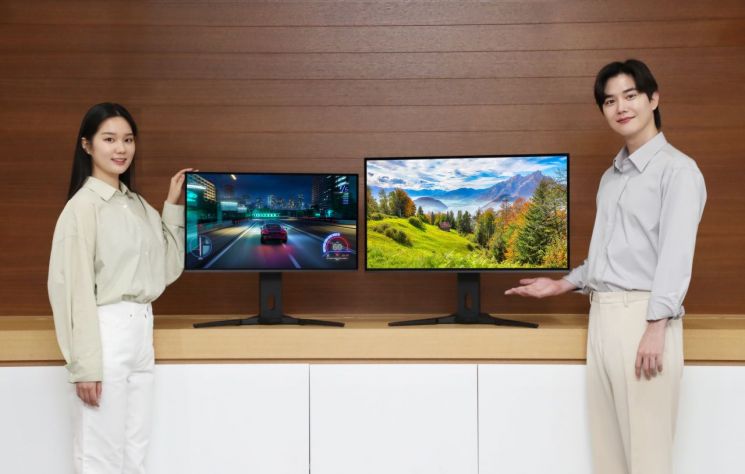 A Samsung Display model is showcasing a 27-inch 360Hz high refresh rate QD-OLED (left) and a 31.5-inch UHD QD-OLED. / Photo by Samsung Display
The TV panels to be showcased at CES are upgraded "3rd generation QD-OLED" products with enhanced brightness. The 3rd generation QD-OLED incorporates evolved panel driving technology and artificial intelligence (AI) technology, achieving a maximum brightness combining the brightness of RGB that exceeds 3000 nits, the brightest among existing OLED TV panels, improving by about 50% compared to the previous year.
Meanwhile, the company will collaborate with global color company Pantone at this exhibition. Pantone provides globally recognized color standards (PMS) and assigns unique numbers to each color. Visitors can compare the colors on the TV screen with Pantone color chips at the exhibition to verify whether QD-OLED reproduces colors realistically. Samsung Display's QD-OLED was the first in the display industry to obtain Pantone certification.
© The Asia Business Daily(www.asiae.co.kr). All rights reserved.
![A Woman Who Jumps Holding a Stolen Dior Bag... The Mind-Shaking, Bizarre Con of a "Human Knockoff" [Slate]](https://cwcontent.asiae.co.kr/asiaresize/183/2026021902243444107_1771435474.jpg)


















