If You Give Cash, Will They Definitely Have Children?
Cash Support and Establishing Care Systems... Both Are Needed to Solve the Problem
Policies Still Focused on Cash Support... Infrastructure Is Also Important
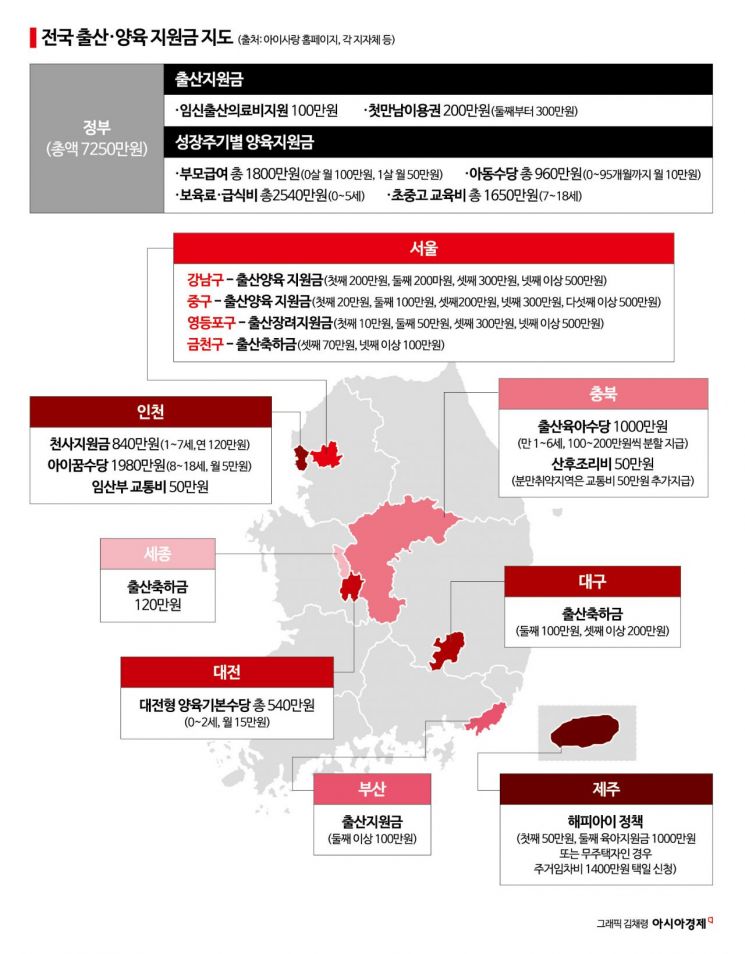
Incheon 101.2 million KRW, Chungbuk 83 million KRW. This is the amount of childbirth and childcare support funds (combined central and local government) that families who gave birth this year can receive. The government has actively established childbirth and childcare allowance systems to compensate for household income losses due to childbirth and childcare. However, as the birth rate continues to decline day by day, questions are arising about the effectiveness of cash-based childbirth and childcare support measures in increasing the birth rate. According to Statistics Korea's "Population Projections 2022?2072," the estimated total fertility rate for 2023 is 0.68. This figure is even lower than the 2022 total fertility rate of 0.78, which was compared to the "14th-century Black Death level" (as mentioned last month by the New York Times).
Experts agree that the effectiveness of cash-based childbirth and childcare support measures alone cannot be guaranteed. They emphasize that a care system in which society shares the burden of childcare must be established for the effects of cash support measures to be realized. In other words, experts advise that childbirth and childcare policies must properly establish two pillars: "cash support" and "care support."
Seok Jae-eun, a professor in the Department of Social Welfare at Hallym University, said, "Because the low birthrate problem is serious, there is skepticism that existing cash support is ineffective," adding, "It is necessary not only to provide financial help through cash support but also to actively encourage parental leave, flexible working hours, and other measures so that individuals do not feel burdened in their careers and can raise children in a supportive environment."
However, he noted that it is difficult to say that the effect of extraordinary childcare allowances is completely absent. Referring to Chungbuk, which has supported and promoted extraordinary childcare allowances, he mentioned that there was an effect of population increase, saying, "This conveyed the message to couples preparing for childbirth that society will share the burden of childcare together."
According to the resident registration population statistics from the Ministry of the Interior and Safety, Chungbuk's birth registrations increased by 1.5% compared to the previous year, ranking first in the rate of change among provinces last year. The other 16 provinces, excluding Chungbuk, saw a decrease in birth registrations during the same period last year. Chungbuk Province views this as a result of the full-scale implementation of childbirth and childcare allowance payments and plans to prepare more proactive low birthrate measures, such as support for multi-child families and interest-free loans for childbirth and childcare support.

Citizens also see "work-family balance" as necessary to solve the low birthrate problem. According to the "Low Birthrate Awareness Survey" jointly conducted by the Low Birthrate and Aging Society Committee and the Ministry of Culture, Sports and Tourism in November last year, among 1,200 citizens aged 18 to 79 nationwide (95% confidence level, ±2.8%P), 25.3% chose "expansion of work and childcare concurrent systems such as parental leave and reduced working hours" as the most effective solution. This was followed by the establishment of social infrastructure such as care and medical services (18.2%).
However, the South Korean government's low birthrate policies still focus heavily on cash support measures. According to the "2022 Local Government Childbirth Support Policy Casebook" released in March last year by the Ministry of Health and Welfare and the Korea Institute of Child Care and Education, the budget for childbirth support projects by local governments nationwide in 2022 was 1.0809 trillion KRW. Among this, projects that directly provide cash accounted for 69.4% (749.68 billion KRW). Infrastructure projects accounted for only 6.6% (71.176 billion KRW).
The policy casebook for this year has not yet been released, but the trend of expanding cash support is expected to continue for the time being. On the 5th, the Ministry of Health and Welfare also announced a plan to expand parental allowance support for newborns this year from the existing "700,000 KRW per month for 0-year-olds and 350,000 KRW per month for 1-year-olds" to "1 million KRW per month for 0-year-olds and 500,000 KRW per month for 1-year-olds."
Seo I-jong, a sociology professor at Seoul National University, emphasized, "South Korea's birth rate is among the lowest in the world, to the extent that it speaks of the collapse of the community," adding, "Long-term measures such as infrastructure development and social awareness changes, along with short-term policies that can produce immediate effects, are necessary." He further stated, "It is difficult to expect the birth rate to rise immediately just by giving cash. A multifaceted approach including social environment changes, corporate culture, establishment of reliable childcare systems, reduction of private education expenses, and resolution of housing price issues is needed for the birth rate to rebound."
© The Asia Business Daily(www.asiae.co.kr). All rights reserved.
![Clutching a Stolen Dior Bag, Saying "I Hate Being Poor but Real"... The Grotesque Con of a "Human Knockoff" [Slate]](https://cwcontent.asiae.co.kr/asiaresize/183/2026021902243444107_1771435474.jpg)

















