Different Rulings by Courts...Causing Social Confusion
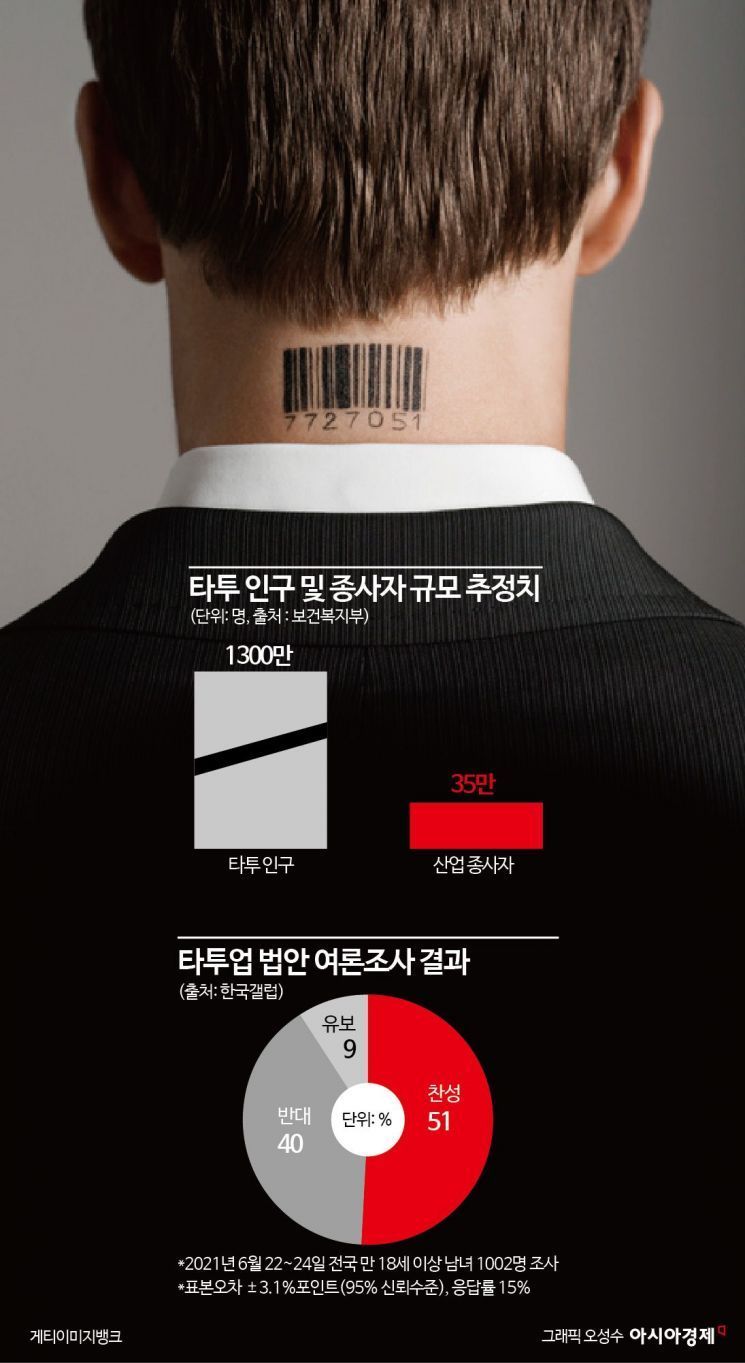
13 Million Tattoo Population, 350,000 Workers
Calls for Legalization...11 Bills Pending
Recently, the number of people getting tattoos has surged, especially among the MZ generation (Millennials + Generation Z), but the issue of illegal tattoo procedures remains unresolved. Under current law, tattoos are defined as medical acts, and procedures performed by non-medical personnel are punishable. Although bills to legalize the tattoo industry have been submitted to the National Assembly, discussions have been sluggish.

Conflicting Judgments on Illegality
According to the legal community on the 8th, the Seoul Eastern District Court last month sentenced tattoo artist Joo Mo (30) to a fine of 2 million won for violating the Medical Service Act. Joo is accused of performing a tattoo procedure using a tattoo machine at a studio in Gwangjin-gu, Seoul, on September 2, 2022, charging 160,000 won.
On the other hand, the Busan District Court Eastern Branch acquitted non-medical person A, stating that "eyebrow tattooing for cosmetic purposes does not constitute disease prevention or treatment," and found A not guilty. From November 2021 to May last year, A performed tattoo procedures on three people by injecting pigment into the epidermis using needles dipped in artificial pigment and charged 100,000 won. As such, legal judgments on tattoo procedures vary by court.
Originally, courts have considered tattooing a medical act since a Supreme Court ruling in 1992, judging tattoo procedures by non-medical personnel as illegal. In 2022, the Constitutional Court ruled constitutional by a 5 to 4 decision on a constitutional complaint filed by the Tattoo Union.
The court determined that the Medical Service Act provision allowing tattoo procedures only by medical personnel does not violate the Constitution. However, criticism has arisen that the Supreme Court ruling, nearly 30 years old, does not reflect the significant social changes, including a tattoo population of 13 million and 350,000 workers.
In fact, public opinion on legalizing the tattoo industry is positive. A June 2021 survey by Gallup Korea of 1,002 men and women aged 18 and over nationwide found that 51% of respondents supported a tattoo industry bill allowing tattoo procedures by qualified general individuals. Opposition was 40%, and 9% were undecided. Support was stronger among younger age groups: 81% in their 20s, 64% in their 30s, and 60% in their 40s. In their 50s, opinions were evenly split, while opposition was higher among those aged 60 and over (59%).
Illegal Only in Korea, Qualification Abroad
South Korea is the only country that defines tattoo procedures by general individuals as illegal. Advanced countries either fully deregulate or recognize qualifications through education completion. New York City in the United States issues tattoo licenses to those who complete education on infection prevention and pass an exam.
In France, individuals who complete at least 21 hours of hygiene and health education and report to the authorities can perform tattoo procedures. In the United Kingdom, tattooing is allowed after receiving over one year of training on tattoo techniques, hygiene, and safety at registered tattoo shops. Japan considered tattooing a medical act but in September 2020, the Supreme Court ruled that it does not constitute a medical act based on social norms.
The National Human Rights Commission has urged legislative discussions, stating that "the current law criminalizing tattoo procedures by non-medical personnel infringes on the freedom of occupational choice of tattoo artists and the freedom of self-expression of those receiving tattoos."
Currently, 11 bills related to tattoo artists (proposed by Park Jumin of the Democratic Party), tattoo and semi-permanent makeup artists (proposed by Kang Ki-yoon of the People Power Party), and the tattoo industry (proposed by Ryu Ho-jeong of the Justice Party) are pending in the Health and Welfare Committee. These bills cover tattoo licensing and scope of work, hygiene management obligations, business registration and closure, and government supervision and management.
Hong Hyung-seon, senior expert at the Health and Welfare Committee, pointed out, "Viewing tattooing as a medical act and leaving it in the illegal domain has caused a gap between social reality and legal systems. Looking at major foreign cases, it is realistic to manage and regulate tattoos within a legal framework. The legislative intent to legalize the tattoo industry seems reasonable. However, it is necessary to conduct sufficient consultations and discussions with related organizations and experts."
© The Asia Business Daily(www.asiae.co.kr). All rights reserved.
![Clutching a Stolen Dior Bag, Saying "I Hate Being Poor but Real"... The Grotesque Con of a "Human Knockoff" [Slate]](https://cwcontent.asiae.co.kr/asiaresize/183/2026021902243444107_1771435474.jpg)












