The three major indices of the U.S. New York stock market showed mixed trends in the early session on the 4th (local time), digesting solid employment data amid weakness in technology stocks including Apple.
At around 10:25 a.m. at the New York Stock Exchange (NYSE), the Dow Jones Industrial Average was trading at the 37,590 level, up 0.43% from the previous close. The S&P 500 index, which is centered on large-cap stocks, rose 0.18% to 4,713. Meanwhile, the tech-heavy Nasdaq index recorded a 0.19% decline to 14,564.
Currently, within the S&P 500, technology, communication, and discretionary consumer sectors are declining, while the other eight sectors are showing gains. Apple, the largest company by market capitalization, is down more than 1% from the previous close after Piper Sandler downgraded its investment rating following Barclays. Mobileye Global, an autonomous driving technology company, plunged 24% as its preliminary sales forecast for fiscal year 2024 is expected to fall short of expectations. APA dropped more than 6% on news of its acquisition of Callon Petroleum. On the other hand, Micron Technology rose over 1% after Piper Sandler upgraded its investment rating. Tesla, which had fallen the previous day, is rebounding. Eli Lilly rose more than 2% on news that it launched a platform allowing consumers access to weight loss drugs.
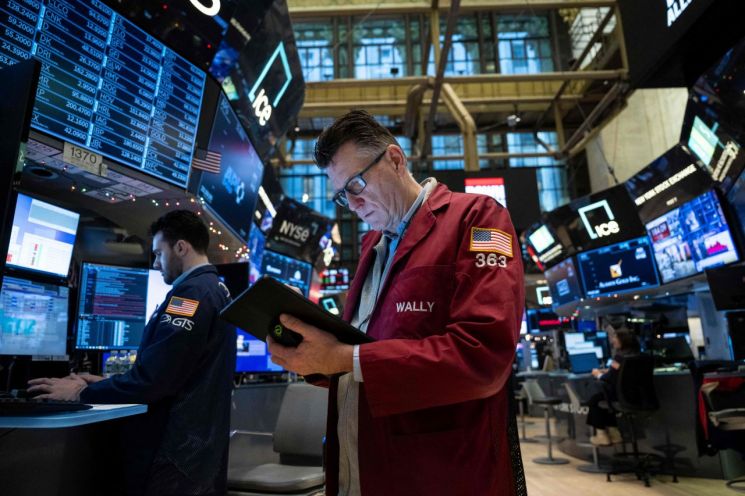
Investors are digesting the minutes of the December Federal Open Market Committee (FOMC) meeting, which contained no specific discussion about interest rate cuts, while also monitoring economic indicators such as the private employment data released that day and the weakness in major big tech stocks including Apple.
The FOMC minutes released the previous afternoon included participants' views that the current interest rate is near its peak and that it would be appropriate to start cutting rates within the year. However, no concrete discussions about rate cuts, which the market had been expecting, took place. Participants agreed that due to high uncertainty, the path of monetary policy could change depending on economic conditions. Some attendees argued at last month's meeting that rates might need to be maintained at the current level longer than expected. Hawkish remarks (favoring monetary tightening) also emerged, suggesting that additional rate hikes might be necessary depending on changes in economic conditions.
These minutes immediately led to market disappointment that rate cuts would not happen as quickly as expected. Additionally, the private employment data released that day also indicated that the labor market remains robust. According to Automatic Data Processing (ADP), U.S. private sector employment increased by 164,000 in December compared to the previous month. This exceeded Wall Street expectations and was significantly higher than the previous month's increase of 101,000. Although the wage growth rate was the lowest since October 2021 at 5.4% year-over-year, it is still considered a level that could exert upward inflationary pressure.
The weekly initial jobless claims released on the same day also fell short of Wall Street forecasts. According to the U.S. Department of Labor, claims for the week of December 24-30 decreased by 18,000 from the previous week to 202,000. Wall Street had expected 216,000 claims. Economic media CNBC described this as "a slowdown in the pace of layoffs in the last week of 2023," calling it a signal of strength in the labor market.
Ian Linsen, strategist at BMO Capital Markets, assessed, "There was nothing in the data to suggest that authorities need to lower rates in the first quarter." The following day, the Labor Department's nonfarm payroll report, closely watched by the Federal Reserve (Fed), will be released. Investors are expected to use this to reassess the pace of the Fed's rate cuts. Wall Street expects the December nonfarm payroll increase to have slowed to 170,000 compared to the previous month.
Currently, the market still largely expects that rate cuts will be implemented as early as March. According to the Chicago Mercantile Exchange (CME) FedWatch tool, the probability that the Fed will cut rates by at least 0.25 percentage points in March exceeds 65% in the federal funds (FF) futures market. The probability of a rate hold remains around 33%, but this has strengthened compared to the previous day and a week ago. This reflects some caution that market expectations for rate cuts may be excessive.
The continued weakness of Apple, the largest company by market capitalization, is also a factor worsening investor sentiment. Following Barclays' downgrade, Apple has fallen for four consecutive trading days. Based on the previous day's closing price, the estimated market capitalization loss is $145 billion. Following Barclays, Piper Sandler also downgraded Apple, confirming downward pressure mainly on technology stocks that surged last year.
In the New York bond market, Treasury yields are rising. The 10-year U.S. Treasury yield is around 3.98%, and the 2-year yield, which is sensitive to monetary policy, rose to about 4.37%. The dollar index, which measures the value of the U.S. dollar against six major currencies, is slightly down at 102.3.
European stock markets are rising. Germany's DAX index rose 0.37%, France's CAC index increased 0.47%, and the UK's FTSE index gained 0.42%.
© The Asia Business Daily(www.asiae.co.kr). All rights reserved.

















