Stock Transfer Lawsuit Taking 864 Days... Han&Co's Complete Victory
Disputes Over 'Dual Representation' and 'Baekmidang Spin-off Promise'
Court Confirms Ruling "Stocks Must Be Transferred as per Contract"
500 Billion Won Damages Suit Remains Against Chairman Hong Won-sik's Family
Hong Won-sik, chairman of Namyang Dairy Products (age 73), and the private equity firm Hahn & Company (Hahn & Co) have concluded their '300 billion won-scale merger and acquisition (M&A) lawsuit' with a final victory for Hahn & Co. On the 4th, the Supreme Court's 2nd Division (Presiding Justice Cheon Dae-yeop) ruled in favor of Hahn & Co in the appeal trial of the stock transfer lawsuit filed by Hahn & Co against Chairman Hong's family. With this ruling, Chairman Hong's family must transfer their shares of Namyang Dairy Products to Hahn & Co. The major shareholder will also change to Hahn & Co. This comes 864 days after Hahn & Co filed the stock transfer lawsuit.

Namyang Dairy Products faced fierce public criticism after claiming that its product Bulgaris had COVID-19 suppression effects.
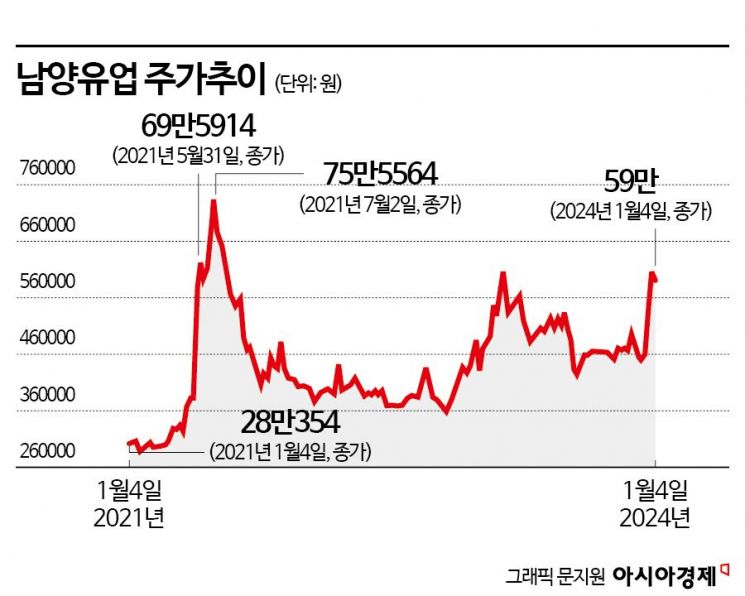
About a week later, Chairman Hong initiated negotiations with Hahn & Co for a stock purchase agreement. After meetings between Chairman Hong and Han Sang-won, president of Hahn & Co (age 52), as well as working-level discussions, both parties signed a contract on the 25th of the same month for Chairman Hong's family to transfer 53.08% of Namyang Dairy Products shares to Hahn & Co for approximately 310.7 billion won (820,000 won per share). Following this news, Namyang Dairy Products' stock price, which had been in the 300,000 won range, surged to between 700,000 and 800,000 won per share.
The turning point occurred as the stock transfer was delayed. When further negotiations broke down, Hahn & Co filed a lawsuit on August 23 of that year demanding "transfer the shares according to the contract." Chairman Hong's side notified a 'contract termination' and pursued a conditional management rights sale to Daewoo Winia instead of Hahn & Co. In response, Hahn & Co filed three injunction applications ? prohibiting the disposal of shares by Chairman Hong's family, prohibiting the exercise of voting rights, and prohibiting the execution of agreements between Namyang Dairy Products and Daewoo Winia ? all of which were granted by the court.
The stock transfer lawsuit intensified, and Chairman Hong highlighted the issue of 'dual representation.' Following the M&A advisor's suggestion, he appointed a lawyer from Kim & Chang law firm as his M&A legal representative, but since Hahn & Co also appointed another lawyer from Kim & Chang, he argued that the contract was flawed. According to civil law and the attorney-at-law act, dual representation is generally invalid or legally ineffective. He also claimed that preconditions such as the 'Baekmidang spin-off' and 'family privileges' were not fulfilled.
Chairman Hong and President Han Clash in Courtroom Testimony in First Trial
During the first trial proceedings on June 21, 2022, Chairman Hong and President Han appeared in court as witnesses. In their approximately two-hour examinations each, they presented conflicting accounts of the shared circumstances.
Chairman Hong first argued that "the spin-off of Baekmidang and the food service division, which was led by my wife, advisor Lee Un-kyung, and the guarantee of privileges for family members including my two sons who are executives at Namyang Dairy Products, were prioritized conditions that were not met." He added, "As someone unexpectedly selling the company, I believed as a husband and father that these conditions must be upheld," and said, "I trusted President Han and believed the promises would be fulfilled."
On the other hand, President Han rebutted, saying, "Chairman Hong focused on raising the per-share purchase price and did not emphasize conditions such as Baekmidang." He claimed, "At a meeting with Chairman Hong, I said, 'If you want, we can consider separating the food service division for acquisition,' but there was no response. The next day, Chairman Hong's side conveyed that 'Chairman Hong is not interested in Baekmidang and does not want it.'" He also emphasized, "In my lifelong M&A experience, I have never made verbal promises or reflected contract conditions in writing without documentation. The principle is to adhere to the contract terms."
Responding to Chairman Hong's side's criticism that "since the family business was suddenly being sold, all conditions had to be secured," President Han drew a line, saying, "This is not a family business but a 'listed company,'" and asked, "Have I ever said I would take care of the family? Isn't receiving 310 billion won from the share sale taking care of the family?"
Regarding the dual representation controversy, Hahn & Co argued, "It is common for one firm to represent both parties in an M&A, so there is no problem." When Chairman Hong's side asked if President Han had obtained consent from Kim & Chang regarding dual representation, he replied, "In 28 years of work, I have never received consent related to dual representation," and said he was not well aware of the process by which both sides appointed different Kim & Chang lawyers.
"Delayed Stock Transfer Caused Shareholder Loss"… Remaining Legal Disputes
The first trial ruled in favor of Hahn & Co, stating that "(both parties') stock purchase contract was concluded." It rejected all of Chairman Hong's claims regarding dual representation and fulfillment of preconditions. The first trial court stated, "There is no detailed and binding assurance regarding the preconditions claimed by Chairman Hong," and "Even if the stock transaction results are unsatisfactory, it cannot be presumed that Chairman Hong's lawyer acted in breach of fiduciary duty." The second trial also upheld this judgment.
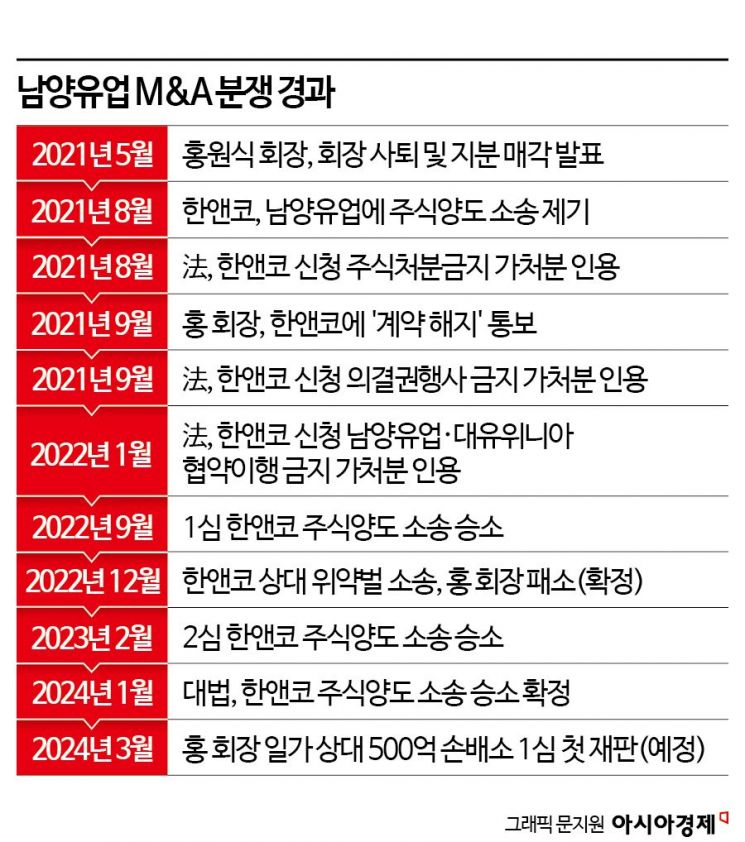
The Supreme Court also ruled in favor of Hahn & Co. The court stated, "'The contract advice by the Kim & Chang lawyer cannot be considered a legal case prohibiting representation from both sides,' which is difficult to accept," but added, "Since Chairman Hong consented to dual advice either before or after the fact, this is an exceptional case with his permission. Therefore, the Supreme Court can accept the lower court's conclusion."
This Supreme Court ruling effectively concludes the management rights dispute. Hahn & Co said, "We welcome the Supreme Court's decision. We have engaged in litigation because we could not tolerate the M&A contract being discarded like waste due to change of mind and false claims, and the long dispute has ended." They added, "Only the procedure for Chairman Hong to fulfill the stock purchase contract remains. We expect him to respect the Supreme Court's ruling." Furthermore, "To normalize the company's management, we will promptly execute the stock purchase contract and develop management improvement plans with Namyang Dairy Products' employees," and "We will restore consumer trust and create a new Namyang Dairy Products."
However, the aftermath of legal disputes is expected to continue. Previously, Chairman Hong filed a penalty lawsuit worth about 31 billion won against Hahn & Co, holding them responsible for the failed M&A. The first trial ruled against Chairman Hong. Although both parties were advised by the court to reconcile and Chairman Hong's side expressed willingness to withdraw the lawsuit, Hahn & Co did not agree, and the verdict was delivered. Since Chairman Hong did not appeal, the penalty lawsuit was finalized at the first trial.
On the contrary, Hahn & Co intends to claim additional damages for losses caused by the delayed stock transfer. In this regard, they have separately filed a damage compensation lawsuit worth about 50 billion won against Chairman Hong's family. The first trial for this case is scheduled for March 14 at the Seoul Central District Court.
A Hahn & Co official said, "The Supreme Court's expected outcome has come. We should focus on promptly securing management rights by executing the contract as per the ruling. Afterwards, we need to address the damages compensation part."
© The Asia Business Daily(www.asiae.co.kr). All rights reserved.



















