KOSPI Down 0.78% Yesterday... Two Consecutive Days of Decline
Rally Ends as Interest Rate Cut Effect Weakens
Short-Term Correction Inevitable, Focus on Profit Momentum
The stock market has been volatile since the beginning of the year. The KOSPI fell sharply for two consecutive days, eventually dropping below the 2600 mark. With the rally driven by expectations of interest rate cuts since November last year coming to an end, a correction is expected in the near term. As a correction phase is anticipated, the importance of corporate earnings is expected to increase.
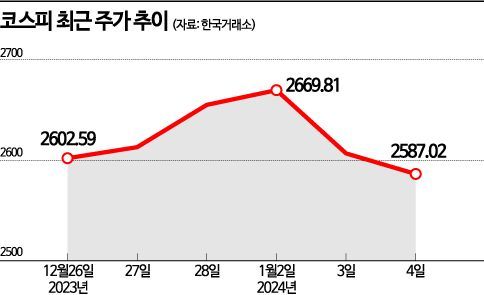
According to the Korea Exchange on the 5th, the KOSPI closed at 2587.02, down 0.78% from the previous day. It fell for two consecutive days, breaking below the 2600 level. The KOSDAQ, which was close to the 880 level, also dropped to the 860 range.
This weakness is due to the weakening of the interest rate cut expectations that had been the momentum for the stock market rise since November last year. Najunghwan, a researcher at NH Investment & Securities, explained, "According to the Chicago Mercantile Exchange (CME) FedWatch, the market-implied probability of the U.S. Federal Reserve (Fed) holding rates steady in March this year increased from 11.5% to 23.2%, which reduced the excessive expectations for rate cuts and negatively affected stock prices. The financial market had been expecting larger rate cuts than the Fed’s guidance, which had been a factor driving stock price increases."
The rally that started in November appears to have ended. Lee Woongchan, a researcher at Hi Investment & Securities, analyzed, "The explosive rise in global stock markets since November was driven by a disinflation narrative based on price stability. However, interest rates and the dollar, which had been falling until the end of last year, have reached levels before their sharp rise at the end of the second quarter, making further declines difficult." He added, "It is appropriate to say that the fuel for the disinflation rally has been exhausted."
In particular, the domestic stock market saw a larger decline as foreign buying, which had driven the market since November last year, reversed. The KOSPI’s fluctuation rate in November and December was 15%, ranking first among the Group of Seven (G7) and Asian countries. Kang Jaehyun, a researcher at SK Securities, said, "The domestic stock market’s drop on the 3rd was unusually large, likely a reaction to the strong foreign carry trade that caused a significant rise in the global stock market at the end of December. Foreign investors simultaneously net bought KOSPI spot and futures at an unprecedented scale in December, so when the risk asset rally stopped, the reaction was inevitably strong."
However, there are opinions that the market has not turned into a bear market. The researcher said, "The factors that could cause a market decline?inflation, recession, and credit risk?do not seem highly likely. It’s just that the market has fallen rapidly and significantly, so the fuel of falling interest rates has been exhausted, and there is no room for further market gains. The market is undergoing a short-term correction process."
In the short term, a sideways market is expected to continue until uncertainties about earnings visibility and the timing of interest rate cuts are resolved. Najunghwan forecasted, "The divergence between the KOSPI’s 12-month trailing earnings per share (EPS) and 12-month forward EPS has expanded to the largest level since June 2021. Until visibility on domestic corporate profit improvements this year increases, the upward momentum of stock prices will be somewhat slow."
With renewed uncertainty from interest rates, focus should shift to earnings. Han Jiyoung, a researcher at Kiwoom Securities, advised, "In periods like recently, when interest rate volatility and Fed policy uncertainty increase macroeconomic instability, a strategy focused on earnings growth is necessary. From the fourth quarter earnings season last year through the first quarter earnings season this year, downward revisions to annual operating profit forecasts are inevitable. However, a strategy to build a portfolio concentrated on sectors and stocks with earnings momentum will be an alternative."
© The Asia Business Daily(www.asiae.co.kr). All rights reserved.

















