Norovirus Can Be Transmitted Through Feces
Overseas Study Confirms Droplet Spread in Toilet Water
Patients infected with the 'Norovirus,' which causes food poisoning, have recently been rapidly increasing. While food poisoning is often thought to occur during the hot summer months, Norovirus survives well even in cold weather. As the number of Norovirus patients rises recently, it is especially important to follow hygiene rules to avoid exposure to Norovirus.
On the 3rd, the Ministry of Food and Drug Safety announced tips to prevent the spread of Norovirus during winter in its food poisoning prediction map. Unlike other food poisoning bacteria, Norovirus remains highly active even at low temperatures, mainly spreading during winter. In particular, Norovirus can be transmitted through food but also poses a risk of infection through direct contact with infected individuals. Infection can occur through touching faucets, door handles, and other surfaces after an infected person uses the restroom without washing their hands, so caution is necessary.
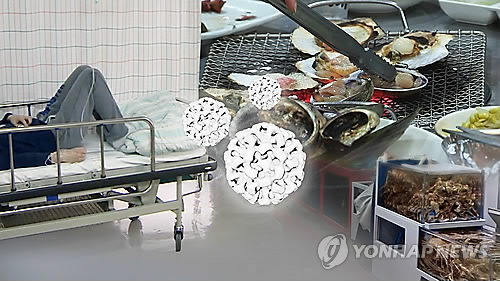 Patients infected with the 'Norovirus,' which causes food poisoning, have been rapidly increasing recently. While food poisoning is often thought to occur during hot summer months, Norovirus can survive well even in cold weather. As the number of Norovirus patients rises recently, it is especially important to follow hygiene rules to avoid exposure to Norovirus.
 [Photo by Yonhap News]
When a patient showing symptoms of vomiting or diarrhea uses the restroom, closing the toilet lid can prevent the spread of droplets. Multiple studies have proven that flushing the toilet causes droplets to spread. A research team from the University of Colorado Boulder visualized droplets splashing outside the toilet using a green laser when flushing. The study confirmed that tiny water droplets splashed up to the ceiling. The droplets reached a height of 1.5 meters at a speed of 2 meters per second.
Similar research was conducted in the UK. A research team from the Leeds Medical School affiliated hospital measured the extent of bacterial spread when the toilet lid was open versus closed. The results showed that flushing with the lid open caused bacteria to be detected not only around the toilet but also on the bathroom floor. The team analyzed, "Flushing the toilet with the lid open increases the likelihood of spreading Norovirus."
To prevent the spread of Norovirus, it is important not only to close the toilet lid and flush after using the toilet or vomiting but also to thoroughly disinfect the surrounding area. The Ministry of Food and Drug Safety urged, "Vomitus should be covered with paper towels soaked in chlorine disinfectant (1000?5000 ppm) for about 5 minutes before wiping, then placed in a plastic bag and disposed of immediately." They added, "When disinfecting surfaces such as door handles and faucets, apply chlorine disinfectant (1000 ppm) and wipe with disposable towels or a wet cloth after 10 minutes." Additionally, the ministry recommended that clothes and bedding soiled with the patient's vomit or feces should be soaked in chlorine (5000 ppm) for more than 30 minutes before washing. They also advised avoiding visits to homes with infected patients and refraining from communal living until 3 days after cleaning and disinfecting following full recovery.
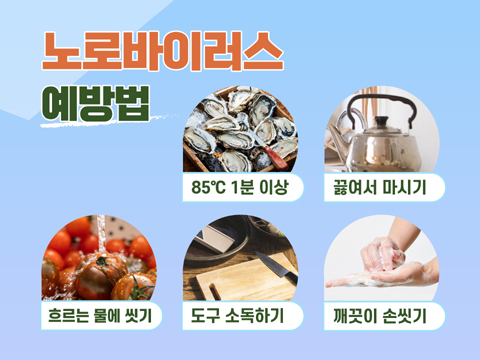 If infected with norovirus, symptoms of food poisoning such as vomiting, diarrhea, abdominal pain, and nausea occur after an incubation period of 1 to 2 days. These symptoms often continue for 2 to 3 days and then rapidly improve. Although death is rare, severe dehydration can be dangerous for infants and young children, so caution is necessary. Prevention involves cooking shellfish such as clams and oysters rather than eating them raw. Groundwater should also be boiled before drinking. Norovirus is inactivated by heating at 80°C for about 5 minutes or at 100°C for about 1 minute. Additionally, frequent handwashing with soap is important.
 [Photo by Asia Economy DB]
Meanwhile, after infection with Norovirus, symptoms of food poisoning such as vomiting, diarrhea, abdominal pain, and nausea appear following an incubation period of 1 to 2 days. Symptoms usually last for 2 to 3 days and then rapidly improve. Death is rare, but severe dehydration can be dangerous for infants and young children, so caution is necessary. Preventive measures include eating shellfish such as clams and oysters cooked rather than raw. Groundwater should also be boiled before drinking. Norovirus is inactivated by heating at 80°C for about 5 minutes or at 100°C for about 1 minute. Additionally, frequent handwashing with soap is important.
© The Asia Business Daily(www.asiae.co.kr). All rights reserved.
!["The Woman Who Threw Herself into the Water Clutching a Stolen Dior Bag"...A Grotesque Success Story That Shakes the Korean Psyche [Slate]](https://cwcontent.asiae.co.kr/asiaresize/183/2026021902243444107_1771435474.jpg)
















