'It Seems Unhealthy' Also Reaches 29.9%
At around 1 p.m. on the 3rd, at the Hyeonhyeolui Jip Hanyang University Station Center in Seongdong-gu, Seoul, the phrase "Your blood donation today becomes someone's tomorrow" and the hastily added yellow paper sign saying "Blood Donation Souvenir 1+1" failed to attract much attention from passersby. Although the blood donation center is located between Hanyang University and the ticket gate, pedestrians seemed to walk by as if nothing existed there. Inside, it was quiet. Five people were donating blood, but there were zero people waiting to donate. Kim (23, female) said, "I think I should do it, but it's hard to find the time to donate blood, and I'm also worried it might not be good for my health, so I don't visit often."
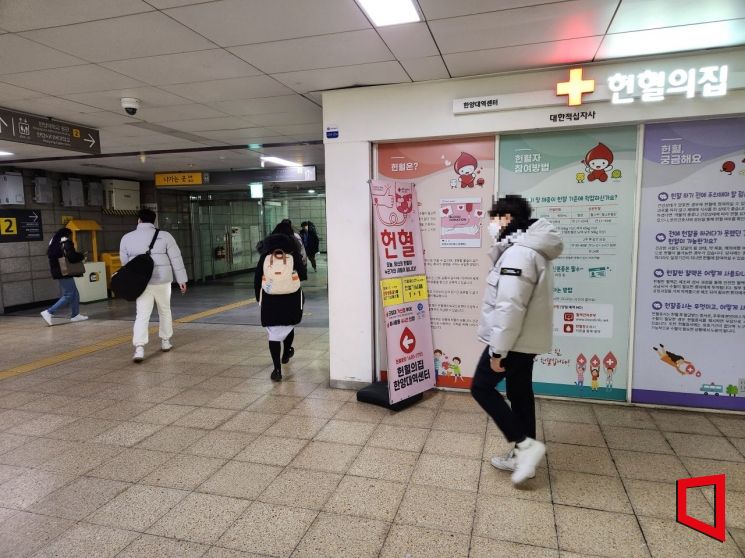 Around 1 p.m. on the 3rd, at the Hyeonhyeolui Jip Hanyang University Station Center in Seongdong-gu, Seoul, it was hard to find passersby paying attention to the Hyeonhyeolui Jip notice./Photo by Tae-won Choi skking@
Amid rising concerns over the blood supply shortage, it has been revealed that misunderstandings about blood donation being harmful to health are still widespread. Experts have verified the safety of blood donation and even suggested that it has beneficial aspects for health management.
According to the Blood Management Headquarters of the Korean Red Cross on the 4th, the number of blood donations has been decreasing: approximately 2.61 million in 2019, 2.43 million in 2020, and 2.41 million in 2021. Although it rebounded to about 2.44 million last year, it is still nearly 200,000 donations short compared to pre-COVID-19 levels. As of the 3rd, the blood supply is only sufficient for 6.2 days. The blood supply crisis stages are classified as follows: 'Attention' when the supply is less than the appropriate level of 5 days, 'Caution' below 3 days, 'Alert' below 2 days, and 'Severe' below 1 day.
Currently, the blood supply is at an appropriate level, but it barely exceeds the 5-day standard, so it is too early to be complacent. This is because young people aged 10 to 20 account for about 54% of all blood donations. The Korean Red Cross expects that blood donations from this group will decrease during the winter vacation and holiday periods in January and February, leading to a corresponding drop in overall blood supply.
One of the reasons citizens avoid donating blood is due to misunderstandings about blood donation. Concerns about side effects are prevalent. According to a survey conducted last month by the market research firm Embrain Trend Monitor on 1,000 adults nationwide (aged 19-59) titled "2023 Blood Donation Experience and Related Perceptions," 42.5% of respondents said they fear contracting infectious diseases such as COVID-19 through blood donation. Additionally, 29.9% responded that they think blood donation might be bad for their health.
However, there is no risk of contracting diseases from donating blood. All medical devices used for blood donation, such as needles and blood bags, are sterile, disposable products that are discarded after a single use. In fact, during blood donation, pulse, blood pressure, temperature, hemoglobin levels, ALT, total protein, hepatitis B and C, syphilis, malaria, unexpected antibodies, and blood subtype are tested, and the results are provided, offering the advantage of a free health checkup.
Professor Namgung In of Ewha Womans University’s Department of Emergency Medicine said, "Since 15% of the human body's blood is surplus, even if 10% is taken, recovery is possible without any symptoms or aftereffects. Korea's blood and infection management is also world-class, so there is no need to worry about infection during the blood donation process." He added, "A kind of health checkup is conducted during the process of testing whether the donated blood can be used. It is also beneficial for health management." A Korean Red Cross official also stated, "Sterile, disposable medical supplies are used for blood collection, so there is no risk of infectious disease transmission. You can check your health status through blood test results, and blood donation is an act that can save lives without any harm to your health."
© The Asia Business Daily(www.asiae.co.kr). All rights reserved.

















