Magnitude 7.6 Earthquake in Japan... 'SOS' Hashtag Spreads on SNS
Woman Shares Sexual Assault Experience During Great East Japan Earthquake
'Sexual Assault' Related Terms Rank High in SNS Searches
Amid a magnitude 7.6 earthquake in Japan, warnings related to 'sexual assault' are rapidly spreading on social networking services (SNS) among people seeking earthquake shelters.
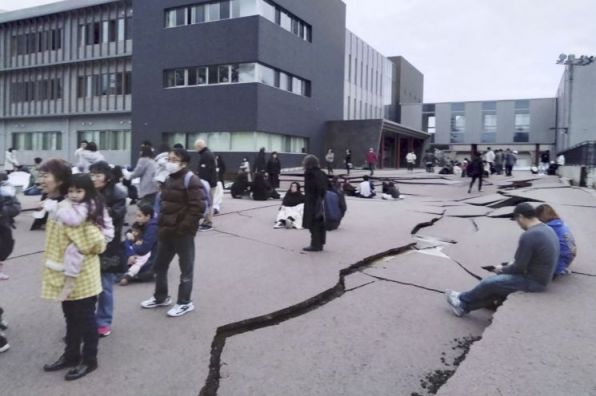 The ground cracked after a magnitude 7.6 earthquake occurred on the 1st in Wajima City, Noto Peninsula, Ishikawa Prefecture, Japan. The Japan Meteorological Agency announced that 93 earthquakes with a seismic intensity of 1 or higher were observed from 4:10 PM to midnight on the same day.
 [Photo by AP Yonhap News]
Earlier, on the 1st, a magnitude 7.6 earthquake struck the Noto Peninsula in Ishikawa Prefecture, Japan. According to local media reports, the Ishikawa Prefectural authorities announced that as of midnight on the 3rd, the death toll from the earthquake was counted at 57. By region, the numbers are ▲Wajima City (24) ▲Suzu City (22) ▲Nanao City (5). There are 136 injured. Following the strong earthquake, fires destroyed 200 buildings, and it is known that 57,360 people have evacuated to 955 shelters in Ishikawa, Niigata Prefectures, and other areas.
In response, concerns about sexual crimes occurring in shelters are spreading on SNS as people share their experiences from the Great East Japan Earthquake. Netizen A said with the hashtag 'SOS', "Women should stick together when sleeping or going to the bathroom," adding, "Many people were victimized during the Great East Japan Earthquake."
Another netizen, B, claimed to have been sexually assaulted during the Great East Japan Earthquake, stating, "I was raped and robbed by a middle-aged man at that time," and advised, "Always carry or hide your bag containing valuables, and if a crime occurs, protect yourself by striking vulnerable areas." B also attached a photo showing the locations of vulnerable body parts.
In addition, posts warning about sexual assault in shelters with the 'SOS' hashtag continue to be uploaded. On the 2nd, on X (formerly Twitter), the Japan real-time trends included 'SOS', 'Shelter Sexual Assault Prevention', 'Shelter Sexual Assault', and 'Protect Your Body Yourself in the Shelter' among the top 10 search terms. A post titled 'How to Avoid Sexual Assault in Shelters' had been reposted 10,000 times, received 28,000 likes, and 546 bookmarks as of 10 a.m. on the 3rd.
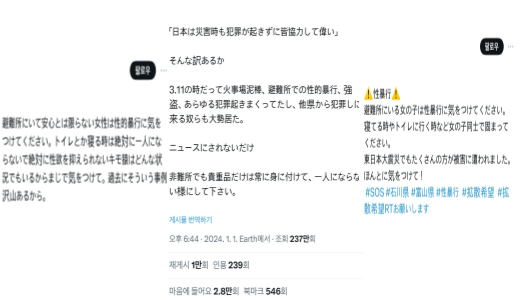 Sharing experiences from the Great East Japan Earthquake while concerns about sexual crimes occurring in shelters are spreading through social media.
 [Photo by X (formerly Twitter)]
The Great East Japan Earthquake, which occurred on the afternoon of March 11, 2011, was a magnitude 9.0 earthquake off the Pacific coast that triggered a massive tsunami. Testimonies emerged that habitual sexual assaults occurred against evacuees in shelters, and Japan's public broadcaster NHK produced a documentary titled 'Buried Voices' in 2021, featuring interviews with women who suffered sexual crimes in shelters.
C, who appeared in the documentary, testified, "After my husband died in the earthquake, the shelter manager forced me into sexual acts," adding, "The shelter manager explicitly coerced me to come to him at night by offering towels or food." Another victim, D, said, "I was abused by several men. I was afraid to tell anyone because I feared being killed," and confessed, "I couldn't report it because I thought they would say I died and was swept away by the tsunami in the sea."
Nine years after the Great East Japan Earthquake, in February 2020, an analysis of approximately 360,000 consultations received by the women-only counseling line 'Donghaeng Hotline' between 2013 and 2018 revealed that over 50% of consultations from the three affected prefectures (▲Iwate ▲Miyagi ▲Fukushima) were related to sexual violence. Particularly, about 40% of the victims were young women in their teens and twenties.
Meanwhile, this recent earthquake is reported to be similar in magnitude to the 1983 magnitude 7.7 Central Sea of Japan earthquake and the 1993 magnitude 7.8 southwestern Hokkaido offshore earthquake. Yasuhiko Umeda, professor emeritus at Kyoto University, explained to the Sankei Shimbun about the cause of the earthquake: "In the Noto Peninsula, a series of earthquakes are occurring as high-temperature fluids exceeding 300 degrees Celsius rise from deep underground," adding, "Torsion in faults inland has accumulated, causing active seismic activity in weaker areas."
Experts also warned that strong earthquakes could occur again in the Noto Peninsula. Fumihiko Imamura, professor at Tohoku University, said, "I hope people do not think that the earthquakes and tsunamis have ended with this," noting that during the 1983 Central Sea of Japan earthquake, locally, tsunami waves over 10 meters high occurred. Professor Nishimura also stated, "Because faults are complexly distributed on the Sea of Japan side, when one moves, surrounding faults tend to move as well, making seismic activity more active."
© The Asia Business Daily(www.asiae.co.kr). All rights reserved.


















