Kim Jong-un Officially Defines Inter-Korean Relations as Hostile States
Secures Legitimacy for Nuclear Strategy by Erasing 'Fellow Countrymen'
7th Nuclear Test Possible Before US Presidential Election
Experts Say "Dialogue with China and Russia Needed to Reduce Tensions"
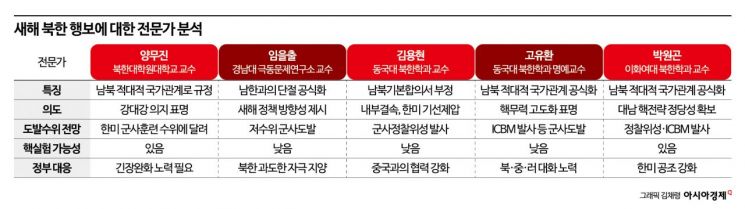
North Korea officially defined inter-Korean relations as a 'hostile state relationship' in the new year. Tensions surrounding the Korean Peninsula are rising. With recent acceleration in security cooperation among South Korea, the United States, and Japan, North Korea has no place left to retreat. Analysts suggest that by engaging in a 'strong versus strong' confrontation, North Korea is attempting to seize the initiative and strengthen internal unity. Experts pointed out the need for efforts to reduce tensions through dialogue with China, which has significant influence over North Korea.
The Meaning of North Korea Officially Declaring Inter-Korean Relations as 'Hostile'
On the 3rd, Asia Economy asked five North Korea experts about North Korea's recent actions. Most experts emphasized the significance of North Korea defining its relationship with South Korea not as a 'special relationship' but as a hostile 'state relationship,' predicting that heightened tensions on the Korean Peninsula are inevitable for the time being.
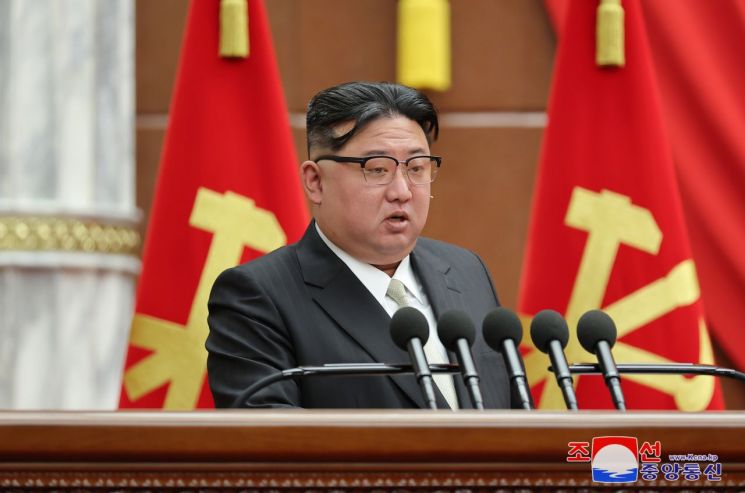
Previously, in the 1991 Basic Agreement on Reconciliation, Non-aggression, and Exchanges and Cooperation between the South and the North, inter-Korean relations were defined as a 'special relationship provisionally formed in the process of striving for unification.' However, after concluding the 9th Plenary Meeting of the 8th Central Committee of the Workers' Party of Korea at the end of last year, North Korean State Affairs Commission Chairman Kim Jong-un declared, "Inter-Korean relations are no longer a relationship between compatriots or a homogeneous relationship but a hostile relationship between two states," overturning the previous definition.
Professor Lim Eul-chul of the Institute of Far Eastern Studies at Gyeongnam National University explained, "The most significant feature of Chairman Kim Jong-un's statement is that he described South Korea as a hostile entity and made a major shift in North Korea's policy toward the South. While this is not new but something North Korea has long prepared, the fact that it was fully institutionalized at an official plenary meeting is meaningful."
Was It Aimed at Justifying the Nuclear Strategy Against the South?
Chairman Kim's provocative messages from the new year are interpreted as an attempt to seize the initiative against South Korea and the United States, who maintain a hardline stance toward North Korea, while also seeking to legitimize North Korea's nuclear strategy against the South.
Professor Kim Yong-hyun of Dongguk University's Department of North Korean Studies said, "It seems North Korea has judged that the Yoon Seok-yeol administration's hardline policy toward the North is unlikely to change. Rather, by showing that North Korea is not losing to the U.S. and South Korea in a strong-versus-strong confrontation, it aims to seize the initiative and strengthen internal cohesion."
Professor Park Won-gon of Ewha Womans University's Department of North Korean Studies stated, "If inter-Korean relations were a compatriot relationship, North Korea could not recklessly use nuclear weapons against South Korea. However, by defining South Korea as a hostile state through this plenary meeting, that has become possible. Since last year, North Korea has been using the term 'Republic of Korea,' which can be seen as an effort to legitimize its nuclear strategy against the South."
There is also an analysis that North Korea is pushing a hardline policy to assert its presence ahead of the parliamentary elections in April this year, but most experts find this unlikely. Professor Yang Moo-jin of the University of North Korean Studies said, "North Korea knows that if it intervenes, conservative forces in South Korea will unite more. This recent behavior should be understood in the context of North Korea's regime characteristics, which do not tolerate damage to the regime or insults to its dignity, rather than as related to the general election."
North Korea Will Adjust Its Level... Possible Nuclear Test Before U.S. Election
Experts all expressed concern about the possibility of North Korean military provocations early in the year. However, they also believe North Korea will find it difficult to arbitrarily escalate the level of provocations. Professor Lim Eul-chul said, "All possibilities are open, including localized provocations or intercontinental ballistic missile (ICBM) launches, but since North Korea must ensure its own survival, it will regulate the level of provocations. It is expected to respond proportionally according to the scale of South Korea-U.S. military exercises."
Opinions among experts differ somewhat regarding the possibility of a seventh nuclear test within the year. North Korea has not conducted a nuclear test since the sixth test in September 2017, but recent indications from Chairman Kim suggesting the possibility of preemptive use of nuclear weapons have strengthened speculation that a nuclear test might occur.
Professor Emeritus Ko Yu-hwan of Dongguk University's Department of North Korean Studies said, "Since North Korea has conducted six nuclear tests, it appears to have completed a certain level of experiments related to nuclear force enhancement. Many analyses suggest that China perceives a seventh nuclear test as a kind of red line, so North Korea is unlikely to act recklessly." There is also an analysis that if North Korea conducts a seventh nuclear test, public opinion in South Korea and Japan favoring nuclear armament will inevitably rise, which would be a burden for North Korea.
On the other hand, Professor Park Won-gon predicted that North Korea might push ahead with a nuclear test to create a favorable situation for itself ahead of the U.S. presidential election in November. He explained, "North Korea, which wants former President Trump to be elected, might conduct the seventh nuclear test before the U.S. election. Former President Trump has been talking about the fact that North Korea did not conduct nuclear tests while he was in office as an achievement, so a nuclear test could be negative for the Biden administration."
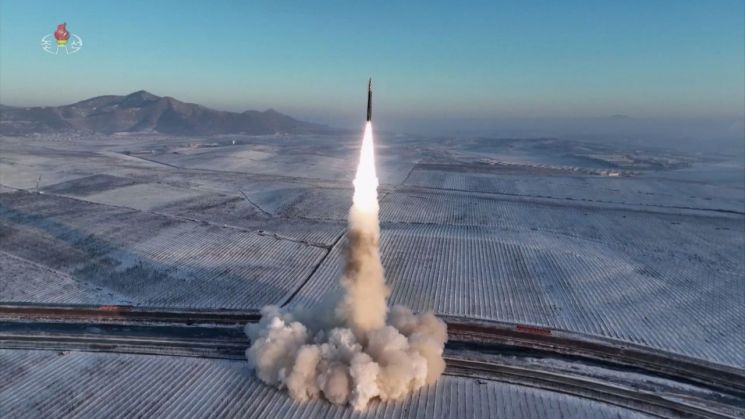 On December 18 last year, under the observation of Kim Jong-un, Chairman of the State Affairs Commission of North Korea, the solid-fuel intercontinental ballistic missile (ICBM) "Hwasong-18" was launched. The launch video was released by Korean Central TV on the 19th of the same month. [Korean Central TV screen] [Image source=Yonhap News]
Concerns Over Accidental Clashes... "China and Russia Must Engage in Dialogue"
As tensions around the Korean Peninsula rise, experts emphasize the need for diplomatic efforts involving dialogue with China and Russia, which have significant influence over North Korea.
Professor Emeritus Ko Yu-hwan said, "Until last year, the government focused on strengthening the South Korea-U.S. alliance to enhance nuclear deterrence. However, from this year, more attention should be paid to diplomacy and dialogue with China, Russia, and North Korea. Since the crisis is escalating and the possibility of accidental clashes is increasing, dialogue is necessary even from a crisis management perspective."
Professor Yang Moo-jin said, "Since our country is a normal state, tensions must be eased to attract foreign investment. The government should focus on managing the situation on the Korean Peninsula stably while recovering the economy. For this, it is necessary to move toward a dialogue phase with North Korea."
© The Asia Business Daily(www.asiae.co.kr). All rights reserved.
![Clutching a Stolen Dior Bag, Saying "I Hate Being Poor but Real"... The Grotesque Con of a "Human Knockoff" [Slate]](https://cwcontent.asiae.co.kr/asiaresize/183/2026021902243444107_1771435474.jpg)


















