Magnitude 7.6 Earthquake Strikes Ishikawa Prefecture, Japan on the 1st
Travelers' Community Shares 'Earthquake Experiences'
On the afternoon of January 1st, the first day of the new year, a powerful earthquake with a magnitude of 7.6 struck the Noto Peninsula area in Ishikawa Prefecture, Japan. Among Korean travelers visiting Japan at the time, there have been shared experiences of the earthquake.
"Water leaked from the station ceiling, evacuated to open fields"
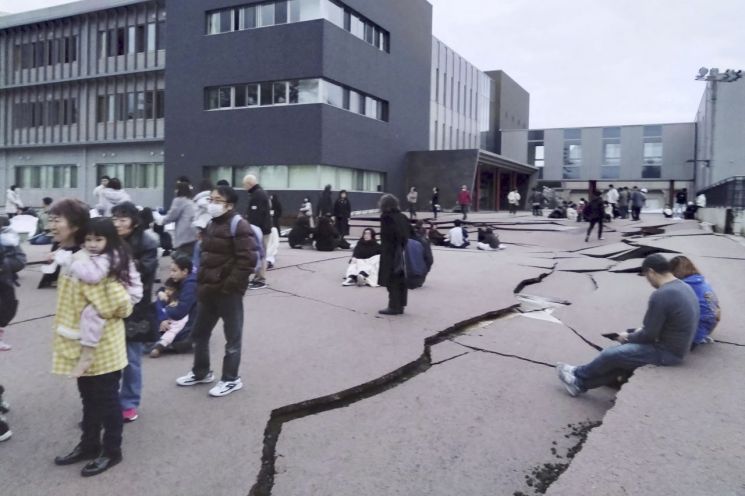 On the 1st, after a magnitude 7.6 earthquake struck the Noto Peninsula in Ishikawa Prefecture, Japan, the ground cracked. [Image source=Yonhap News]
On the 2nd, the Chosun Ilbo reported these experiences by quoting posts from a Japanese travel community. Korean tourist A, who was at Kanazawa Station in Ishikawa Prefecture during the earthquake, said, “Water was leaking from the ceiling of Kanazawa Station, and the station staff were evacuating everyone outside the station. I was shocked by experiencing a magnitude 7 earthquake for the first time in my life. I’m worried there might be problems at the airport since I’m flying back tomorrow morning.”
Another traveler B, who was also at Kanazawa Station, said, “I was about to board a bus in the square in front of the station when I thought a train was passing by.” He added, “An alert saying ‘Earthquake’ popped up on my phone, so I immediately ran to an open field.” An open field refers to a wide, unobstructed area without trees or buildings, such as a playground, where people should evacuate during an earthquake. B said, “The ground was shaking so much that it was hard to keep balance, which made me laugh nervously. I went straight to a large park and stayed there for an hour or two. I didn’t even have the courage to go eat, and when I finally went to a convenience store later, there was a long line of people buying emergency food supplies.”
C, who was traveling in Osaka City, also wrote, “Around 4:30 p.m., the 'Harukas 300' building shook and the elevator stopped. While waiting for the elevator to go up to the 60th floor after buying a ticket at the 16th-floor ticket office, I felt the shaking and then the elevator stopped, saying it was not working right now.”
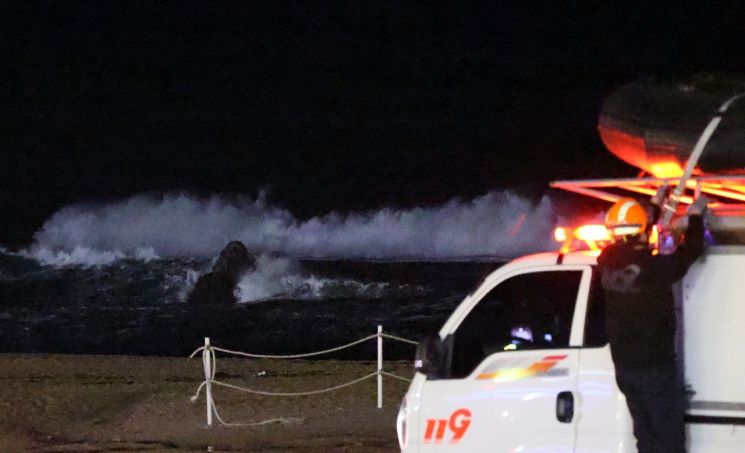 Waves are crashing in the sea in front of Anmok Beach, Gangneung-si, Gangwon, on the night of the 1st. [Image source=Yonhap News]
Japan experienced its strongest earthquake since the Great East Japan Earthquake (magnitude 9) in March 2011, causing fear throughout the country from the first day of the new year. According to the Japan Meteorological Agency, from 4:10 p.m. on the 1st until midnight on the 2nd, 93 earthquakes with a seismic intensity of 1 or higher were recorded. This area is a high-risk zone where magnitude 6 earthquakes occurred in 2007, 2022, and 2023.
The Japan Meteorological Agency also issued a tsunami warning immediately after the earthquake, predicting a tsunami along the entire western coast. A large tsunami with a height of 5 meters occurred on the Noto Peninsula where the earthquake struck. The tsunami’s effects reached as far as the East Coast of Gangwon Province, causing waves up to 67 cm high in Mukho. Gangwon Province took safety measures by sending emergency disaster messages to six cities and counties along the East Coast that afternoon.
© The Asia Business Daily(www.asiae.co.kr). All rights reserved.
![Clutching a Stolen Dior Bag, Saying "I Hate Being Poor but Real"... The Grotesque Con of a "Human Knockoff" [Slate]](https://cwcontent.asiae.co.kr/asiaresize/183/2026021902243444107_1771435474.jpg)

















