Retail Sales Index Down 1.4% Year-on-Year
Including Restaurants, Longest Decline on Record
Due to the impact of high inflation and high interest rates, consumption of goods has decreased, resulting in the retail sales index from January to November last year recording a 'negative' for the first time in 20 years.
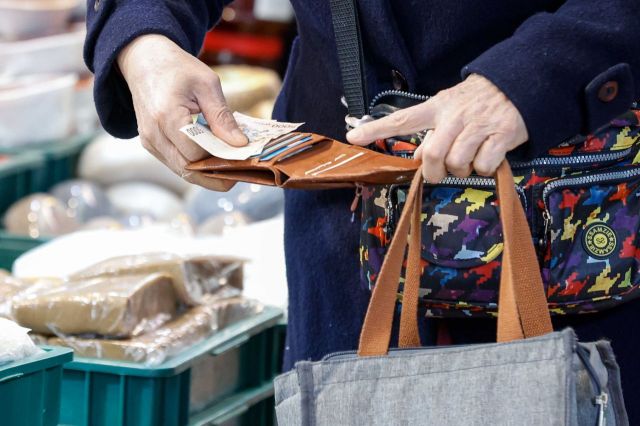 A consumer is paying after purchasing goods at Mangwon Market in Mapo-gu, Seoul. Photo by Jinhyung Kang aymsdream@
According to the National Statistical Portal (KOSIS) of Statistics Korea on the 1st, the retail sales index (constant index) for November last year was 106.6 (2020=100), a 1.4% decrease compared to the cumulative total of the previous year. This compares the average from January to November last year with the same period the previous year. The retail sales index is calculated by surveying about 2,700 sample businesses that sell goods and consumer products to the general public. It is the first time since 2003 (-3.1%) that the retail sales index has recorded a negative.
By product category, semi-durable goods such as clothing, shoes, and bags decreased by 2.3%. This is the first decrease since 2020 (-12.0%). Non-durable goods, mainly food and beverages, vehicle fuel, and cosmetics, which are typically used for less than one year, also decreased by 1.7%. The decline was the largest since a 9.1% decrease in 1998. Durable goods, such as passenger cars, which are high-priced items used for more than one year, increased by 0.1%. Although this is an improvement compared to 2022 (-2.9%), it remains lower than in 2020 (11.6%) and 2021 (6.7%).
The Korea Development Institute (KDI) analyzed the current economic situation in its economic outlook published in November last year, stating, "Private consumption is slowing down mainly in goods consumption, which is significantly affected by high interest rates, and consumer sentiment has also somewhat weakened."
The index combining restaurant business and goods consumption has been decreasing for the longest period on record. The retail sales index including restaurants (constant index) was 107.2 (2020=100) in November last year, down 1.0% compared to the same month the previous year. This marks eight consecutive months of decline since April last year (-0.9%). This is the longest period of decline since related statistics began to be compiled in 2010. On a cumulative basis from January to November last year, it also decreased by 1.1% compared to the previous year, marking the first negative since 2020 (-2.4%).
In the case of service industry production (constant index), it increased by 3.1% in the January to November period last year compared to the same period the previous year. However, the growth rate slowed compared to 2021 (4.7%) and 2022 (6.8%).
© The Asia Business Daily(www.asiae.co.kr). All rights reserved.

















