At the Start of Minseon 7th Term, Jungnang-gu Budget Was 565.7 Billion KRW... Achieved 1.071 Trillion KRW in 2024
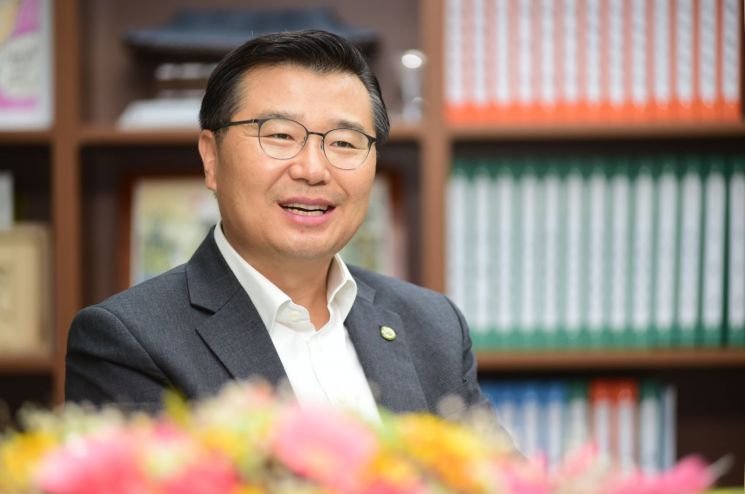
Ryu Gyeong-gi, Mayor of Jungnang-gu, is continuing the era of a 1 trillion KRW budget in 2024, following 2023.
Jungnang-gu, with a population of 380,000, achieving a budget of 1 trillion KRW is attributed to Mayor Ryu's exceptional local project ideas.
Compared to Gwanak-gu and Gangdong-gu, each with populations exceeding 500,000 and having entered the 1 trillion KRW budget era, the budget scale in the Seoul outskirts district of Jungnang-gu is remarkably large.
Especially considering that in 2018, the first year Mayor Ryu was elected as the first directly elected mayor of Jungnang-gu during the 7th local government term, the budget was 565.7 billion KRW, it is evaluated as a miracle that the budget was set at 1.071 trillion KRW in his 7th year in office, an increase of 505.3 billion KRW (89%). A Jungnang-gu official explained, "Increasing the budget to nearly double since Mayor Ryu took office is almost miraculous," adding, "This proves that Mayor Ryu, a former Seoul Deputy Mayor, is doing a lot for the region."
Among the 25 autonomous districts of Seoul, Jungnang-gu ranked 6th in budget size.
This is interpreted as a result of Mayor Ryu, a former Seoul Administrative Deputy Mayor, attracting many large-scale projects such as urban development projects funded by both national and city budgets after taking office as Jungnang-gu mayor.
The district prepared the 2024 budget at 1.071 trillion KRW and submitted it to the Jungnang-gu Council on November 17. The next year's budget consists of 1.0515 trillion KRW in the general account and 19.5 billion KRW in the special account, totaling 1.071 trillion KRW, a 5.4% increase compared to this year's main budget of 1.0162 trillion KRW.
Especially next year, despite unprecedented revenue declines and difficult financial conditions, the goal is to focus on resident benefit projects that improve the quality of life for residents through strategic and efficient financial management.
To this end, the district reviewed all ongoing projects, reorganized similar and overlapping projects, low-performance projects, and traditionally conducted projects, and reduced rigid expenses by up to 30%. They also secured funds through bold expenditure restructuring by adjusting project priorities and investment timing, and actively utilized fund resources to cover shortages.
The budget thus prepared will be actively invested in building a dense welfare service network, strengthening social safety nets, revitalizing the local economy, and enhancing the foundation for educational development.
Looking at the budget by sector, first, the social welfare sector budget was set at 630.4 billion KRW. This is an increase of 62.1 billion KRW from this year's 568.3 billion KRW, accounting for 60% of the total budget. It will expand universal welfare such as basic pensions and livelihood/housing benefits, strengthen welfare for target groups including seniors, women, childcare, and the disabled, and newly promote specialized projects in Jungnang-gu such as ▲shingles vaccination ▲Jungnang Residents Healthy Festival ▲creation of a patriotic and veterans memorial space.
Secondly, 12.6 billion KRW will be invested to create a vibrant economic city base. This includes ▲30 billion KRW for the construction of the Jungnang Fashion Support Center and ▲1.2 billion KRW for traditional market and alleyway shopping district specialization projects to support competitiveness of small business owners and local merchants. Additionally, 5.7 billion KRW, an increase of 2 billion KRW from the previous year, will be invested to create quality jobs through the ‘Donghaeng Jobs’ program.
Next, 90.3 billion KRW was allocated to improve residents' living environments and urban development. This includes ▲2.3 billion KRW for the full-scale promotion of Moa Housing ▲18.9 billion KRW for regional and street cleaning management ▲8.4 billion KRW for parking lot construction projects in Junghwa 2-dong and Hyewon Girls' High School ▲500 million KRW for sewage odor reduction projects ▲700 million KRW for apartment support projects ▲500 million KRW for Manguro design streetlight installation projects, aiming to create a living environment where residents can live comfortably.
To strengthen educational competitiveness and reduce educational disparities, 20.5 billion KRW will be intensively invested. Support for school education expenses will be expanded from 10 billion KRW to 12 billion KRW, pursuing a balance between nurturing future society talents and educational welfare through public meal center operation, eco-friendly meals, and free education support.
The district will also invest 24.5 billion KRW to revitalize the culture and sports sector. This includes ▲2.5 billion KRW for the construction of a complex facility with a parking lot at Myeonmok-dong Library ▲1.2 billion KRW for sports class voucher support ▲12.3 billion KRW to support consignment projects in the culture and sports sector such as the Jungnang Cultural Foundation, Jungnang Cultural Center, Facility Management Corporation, and Sports Council. New projects will also be expanded, including astronomical observation equipment and education at Jungnang Mangwoo Space Sky Garden, and the establishment and operation support of a women's soccer team.
Furthermore, investment projects for building community centers to meet diverse resident needs will continue. This includes ▲1.5 billion KRW for the construction of the Jungnang 2nd Media Center and ▲17.2 billion KRW for the construction of complex community centers in Junghwa 2-dong, Myeonmok 7-dong, and Myeonmok 2-dong.
Additionally, efforts will be made to build resident networks and create conditions for residents to expand participation in district administration through ▲expansion of cooperative schools and resident autonomy committee operations and ▲operation of village vitality centers.
Mayor Ryu Gyeong-gi of Jungnang-gu said, "Despite difficult financial conditions this year, we prepared the 2024 budget focusing on strengthening residents' welfare and safety, revitalizing the local economy, and enhancing the educational foundation," adding, "Next year, we will actively promote projects that residents can feel in their daily lives, such as revitalizing the local economy and providing thorough support to residents in blind spots."
© The Asia Business Daily(www.asiae.co.kr). All rights reserved.
![Clutching a Stolen Dior Bag, Saying "I Hate Being Poor but Real"... The Grotesque Con of a "Human Knockoff" [Slate]](https://cwcontent.asiae.co.kr/asiaresize/183/2026021902243444107_1771435474.jpg)
















