Fed Interest Rate Cut Outlook Becomes Concrete
Pound and Franc Rise ↑
The U.S. Federal Reserve (Fed) has signaled an interest rate cut next year, leading to forecasts that the value of the U.S. dollar will fall to its lowest level since the COVID-19 pandemic.
On the 31st, Bloomberg reported that its own compiled dollar index has dropped nearly 3% so far this year, marking the largest annual decline since 2020 (as of the 28th).
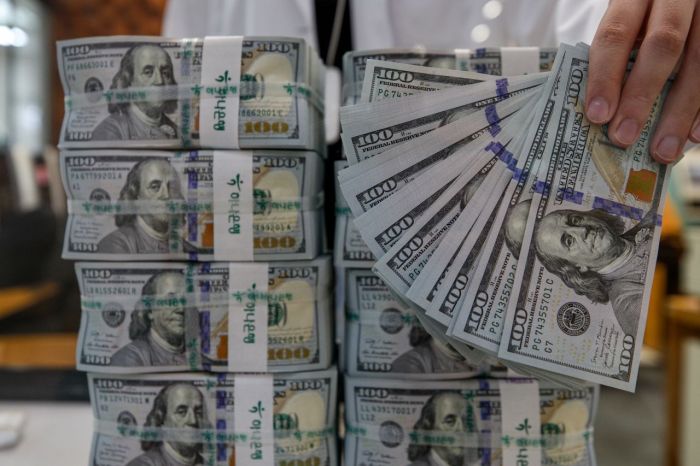 On the 14th, an employee is organizing dollars at the Hana Bank Counterfeit Response Center in Jung-gu, Seoul. Photo by Jinhyung Kang aymsdream@
Bloomberg's compiled dollar index fell 5.5% in 2020, while it rose 4.8% and 6.2% in 2021 and 2022, respectively.
Bloomberg analyzed, "In the fourth quarter, the dollar's value declined as expectations solidified that the Fed will significantly ease monetary policy next year, while central banks in other countries are expected to maintain high interest rates."
On the 13th, the Fed presented an expected year-end interest rate of 4.6% for next year in its Federal Open Market Committee (FOMC) regular meeting's dot plot. This is a reduction from the 5.1% announced in September. The current U.S. benchmark interest rate is 5.25?5.5%, indicating that about three rate cuts are anticipated next year. Traders expect the Fed to begin its first rate cut in March next year and lower rates by at least 150 basis points (1bp = 0.01 percentage points). The dollar has been falling more sharply since the December FOMC meeting.
Amanda Sundstrom, bond and foreign exchange strategist at SEB AB, Sweden's largest bank, explained, "The market believes the Fed can cut rates enough to stimulate the economy without reigniting inflationary pressures."
Meanwhile, the British pound and Swiss franc are moving in the opposite direction to the dollar. The pound has risen 5.9%, reaching its highest level since Brexit (the United Kingdom's exit from the European Union), and the franc has increased 9.7%, marking its highest level since 2010.
Jeffrey Yu, currency and macro strategist at Bank of New York Mellon (BNY Mellon), said, "If we were to identify the central bank most likely to intervene to depreciate its currency next year, it would be the Swiss National Bank (SNB). The pound will not aggressively chase higher levels until the Bank of England (BOE) clearly steps in."
© The Asia Business Daily(www.asiae.co.kr). All rights reserved.
!["The Woman Who Threw Herself into the Water Clutching a Stolen Dior Bag"...A Grotesque Success Story That Shakes the Korean Psyche [Slate]](https://cwcontent.asiae.co.kr/asiaresize/183/2026021902243444107_1771435474.jpg)
















