December and Annual Consumer Price Trends
The consumer price inflation rate in December was 3.2%, slightly easing from the previous month (3.3%). However, due to adverse weather conditions such as heavy snowfall, prices of agricultural products rose by 15.7% this month as well, continuing to burden the everyday shopping expenses of ordinary citizens. The annual inflation rate for this year was recorded at 3.6%.
According to the 'December and Annual Consumer Price Trends' released by Statistics Korea on the 29th, consumer prices this month rose 3.2% compared to the same month last year. It has remained in the 3% range for five consecutive months since August (3.4%). However, the inflation rate, which had risen to 3.8% in October, has been gradually easing in November (3.3%) and this month.
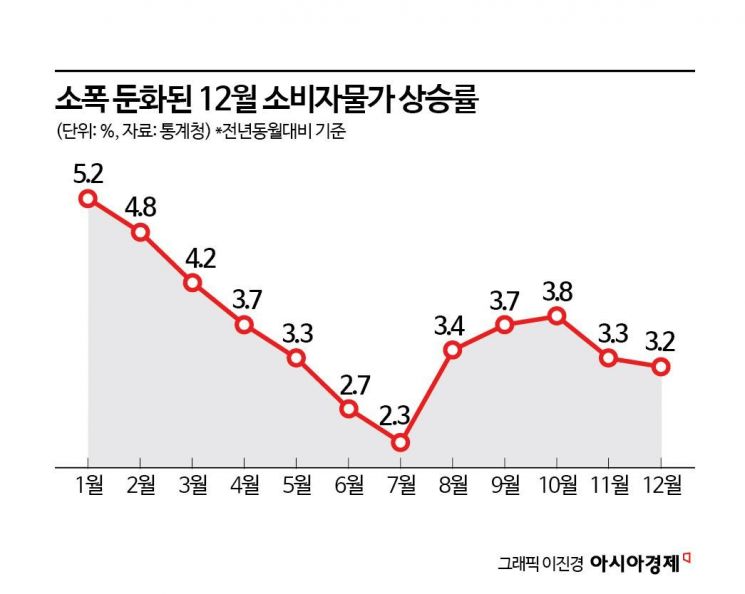
The slight easing of inflation compared to last month is influenced by prices of processed foods, industrial products, and others. The inflation rate for processed foods dropped from 5.1% in November to 4.2%. Kim Bo-kyung, Economic Trend Statistics Officer at Statistics Korea, explained, "The inflation rate decreased by 0.1 percentage points from the previous month due to a slowdown in processed foods and other industrial products (such as pet supplies and bags)." This was affected by the base effect from the significant price increases in these items last December. The Ministry of Economy and Finance evaluated, "Although agricultural product prices rose in December, prices of petroleum products, processed foods, and durable goods declined," adding, "Along with the base effect, the burden from raw material prices has eased, leading to an overall stabilization of prices."
Oil prices also showed a stable trend. International oil prices recently declined to the mid-$70 range per barrel of Dubai crude on the 27th, due to concerns over weak global demand and reduced likelihood of escalation in Middle East conflicts. Accordingly, the petroleum product index in December fell 5.2% compared to the same month last year. This decline has continued since September (-4.9%), October (-1.3%), and November (-5.1%). Officer Kim noted, "Diesel prices have recorded negative growth compared to the same month last year since March," adding, "Following -13.2% in November, December also recorded -14.5%. This appears to be influenced by the stabilization of international oil prices and government measures such as fuel tax reductions." The core inflation index, which excludes volatile food and energy prices and reflects the underlying inflation trend, rose by 2.8%, down 0.1 percentage points from November (2.9%). The living cost index was 3.7%.
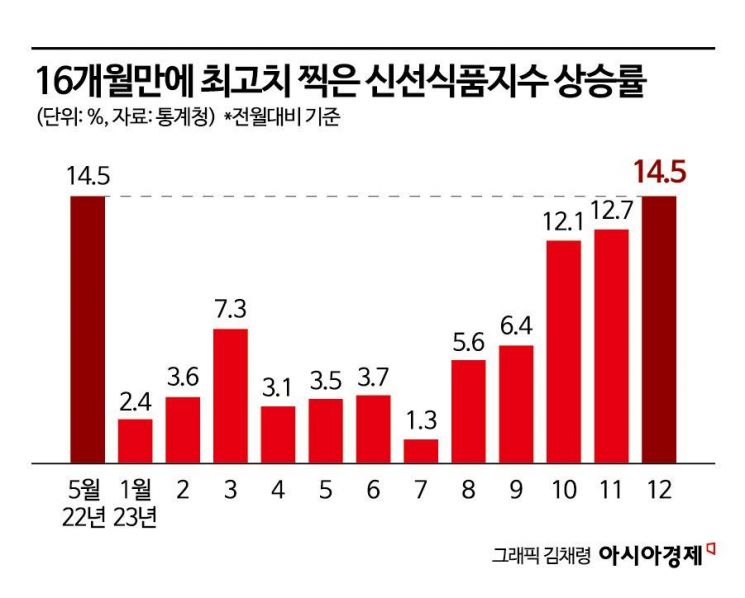
Agricultural product prices rose sharply again this month. Following an increase of 13.6% in November, prices rose 15.7% this month, leading the rise in prices of agricultural, livestock, and fishery products (which increased by 7.7%). Apples surged by 54.5%, and tomatoes by 45.8%. The significant impact was due to reduced production caused by adverse weather conditions. The fresh food index also recorded a high increase of 14.5% this month, the largest rise in 16 months since August 2021 (14.5%). Production decreased due to worsening weather conditions such as heavy rain and snowfall, and apples were affected by a reduction in cultivation area.
Annual Consumer Price Index at 3.6%... Agricultural Products Have Recorded Double-Digit Increases Since October
The annual consumer price index this year rose 3.6% compared to last year. Although this is a slowdown from the sharp increase last year (5.1%), it remains high compared to 2021 (2.5%). Prices for electricity, gas, and water rose 20.0% this year, driven by increases in electricity and city gas prices, leading the overall inflation. This is the largest increase in these categories since 2010, when related data began to be compiled, marking a 13-year high.
In particular, prices of agricultural, livestock, and fishery products rose 3.1%, centered on agricultural products (6.0%) and fishery products (5.4%). Since the second half of this year, agricultural product prices have remained high due to heatwaves in summer and abnormal cold temperatures in autumn. Prices rose in double digits for three consecutive months in October, November (14.7%), and December (15.7%). Notably, apples (24.2%), tangerines (19.1%), strawberries (11.1%), and green onions (18.1%) saw significant increases.
Prices of agricultural and fishery products are expected to remain unstable for the time being, continuing to burden the shopping expenses of ordinary citizens. Officer Kim predicted, "Although the government is expanding imports of fruits and other items, it is unlikely that prices will significantly drop within a month or two." A Ministry of Economy and Finance official said, "Due to changes in weather conditions, fruit prices continue to remain high," adding, "The government will make efforts to ease the price burden by importing additional small-sized fruits and others."
© The Asia Business Daily(www.asiae.co.kr). All rights reserved.

![Clutching a Stolen Dior Bag, Saying "I Hate Being Poor but Real"... The Grotesque Con of a "Human Knockoff" [Slate]](https://cwcontent.asiae.co.kr/asiaresize/183/2026021902243444107_1771435474.jpg)















