Jin Air Widens Gap in International Flights
Early Deployment of Large Aircraft and Focus on Medium- to Long-Haul Routes Prove Effective
T'way Air, which had been stuck at third place among low-cost carriers (LCCs), is now on the verge of rising to second place. This is attributed to a steady increase in international passengers. The plan to secure long-haul routes centered on large aircraft is being recognized for its success.
According to industry sources on the 29th, T'way Air is expected to secure second place this year. Both passenger numbers and revenue are projected to surpass Jin Air, which currently holds second place. According to the Ministry of Land, Infrastructure and Transport's Aviation Information Portal, T'way Air's passenger count from January to November this year was 9,071,249. This is about 97,000 more than Jin Air's passenger count during the same period.
The lead in international routes was crucial. During the same period, Jin Air had 310,099 more domestic passengers, but T'way Air surpassed Jin Air by over 400,000 in international passengers. Until February, T'way Air's international passenger numbers had not exceeded Jin Air's. However, since March, T'way Air has maintained a lead every month. The gap widened significantly in June, the start of the summer vacation season. In June, T'way Air's international passenger count was 433,554, which was more than 95,000 higher than Jin Air's 338,043. The gap between June and September alone reached 230,000.
Since revenue per passenger is higher, this also impacted performance. On a separate basis, T'way Air's revenue exceeded Jin Air's throughout the first to third quarters this year. According to financial information analysis firm FnGuide, the market forecast for fourth-quarter revenue estimates T'way Air at 320 billion KRW and Jin Air at 293 billion KRW. If this trend continues, T'way Air's annual revenue this year will reach 1.3101 trillion KRW, nearly 100 billion KRW more than Jin Air's 1.230 trillion KRW.
Expanding medium-to-large aircraft and focusing operations on profitable medium- to long-haul routes is seen as a successful strategy. This reflects the 'medium- to long-haul route differentiation' emphasized by T'way Air CEO Jeong Hong-geun since 2017. At the shareholders' meeting last March, CEO Jeong stated, "We will secure absolute competitiveness by expanding medium- to long-haul routes in the future."
Currently, as of the third quarter this year, T'way Air operates 30 aircraft, including three large A330-300 planes. Next year, they plan to add seven aircraft, including two large planes. A T'way Air official explained, "Before the end of the COVID-19 situation in February 2022, we became the first LCC to introduce large aircraft to prepare for endemic demand. We actively deployed large aircraft with over 300 seats on popular routes such as Japan and Bangkok, and also expanded medium- to long-haul routes, which had a positive effect."
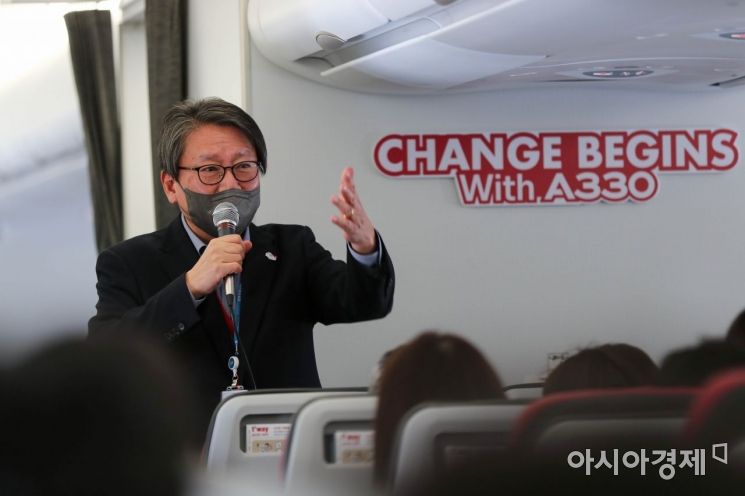 Jung Hong-geun, CEO of T'way Air, is answering questions from the press at the 'CHANGE BEGINS with A330' media day event commemorating the introduction of Airbus A330 aircraft, held on the 17th at the parking area of Gimpo International Airport in Gangseo-gu, Seoul. Photo by Airport Photographers Group
© The Asia Business Daily(www.asiae.co.kr). All rights reserved.

















