Failure to Overcome Maturity Crisis of Trillions in Borrowings
Financial Sector on Edge After Workout Fallout
Financial Authorities: "Responding with Reference to 'Contingency Plan'"
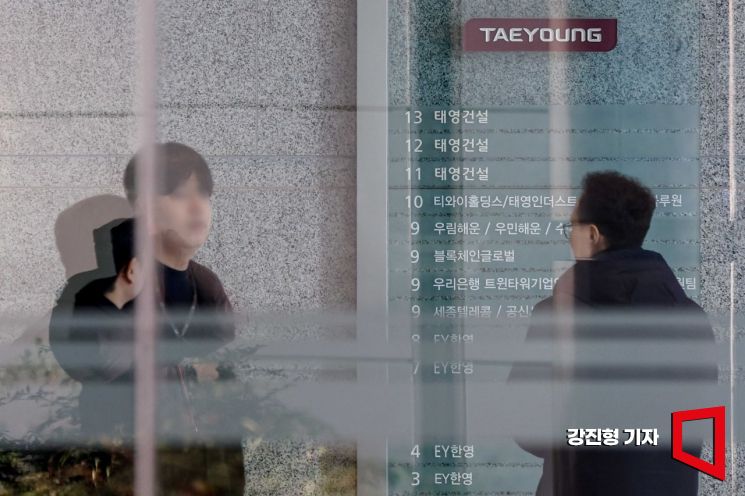 On the 28th, Taeyoung Construction, which is experiencing a liquidity crisis due to real estate project financing (PF), applied for a workout (corporate restructuring). The entrance of Taeyoung Construction headquarters in Yeongdeungpo-gu, Seoul. Photo by Jinhyung Kang aymsdream@
Mid-sized construction company Taeyoung Construction has ultimately filed for workout (corporate restructuring). Despite efforts to improve its financial situation through the sale of major assets amid various rumors of liquidity crises and bankruptcy, it failed to overcome the critical deadline for repayment of several hundred billion won in borrowings.
Financial authorities and the banking sector are closely monitoring the situation following Taeyoung Construction's workout application, paying close attention to the ripple effects on non-bank sectors such as securities firms and capital companies due to the real estate project financing (PF) defaults. In particular, financial authorities are reportedly sharing real-time updates on the actions of the main creditor bank, Korea Development Bank, and have begun drafting comprehensive measures related to PF.
According to financial circles and the Financial Supervisory Service on the 28th, as of the end of the third quarter this year, Taeyoung Construction's long-term borrowings from domestic banks amount to 469.3 billion won, and short-term borrowings total 225 billion won. The long-term borrowings include general funds, facility loans, and real estate PF loans, meaning that if the workout is confirmed, losses for the creditor group will be inevitable.
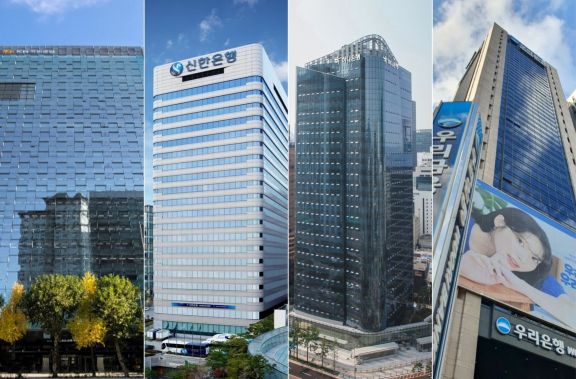
By bank, the main creditor bank Korea Development Bank holds 200.2 billion won, including 129.2 billion won in PF loans and 71 billion won in short-term borrowings. Following that, Kookmin Bank and Industrial Bank of Korea have lent 160 billion won and 99.7 billion won respectively. Woori Bank and Shinhan Bank have each provided loans of 72 billion won and 63.6 billion won. Hana Bank has also lent 61.9 billion won, including PF loans.
Since Taeyoung Construction has applied for workout, Korea Development Bank, as the main creditor bank, will lead the creditors' financial institution council. The council will discuss and decide on the workout within a month by obtaining the consent of 75% of creditors. During this process, restructuring measures such as debt moratoriums will be pursued, and financial institutions will have to bear losses on some claims.
A Korea Development Bank official stated, "Since the creditor group includes banks, secondary financial institutions, and individuals who purchased PF-asset-backed commercial papers (ABCP), it is expected to take some time to gather opinions." Another creditor bank official said, "Whether to recover some working capital loans treated as credit will depend on how the situation unfolds."
Financial authorities are closely watching the situation and acting urgently. On the 26th, a 'F(finance)4' meeting was held with the participation of Choi Sang-mok, Deputy Prime Minister and Minister of Economy and Finance nominee; Lee Chang-yong, Governor of the Bank of Korea; Kim Ju-hyun, Chairman of the Financial Services Commission; and Lee Bok-hyun, Governor of the Financial Supervisory Service, to discuss the impact and response measures for this crisis.
Financial authorities have been monitoring PF defaults as the biggest risk next year. Since Taeyoung Construction has applied for workout, there is a high possibility that related measures will be announced soon, as the aftershocks could include chain damage to subcontractors and credit tightening across the industry. However, a Financial Services Commission official explained, "Compared to the Legoland incident, the market itself has stabilized, and since Taeyoung Construction's unique problems played a major role, the likelihood of credit tightening similar to last year is low." He added, "Regarding the potential chain crises involving construction companies and subcontractors (partners), existing contingency plans are well prepared, and responses will be based on those."
The tension is also rising among financial institutions that do not hold Taeyoung Construction bonds. The capital sector, which has expanded its PF business instead of retail, must prepare for large-scale losses depending on the decisions of financial authorities and the creditors' council. A senior official at a mid-sized capital company analyzed, "If the real estate PF defaults become a reality due to Taeyoung Construction's workout, even bridge loan senior creditors will inevitably be affected. Large capital companies backed by financial holding companies or small capital companies focusing on installment and leasing businesses will endure, but others will suffer considerable damage."
© The Asia Business Daily(www.asiae.co.kr). All rights reserved.
![Clutching a Stolen Dior Bag, Saying "I Hate Being Poor but Real"... The Grotesque Con of a "Human Knockoff" [Slate]](https://cwcontent.asiae.co.kr/asiaresize/183/2026021902243444107_1771435474.jpg)

















