National Pukyong University·ASC·Korea Future Aquaculture Technology Research Association·AquaPro Agreement
Commitment to Collaborate on Expanding Eco-friendly and Responsible Aquaculture Market
Leading organizations in the domestic and international aquaculture sector have joined hands to promote and advance sustainable aquaculture technology for the future of South Korea.
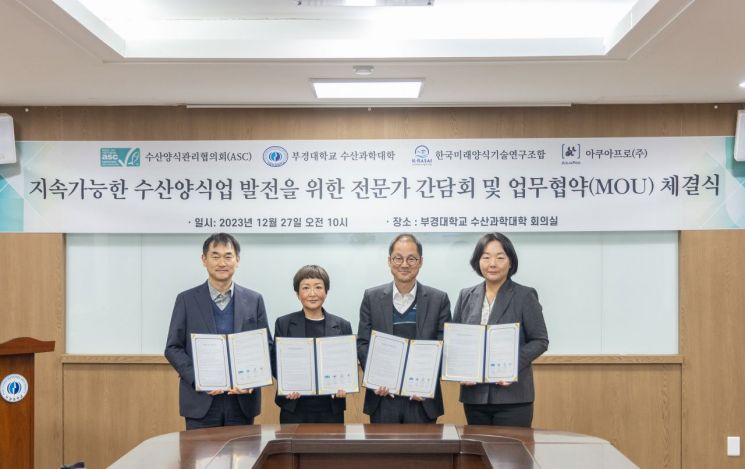 (From left) Lee Suyong, Head of ASC Korea Office, Park Miseon, Chairperson of Korea Future Aquaculture Technology Research Association, Park Wongyu, Dean of the College of Fisheries Science at Pukyong National University, and Yoon Jihyun, CEO of Aquapro, are posing for a commemorative photo after signing an agreement.
On the 27th, the College of Fisheries Sciences at Pukyong National University, ASC (Aquaculture Stewardship Council), the Korea Future Aquaculture Technology Research Association, and Aquapro held a multilateral agreement ceremony in the conference room of the College of Fisheries Sciences at Pukyong National University to spread sustainable aquaculture technology.
This agreement was established to promote the dissemination of sustainable aquaculture technology for the future of the domestic aquaculture industry, collaborate to improve the quality and expand the market of responsibly farmed aquatic products for the environment and society, and to promote ASC aquaculture certification.
Through this agreement, Pukyong National University, a leading national university specializing in fisheries and marine sciences in South Korea; ASC, an international aquaculture certification organization headquartered in the UK and the Netherlands that promotes the market expansion of sustainable seafood; the Korea Future Aquaculture Technology Research Association, a technology network for aquaculture transformation using smart farm and digital technologies; and Aquapro, the first domestic company to succeed in flatfish farming using a recirculating aquaculture system (RAS), will expand their cooperation.
Recently, as sustainable seafood production that fulfills environmental and social responsibilities has spread worldwide, the use of technologies such as traceability, high-efficiency and low-fishmeal compound feed, recirculating aquaculture systems (RAS), and restrictions on the use of chemicals and antibiotics has increased. With the expansion of ASC certification in European salmon farming and high-value fish farming in Japan, the organizations that signed the agreement on this day are working to strengthen their cooperation.
Specific areas of cooperation include ▲producer education and promotion ▲collaboration to improve market access and expansion for ASC-certified aquaculture products ▲raising consumer awareness of the necessity of sustainable seafood ▲spreading consumption culture and joint promotional activities ▲expanding environmentally friendly compound feed and developing and sharing smart aquaculture technologies.
Prior to the agreement ceremony, a roundtable meeting was held with representatives from the signatory organizations, the National Institute of Fisheries Science, and the Jeju Marine and Fisheries Research Institute, where key issues related to sustainable aquaculture were presented. Discussions were also held on measures to improve current aquaculture practices, which involve excessive resource consumption and disregard for safety, environmental, and social responsibilities.
© The Asia Business Daily(www.asiae.co.kr). All rights reserved.

















