'K-Joseon Supergap Technology Alliance' Launch
"Support for Entire Demonstration Project Needs Reassessment"
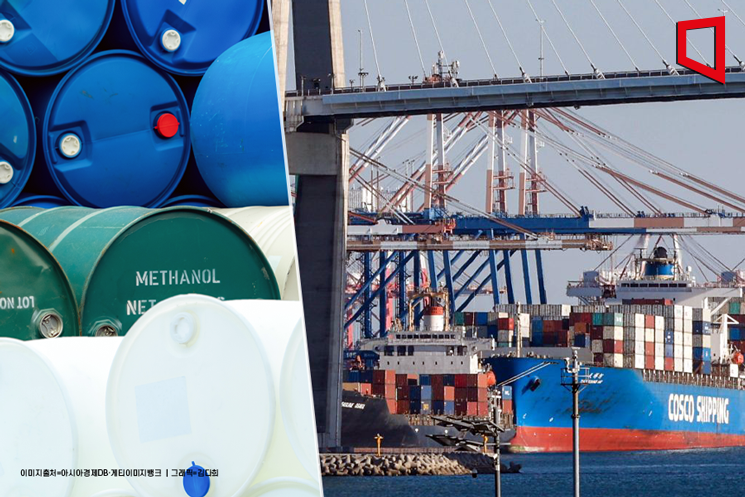
Executives in charge of technology at Korea's top three shipbuilders?HD Hyundai, Samsung Heavy Industries, and Hanwha Ocean?have identified the activation of eco-friendly ships as the core of their technological super-gap and have called on the government to ease demonstration regulations. In a situation where the dominance of eco-friendly ship fuels such as ammonia, methanol, and hydrogen cannot be predicted, various demonstration projects are essential, but regulations that do not reflect reality are holding back shipbuilders who are racing against time.
On the 27th, Lee Hyun-ho, head of the Ship and Offshore Research Institute at HD Hyundai Heavy Industries, met with reporters right after the launch ceremony of the ‘K-Ship Super-Gap Technology Alliance’ held at the Conrad Hotel in Yeongdeungpo-gu, Seoul. He said, "At first, methanol-powered ships seemed likely to dominate, but the market is not necessarily going that way," adding, "There are still not many shipping companies that can supply methanol." He continued, "If liquefied natural gas (LNG) ships were the trend, we would only need to develop LNG-related technology, but the reality is that we also have to research other eco-friendly ship fuels such as methanol, ammonia, and hydrogen," and lamented, "Under limited manpower conditions, responding to eco-friendly transitions makes it most difficult to decide how to structure the portfolio and where to set priorities."
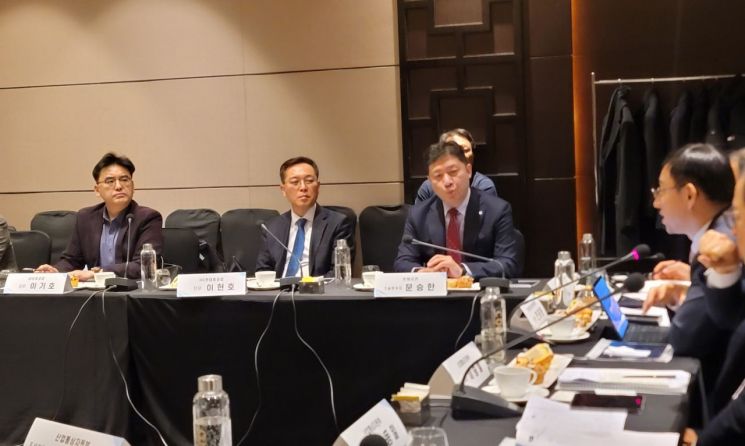 At the launch ceremony of the 'K-Shipbuilding Supergap Technology Alliance' held on the 27th at the Conrad Hotel in Yeongdeungpo-gu, Seoul, (from left) Lee Ho-gi, Head of Samsung Heavy Industries Eco-friendly Research Center, Lee Hyun-ho, Head of HD Hyundai Heavy Industries Ship and Offshore Research Institute, and Moon Seung-han, CTO of Hanwha Ocean Merchant Ship Technology Headquarters, are attentively listening to the remarks of Jeon Yoon-jong, President of the Korea Institute for Advancement of Technology.
 [Photo by Choi Seo-yoon]
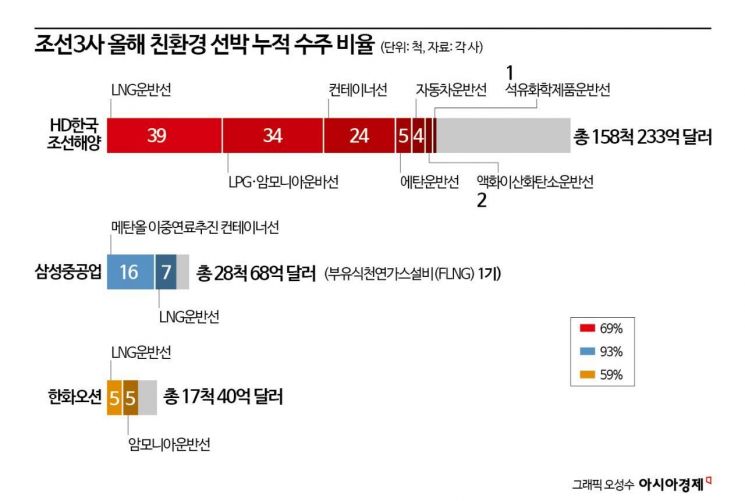
Eco-friendly ships are considered the core of Korea's shipbuilding industry's super-gap strategy. However, since eco-friendly fuels are diverse and the demands of customers ordering ships are complicated, it is not realistic to focus on just one technology. In fact, the world's third-largest French shipping company CMA CGM recently changed the propulsion fuel of eight dual-fuel container ships ordered in China from methanol to LNG.
Shipbuilders emphasize that regulations at the demonstration stage must be eased to fully commit to developing eco-friendly ships. Lee Ho-gi, head of the Eco-friendly Research Center at Samsung Heavy Industries, who attended the event, said, "Demonstrations of eco-friendly ships such as ammonia ships can only be conducted in regulatory free zones," adding, "The super-gap roadmap must include regulatory easing to prevent being held back by regulations when demonstrating new technologies." Lee Hyun-ho also stressed the need for regulatory easing, saying, "It is important to immediately reflect the opinions of shipping companies when demonstrating eco-friendly technologies."
Not only eco-friendly fuels but also supply chain stability and localization of equipment were cited as important tasks. Moon Seung-han, CTO of Hanwha Ocean's Merchant Ship Technology Headquarters, said that demonstration projects in the equipment sector must be fully supported. Moon said, "The part that the shipbuilding industry should pay close attention to is equipment," adding, "We are conducting demonstration work with various material, parts, and equipment companies for localization, but there are many cases where problems arise when the products are actually commercialized and installed on ships." He added, "As a result, small and medium-sized material and parts companies face management difficulties," and said, "Support for the entire demonstration project needs to be re-examined."
Lee Hyun-ho also said, "While the transition to eco-friendly fuels is important, carbon neutrality can only be achieved by completing the entire value chain, including engines, fuel supply systems, supply chains, and after-sales services," and added, "Next year, we plan to pay more attention to stabilizing the supply chain."
The Tech Alliance launch ceremony was attended by 20 participants from the three shipbuilders, the Ministry of Trade, Industry and Energy, and related academia, industry, and government sectors. The Tech Alliance, composed of three divisions?future eco-friendly ships, digital transformation, and smart autonomous navigation?with 12 members each, plans to prepare a super-gap technology roadmap by the end of March next year. A shipbuilding industry official said, "Currently, only suppliers are part of the alliance, and actual customers such as shipping companies and shipowners are not included," adding, "It is regrettable that the entities who will use eco-friendly ships do not have the opportunity to request 'please do this' and discuss it."
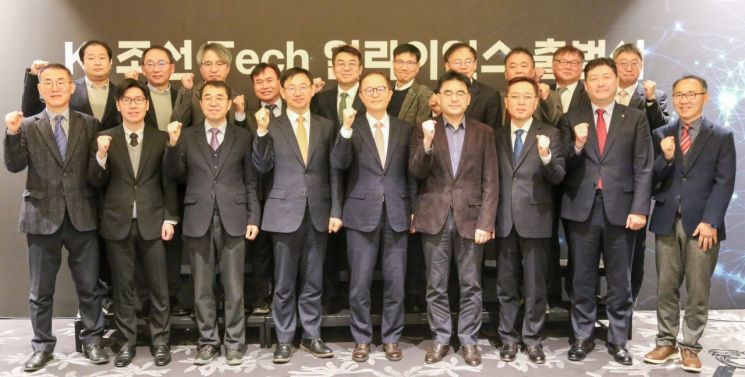 At the launch ceremony of the 'K-Shipbuilding Supergap Technology Alliance' held on the 27th at the Conrad Hotel in Yeongdeungpo-gu, Seoul, industry-academia-research-government officials are taking a commemorative photo.
 [Photo by Ministry of Trade, Industry and Energy]
© The Asia Business Daily(www.asiae.co.kr). All rights reserved.
![Clutching a Stolen Dior Bag, Saying "I Hate Being Poor but Real"... The Grotesque Con of a "Human Knockoff" [Slate]](https://cwcontent.asiae.co.kr/asiaresize/183/2026021902243444107_1771435474.jpg)













