Two Dead in Fire at Banghak-dong Apartment
Initial Reporter Confirms 'Fire Death' in First Autopsy
Police and Firefighters Conduct Joint On-Site Investigation from Morning of 26th
On Christmas Day, December 25, the initial autopsy results revealed that the causes of death for two people who died in a fire at an apartment in Banghak-dong, Dobong-gu, Seoul, were 'death from falling' and 'death from fire,' respectively.
On the 26th, the police announced that the cause of death for Park (32), a resident on the 4th floor who died while saving his two children, was "multiple blunt force injuries due to a fall," and the cause of death for Lim (38), who was found dead on the emergency stairs on the 11th floor, was "death from fire due to inhalation of smoke." They were victims while escaping a fire that broke out on the 3rd floor of an apartment in Banghak-dong in the early morning of the 25th.
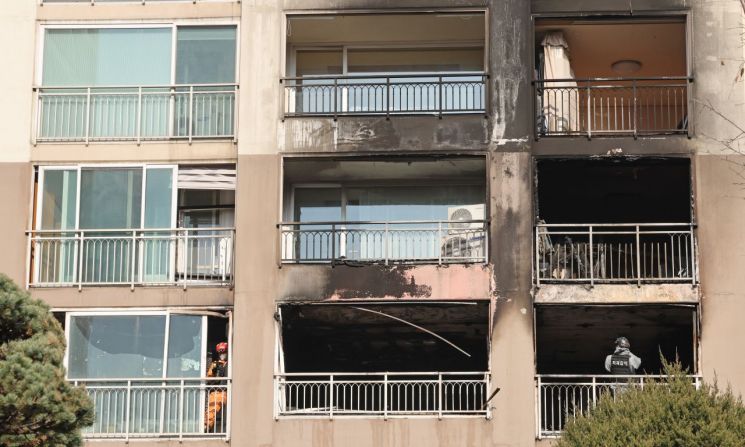
Park, who lived on the 4th floor directly above the fire-affected unit, is understood to have died while trying to save his two daughters, aged 0 and 2, along with his wife Jeong (34). Park threw his eldest daughter onto a pile of recycling bags stacked by security guards and then jumped down holding his 7-month-old second daughter in his arms. Jeong reportedly jumped down afterward. During this process, Park fell sideways and hit his head on the ground, resulting in his death. Jeong sustained injuries to her shoulder and other areas and was taken to the hospital for treatment, while their two children are reported to be out of danger.
Lim was the first person to report the fire to 119 and was found in cardiac arrest on the stairs of the 11th floor. It is reported that he evacuated his family members who were living with him first and then moved upward to escape the flames but died from smoke inhalation. The fire resulted in two deaths, one serious injury, and 28 minor injuries. The police and fire authorities began an on-site investigation at 11 a.m. on the 26th. A police official stated, "We plan to identify the exact ignition point and cause in unit 301," adding, "It is difficult to predict how long the investigation will take."
Essential Evacuation Methods During Apartment Fires
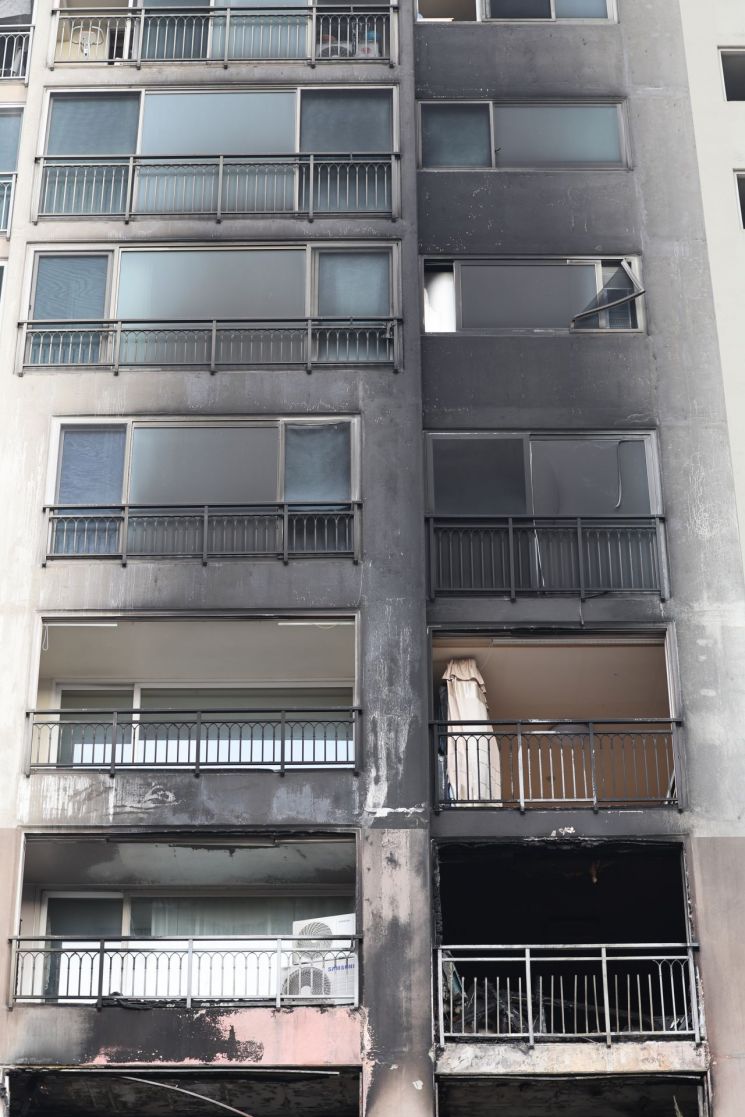 On the early morning of Christmas, a fire broke out in a high-rise apartment in Dobong-gu, Seoul, resulting in the deaths of two people. On the 26th, traces of the fire remained.
 [Photo by Yonhap News]
Apartments house the majority of the population and, due to their structure and environment, have a higher risk of fire compared to other facilities. Most casualties during fires occur due to smoke (flames) during evacuation. Since apartments are collective residential spaces with many residents living together, it is crucial to know the correct evacuation methods during a fire. Many people vaguely think that they can just evacuate outside when a fire breaks out, but in urgent situations, they may fail to find evacuation routes or respond appropriately.
According to the Fire Department's evacuation safety measures, there are four types of responses during an apartment fire. First, if a fire occurs in your own unit, you should use the stairs to evacuate to a safe place such as the ground floor or rooftop while staying low. When evacuating, always close the door behind you and use the stairs instead of the elevator. It is especially important to press the emergency bell and report the fire to 119 quickly to alert others.
If evacuation is difficult, move to designated evacuation spaces, lightweight partitions, or downward evacuation devices (emergency escape devices) and wait there. If such spaces are not available, move away from flames or smoke, close the door, block gaps with wet towels to prevent smoke from entering, and wait for rescue. If a fire occurs in another unit or area of the apartment, and flames or smoke have not yet entered your unit, it is necessary to stay put and monitor the situation. Close windows to prevent smoke from entering and follow 119 reports and announcements.
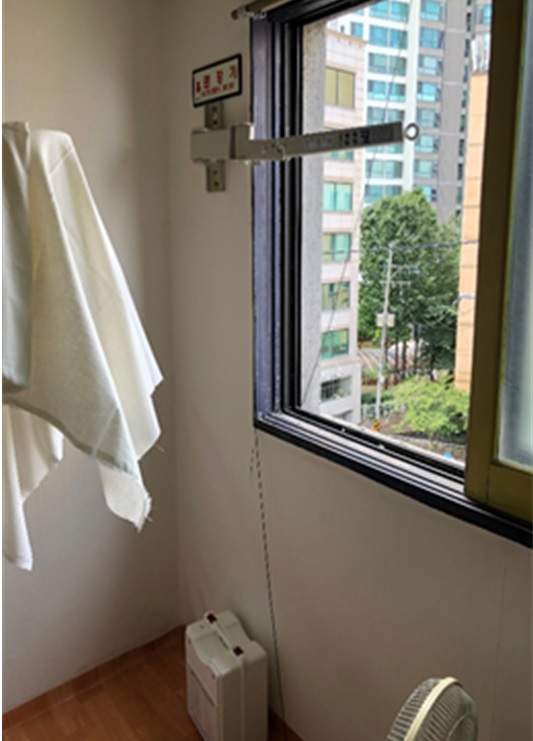 The descender should be hooked onto the support ring, and the support should be extended out the window before throwing the rope. Then, fasten the descender belt around the chest and tighten it. After that, you can go out the window and descend by holding onto the wall.
 [Photo by Asia Economy DB]
If flames or smoke enter your unit, move to accessible corridors or stairs for evacuation. If it is difficult to evacuate outside, move to evacuation spaces, lightweight partitions, or emergency escape devices within the unit. If even this is not possible, move away from flames or smoke, close the door, block gaps with wet towels, and wait for rescue. Especially for homes equipped with emergency escape devices, keep the components near the window and learn how to use them in advance.
The emergency escape device works by hooking the device's ring onto a support hook, extending the support outside the window, and then throwing the rope down. Then, wear the escape belt at chest height, tighten it, and descend by holding onto the wall outside the window. For high-rise apartments, there are designated evacuation floors, so knowing these floors in advance can be helpful during a fire.
© The Asia Business Daily(www.asiae.co.kr). All rights reserved.



















