46th Korea Industry Federation Forum... 2024 Industrial Economy Diagnosis
"Large Enterprise Employment Share 13.9%... OECD Average 30.6%"
"Galapagos-style Regulatory Improvements Including Large Enterprise Group Designation System"
Jung Manki, Vice Chairman of the Korea International Trade Association and Chairman of the Korea Industrial Federation Forum, stated on the 27th, "The birth rate among workers in large corporations is 1.4 times higher than that of small and medium-sized enterprises (SMEs), but the proportion of employees in large corporations is only 13.9% of the total, which is lower than the OECD average of 30.6%," and argued, "To restore the birth rate, we need to build a favorable business environment."
Vice Chairman Jung made these remarks at the 46th Industrial Development Forum held at the Trade Tower in Samseong-dong, Gangnam-gu, Seoul. The Industrial Federation Forum is an organization composed of 17 industry groups including semiconductors and batteries. Jung said, "To restore the birth rate, SMEs should grow into large corporations, and large corporations should grow into global corporations by building a good business environment."
He added, "If we improve Galapagos-like regulations such as the designation system for large business groups, the SME suitable industry system, the uniform 52-hour workweek system, the fixed-term employment law allowing non-regular workers for a maximum of two years, the prohibition of manufacturing dispatch, and the Chemical Substances Control Act and Chemical Safety Act, we will be able to provide our companies with a business environment at least equal to that of major competing countries."
He predicted that next year, Korea will recover its export performance and achieve a large trade surplus, focusing on the information and communication technology (ICT) sector and the Chinese market. However, he emphasized that support for future industries such as semiconductors, secondary batteries, and electric vehicles must continue due to high uncertainties caused by ongoing US-China conflicts, accelerated carbon neutrality policies, international political instability due to changes in major countries' political leadership, and continued armed conflicts between countries. Vice Chairman Jung said, "We need to promote the extension of tax credits for future industry facilities and R&D investments and provide production subsidies until 2030."
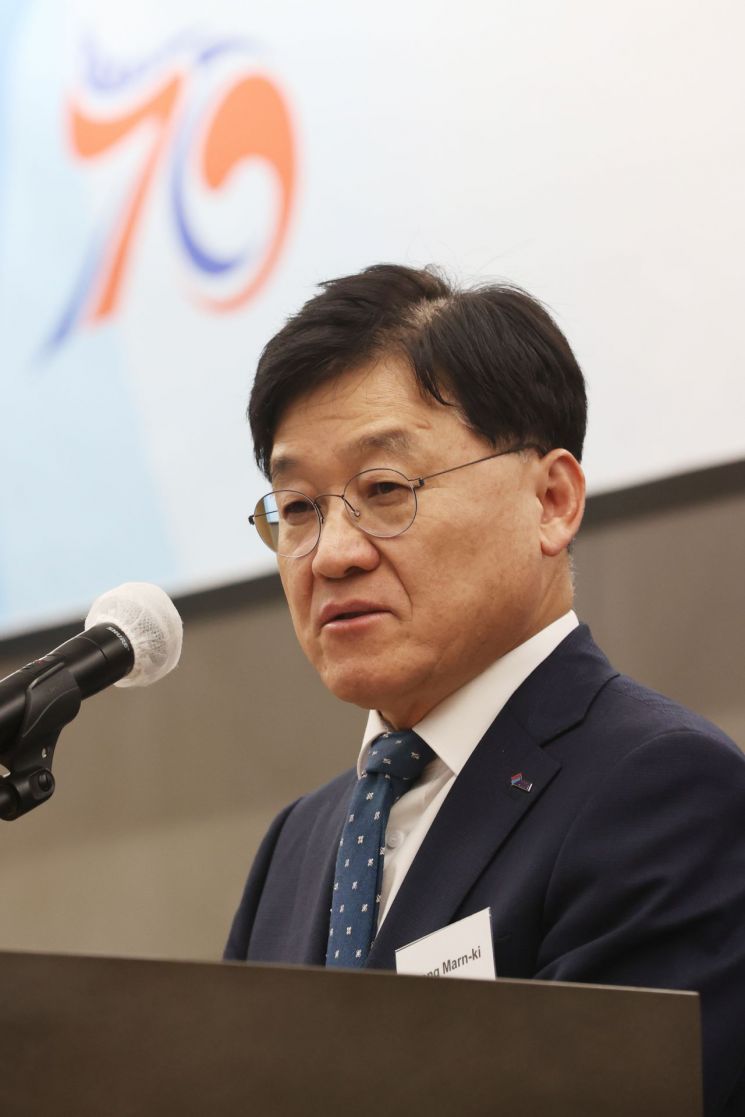 Jung Manki, Vice Chairman of the Korea International Trade Association and Chairman of the Korea Industrial Federation Forum.
 Photo by Yonhap News
The Korea Institute for Industrial Economics and Trade forecasted a 2% growth in exports next year. Park Seong-geun, head of the Trend Analysis Office at the Korea Institute for Industrial Economics and Trade, said, "Next year, our economy is expected to grow by 2.0% as exports recover with an increasing trend while domestic demand growth slows down," adding, "As the semiconductor market gradually recovers, improvements are expected to continue into the second half of the year."
Park suggested that responses to paradigm shifts in the automobile industry, expanded support related to the transition to low-carbon steel products, diversification of fuel types and crude oil import sources and business diversification into non-petroleum sectors, promotion of downstream strategies in the petrochemical industry, increased investment in eco-friendly and high value-added materials in the textile industry, preparation of response strategies to major countries' semiconductor policies, responses to strengthened battery requirements under the Inflation Reduction Act (IRA), and development of display materials, parts, and equipment technologies are necessary.
The Korea International Trade Association forecasted that the global economic growth rate will remain in the high 2% range and global trade will maintain a low growth trend in the low 3% range next year. It predicted that Korea's exports will increase by 7.9% from the previous year to reach $680 billion (approximately 882 trillion won). Hong Ji-sang, a research fellow at the Korea International Trade Association, said, "Export conditions will not improve significantly due to the continued slowdown in growth in major advanced consumer markets such as the United States and the European Union (EU), as well as China, Korea's largest export market," but added, "There are also factors for economic recovery such as the possibility of US interest rate cuts and additional economic stimulus measures in China."
© The Asia Business Daily(www.asiae.co.kr). All rights reserved.

















