Controversy Over Resident Complaints Asking to Stop Stair Exercise
Electricity Fee of 1 Won Charged for Turning Sensor Light On 1000 Times
The public's opinion is divided over a complaint from a resident in the same building demanding additional electricity fees from another resident who was exercising by climbing stairs.
On the 24th, various online communities shared a story titled "Electricity usage caused by exercising using stairs within an apartment building."
 A resident who was exercising by repeatedly walking up and down the stairs received a complaint from a fellow resident in their 60s in the same building, demanding additional payment for electricity bills. The photo is not related to the specific content of the article. [Photo by Pixabay]
The author, Mr. A, introduced himself as living in a 12-story apartment and explained, "For the past 4 to 5 months, I have been doing walking exercise by repeatedly walking up from the 1st to the 12th floor and taking the elevator down. It is a total of 5 rounds."
However, on the 23rd, while Mr. A was taking the elevator to do his stair exercise, he encountered Mr. B, a resident in his 60s living in the same apartment. Mr. B asked, "Do you exercise every day?" When Mr. A answered yes, Mr. B immediately pointed out, "It doesn't seem right to cause the sensor lights to turn on when you climb the stairs for your exercise and to use the elevator on the way down, thereby generating electricity costs."
Mr. A rebutted, "I live on the 1st floor but also pay for the shared electricity fees. That's why I use the elevator." After hearing this, Mr. B said, "Do residents on the 1st floor also pay elevator usage fees? I will go to the management office to discuss this issue," and then left. However, the next day, Mr. A met a management office staff member not because of the elevator usage fee but due to a complaint about the sensor light activation.
The staff member told Mr. A, "Mr. B came to the management office and filed a complaint for over an hour. He said it was a problem that you exercise on the stairs and use the elevator while turning on the sensor lights." The staff member added, "The stairs are a shared space, and since you also pay for the shared electricity fees, there is no problem. I told Mr. B that we can only warn or caution residents about such issues."
Mr. B claimed that Mr. A's stair walking exercise was an act of 'unjust enrichment.' He argued that exercising for health in a shared space constitutes unjust enrichment. The staff member advised Mr. A, "He filed the complaint very strongly, so I had to come. If you plan to continue exercising, how about doing it in the adjacent line?"
After finishing the conversation with the management office staff, Mr. A was cooling off at home when Mr. B came to see him shortly after. Mr. B asked, "Did you hear what the management office said?" Mr. A replied, "I also pay shared electricity and elevator usage fees. I don't think I have caused any harm." Then, Mr. B scolded him, saying, "So you plan to continue? Young people have no manners. When an elder speaks, shouldn't you just agree?"
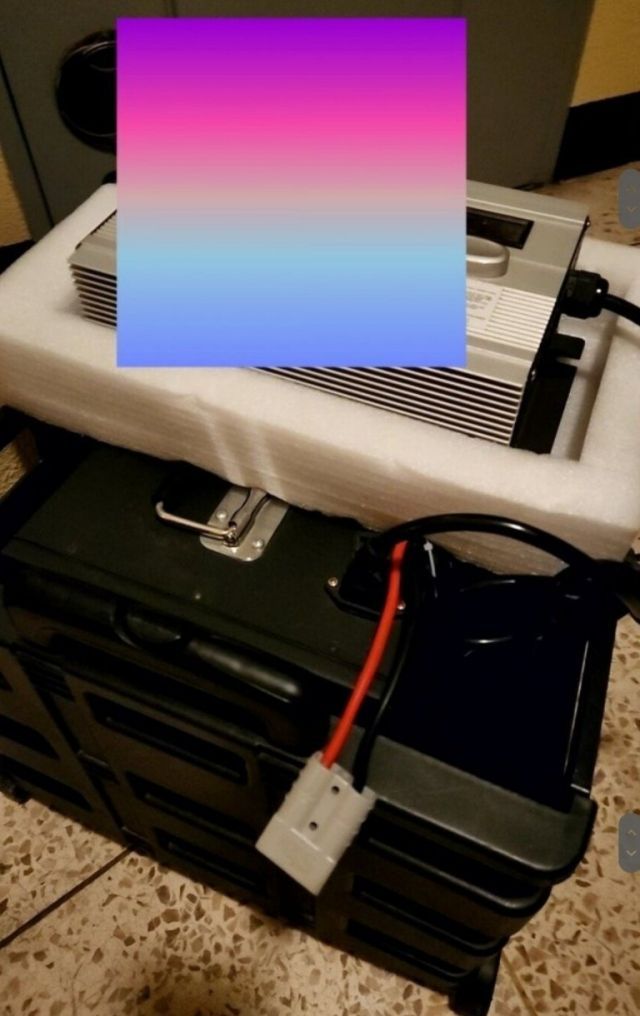 Mr. B, who filed the complaint, is charging an electronic device that appears to be a type of battery in front of his house. The gradient at the top seems to be a measure to obscure the brand.
 [Photo by Online Community]
Feeling that the conversation might escalate into an argument, Mr. A ended it by saying, "I have nothing more to say." He concluded, "While it may feel unfair that additional electricity costs arise because of me, I think this level of activity is acceptable compared to the electricity fees I pay. Do I really have to pay extra for the electricity generated by using the stairs?" He added, "If another complaint is filed, I plan to file a counter-complaint against Mr. B for violating fire safety laws. Mr. B is always charging something in front of his house; if anyone knows about this, please let me know."
Mixed Reactions from Netizens to the Story
Netizens' reactions to Mr. A's story were divided. Many felt that since the stairs are a shared space and climbing them does not cause significant damage, Mr. B's reaction was an overreaction.
First, sensor lights are generally known to incur about 1 won (Korean currency) in electricity costs after being turned on approximately 1,000 times. According to an analysis by the Korea Energy Agency, a 40Wh standard bulb requires an additional 0.0137Wh of power each time it is turned on. Considering that the electricity rate per kWh (1000Wh) exceeds 100 won, each time Mr. A triggers the sensor light, it results in about 0.001 won of additional electricity cost. Even if Mr. A turns the sensor lights on and off all day while going up and down the stairs, the actual additional electricity cost is negligible.
On the other hand, some argued that since the primary purpose of apartment stairs is not exercise, such use should be discouraged. One netizen said, "Demanding electricity fees for sensor lights or elevators is excessive, but repeatedly going up and down the stairs can cause noise from stomping footsteps." Another netizen wrote, "Regardless of electricity fees, repeatedly using the elevator from the top floor to the 1st floor for exercise purposes can cause inconvenience to other residents."
One netizen speculated that the electronic device Mr. B was charging in a photo might be a 'large-capacity battery' and advised that Mr. A should be the one to raise the issue.
© The Asia Business Daily(www.asiae.co.kr). All rights reserved.



















