Use of the term 'Lunar New Year'
The United Nations (UN) has officially designated the 'Lunar New Year' as a public holiday.
On the 24th, according to reports from the Hong Kong South China Morning Post (SCMP) and others, at the 78th UN General Assembly meeting held on the 22nd (local time), a resolution to designate the 'Lunar New Year' as a 'floating holiday' was adopted unanimously. This means that the Lunar New Year has become the eighth optional holiday that UN staff worldwide can celebrate throughout the year.
Previously, the UN had designated the Jewish holiday Yom Kippur, Buddha's Birthday, the Hindu festival Diwali, the Sikh festival Gurpurab, Orthodox Christmas, Orthodox Good Friday, and the Persian New Year festival Nowruz as 'floating holidays.'
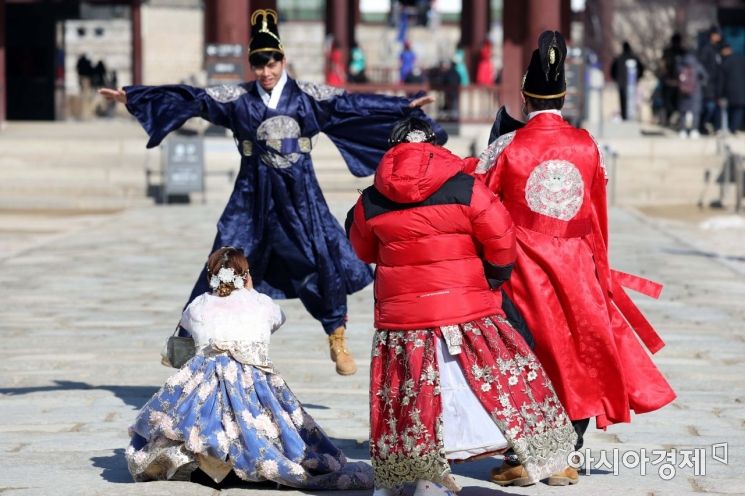 On the last day of the Lunar New Year holiday, foreigners wearing hanbok are enjoying their time at Gyeongbokgung Palace in Jongno-gu, Seoul. Photo by Moon Honam munonam@
According to UN regulations, staff can have nine fixed holidays and floating holidays throughout the year. During these periods, UN agencies refrain from holding meetings, so official meetings will no longer be held during the Lunar New Year.
In a statement posted in Chinese, the UN said, "The designation of the Lunar New Year as a UN holiday has long been a concern for our Chinese staff," adding, "Some Chinese staff proposed using the term 'Lunar New Year' instead of 'Chinese New Year' to gain support from other Asian countries." The Lunar New Year is celebrated as a traditional holiday not only in Korea and China but also in several Asian countries such as Vietnam and Indonesia.
Dai Bing, Deputy Permanent Representative of China to the UN, claimed through the Chinese Permanent Mission to the UN website that "this decision reflects the influence of Chinese culture." He said, "Chun Jie (Spring Festival, the Chinese name for Lunar New Year) is a traditional holiday when families gather and welcome the new year, and it embodies the ideals of Chinese civilization such as peace and harmony, family unity, social inclusion, and harmonious coexistence between humans and nature, which are universal values of humanity." He added, "Many countries and regions have already designated the Lunar New Year as a legal public holiday, and one-fifth of the world's population celebrates Chun Jie in various forms."
The Chinese Communist Party's official newspaper, the People's Daily, published an article titled "Chun Jie Heading to the World, The World Embracing Chun Jie" on the front page of its issue on the 24th. The article claimed, "Today, the influence and dissemination of Chinese culture are increasing day by day," and "Chun Jie is continuously spreading worldwide, and the world warmly embraces Chun Jie."
Previously, the UN caused controversy by using the term 'Chinese Lunar Calendar' on Lunar New Year commemorative stamps issued last year and again this year. Seo Kyung-deok, a professor in the Department of Liberal Arts at Sungshin Women's University and an advocate for protecting Korean culture, raised issues not only with the UN but also with Nike and Apple for referring to the Lunar New Year as 'Chinese New Year' on their online accounts and urged them to correct this.
China continues to insist on the term 'Chinese New Year' despite the Lunar New Year being a common cultural event not only in China but across Asian countries. The phrase 'Chinese New Year' was also used during the opening ceremony of the 2022 Beijing Winter Olympics, and Chinese netizens have launched malicious comment attacks against individuals like Professor Seo who demand correction of the 'Chinese New Year' labeling.
© The Asia Business Daily(www.asiae.co.kr). All rights reserved.

















