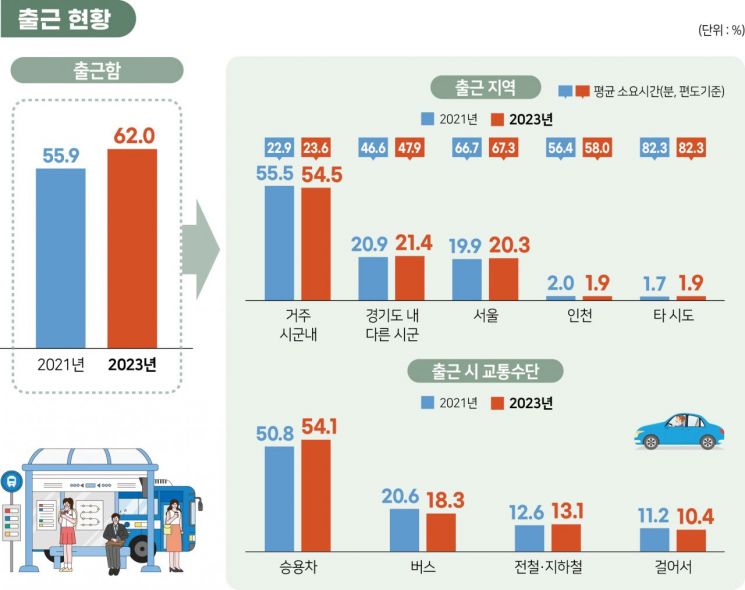
The average commute time for residents of Gyeonggi Province is 39 minutes, while commuting to Seoul takes about 1 hour and 7 minutes, approximately 1.7 times longer.
Gyeonggi Province announced the results of the "2023 Gyeonggi Province Social Survey" on the 24th, which was conducted from September 1 to 15. The survey targeted 62,257 individuals aged 15 and older from 31,740 households within the province, covering six areas: welfare, housing and transportation, culture and leisure, education, income and consumption, and jobs and labor.
The survey found that 6 out of 10 residents aged 15 and older commute to work, with 54.5% commuting within their residing city or county. Commuting to other cities or counties within the province accounted for 21.4%, and commuting to Seoul was 20.3%.
The average commute time was 39 minutes. Commuting within the residing city or county took an average of 24 minutes, commuting to other cities or counties within the province took 48 minutes, and commuting to Seoul took 1 hour and 7 minutes.
By age group, commuting within the residing city or county was the highest across all age groups. Commuting to Seoul was more common among those in their 30s (25.2%) and 20s (23.7%). As age increased, commuting to Seoul decreased, while commuting within the residing city or county increased.
By city or county, the highest proportions of commuting within the residing city or county were in Yeoncheon (89.4%), Yeoju (86.3%), and Gapyeong (85.8%). The highest proportions commuting to other cities or counties within the province were Osan (47.5%), Uiwang (44.7%), and Gunpo (38.5%).
Conversely, the city or county with the highest proportion commuting to Seoul was Gwacheon (50.1%), followed by Gwangmyeong (46.9%), Hanam (45.9%), and Guri (42.2%).
The primary mode of transportation for commuting was private car (54.1%), accounting for more than half, followed by public transportation: bus (18.3%) and subway/metro (13.1%).
The cities or counties with the highest public transportation usage rates, including buses and subways, were Gwacheon (50.4%), Seongnam (46.8%), Gwangmyeong (45.7%), Anyang (44.2%), and Bucheon (42.4%).
By age, teenagers (75.2%) and those in their 20s (53.5%) primarily used buses and subways for commuting, while those aged 30 and above had higher rates of commuting by private car.
Regarding satisfaction with public transportation, 34.4% of city and village bus users reported being satisfied. The most common reasons for satisfaction were the provision of bus arrival information at stops (68.0%) and fare discounts through transfer discounts (52.2%).
Gyeonggi Province plans to use the results of this survey as basic data for policy formulation in the province and its 31 cities and counties.
© The Asia Business Daily(www.asiae.co.kr). All rights reserved.

















