"The inscription of the Gaya Tumuli as a World Heritage Site, which proved the existence of the ancient state of Gaya, calls for efforts to redefine ancient history as the Four Kingdoms Period."
Hong Taeyong, mayor of Gimhae City, Gyeongnam Province, said this at the Gyeongnam Gaya Tumuli World Heritage inscription ceremony held at Haman Gymnasium on the 21st.
 Hong Tae-yong, mayor of Gimhae City, Gyeongnam, attended the commemorative ceremony for the inscription of the Gaya Tumuli in Gyeongnam as a World Heritage Site.
 [Photo by Lee Se-ryeong]
Mayor Hong said, "Gyeongnam Province and local governments worked together to have the Gaya Tumuli designated as a world cultural heritage site after more than 10 years, and we received the official certificate last month," adding, "The steps to preserve Gaya history and to redefine history are just beginning now."
"While reexamining Gaya history, efforts to reorganize ancient history are also necessary," he emphasized, "Now, the ancient states should change from the Three Kingdoms of Goguryeo, Baekje, and Silla to the Four Kingdoms including Gaya."
He continued, "I hope that related local governments will work together to preserve the Gaya Tumuli, including Daeseong-dong in Gimhae, and to revitalize Gaya history research, continuing new challenges until the day when not only the Gaya Tumuli but the entire Gaya cultural heritage is inscribed as a World Heritage Site."
Gaya was an ancient state that flourished with iron culture in the southern part of the Korean Peninsula from the 1st century BCE to the 5th century CE.
It coexisted with Goguryeo, Baekje, and Silla, but due to a lack of its own historical records, ancient history has been recognized as the Three Kingdoms Period until related research began to be revitalized after the 1980s.
The Gaya Tumuli are representative burial mounds of Geumgwan Gaya, which formed the Gaya Confederacy from the 1st to 5th centuries, and are considered heritage that well shows the early types of various attributes of tombs shared by the Gaya political entity.
Gyeongnam Province, where 67% of the more than 2,500 Gaya relics nationwide exist, began efforts to inscribe the Gaya Tumuli as a World Heritage Site in 2013 and achieved inscription on September 17 of this year.
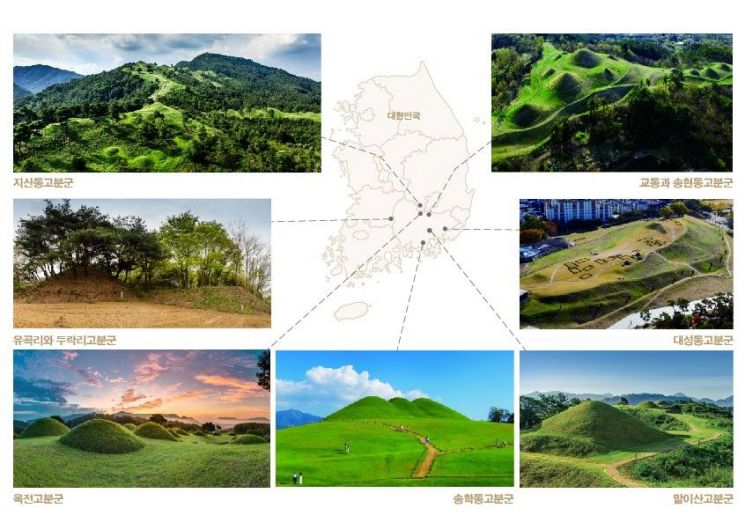
The Gaya Tumuli inscribed as a World Heritage Site include seven sites: Daeseong-dong in Gimhae, Mari Mountain in Haman, Gyodong and Songhyeon-dong in Changnyeong, Songhak-dong in Goseong, Okjeon Tumuli in Hapcheon in Gyeongnam, and Jisandong in Goryeong in Gyeongbuk, as well as Yugok and Durak-ri Tumuli in Namwon, Jeonbuk.
© The Asia Business Daily(www.asiae.co.kr). All rights reserved.


















