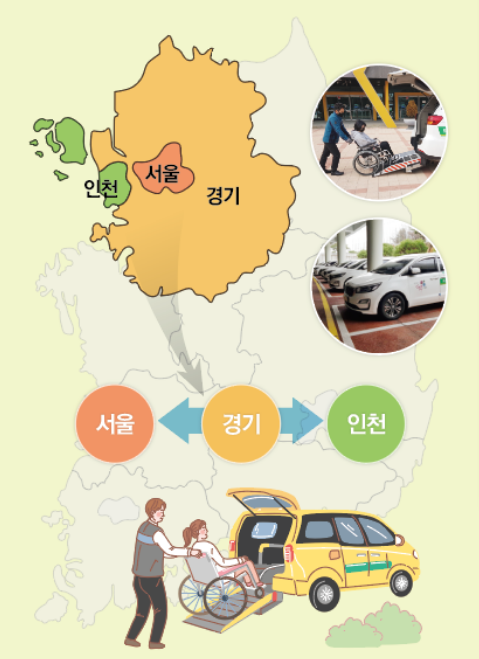
 From the 21st, local governments in the Seoul metropolitan area, including Gyeonggi, Seoul, and Incheon, have started pilot operations of the call taxi service for people with disabilities.
‘Disabled Call Taxi’ (special transportation service) operated by local governments in the Seoul metropolitan area, including Gyeonggi Province, Seoul, and Incheon, will be piloted across the entire metropolitan area beyond their respective regions starting from the 21st. The three local governments will begin full-scale operation from July next year after the pilot period.
Gyeonggi Province announced on the 19th that it signed the ‘Special Transportation Service Metropolitan Area Mobility Agreement’ with Seoul and Incheon regarding this matter.
Special transportation service refers to disabled call taxis equipped with wheelchair boarding facilities to support the mobility of severely disabled pedestrians who experience difficulty in movement, as stipulated by the ‘Act on the Promotion of Convenience for Transportation Vulnerable Persons.’
This expanded operation follows the revision of the Enforcement Decree and Enforcement Rules of the Act on Transportation Vulnerable Persons by the Ministry of Land, Infrastructure and Transport in July, which extended the operation range of special transportation services to adjacent metropolitan local governments. Previously, each of the 31 cities and counties in the province provided special transportation service independently.
Earlier, on October 4th, Gyeonggi Province expanded the operation range of special transportation services from individual cities and counties to all 31 cities and counties. Subsequently, through continuous consultations with Seoul and Incheon, the operation range was extended to cover the entire metropolitan area.
The service is available to severely disabled pedestrians as defined by relevant laws, and reservations can be made in advance from 7 a.m. to 10 p.m. daily at the Transportation Vulnerable Mobility Support Center or other designated centers, starting one day before the desired use date.
Gyeonggi Province plans to supplement operational standards such as usage fees and methods during the pilot operation with Seoul and Incheon until June 30 next year. Until the end of the pilot period, the current city/province-specific fees will apply, and from July 1 next year, the three local governments will apply the same metropolitan area fee.
Unlike Seoul and Incheon (where metropolitan dedicated vehicles account for about 5% of the fleet per local government), Gyeonggi Province will expand the operation of metropolitan dedicated vehicles to 10% of the total fleet.
As of last month, Gyeonggi Province operates 1,197 special transportation vehicles, the largest scale nationwide. Next year, vehicles exclusively for transportation vulnerable persons without wheelchair lifts will also be introduced.
Kim Sang-su, Director of the Gyeonggi Province Transportation Bureau, stated, "The right to mobility is important and fundamentally guaranteed for everyone. Through continuous consultations with Seoul and Incheon, we will actively strive to reduce inconveniences for transportation vulnerable persons in Gyeonggi Province and provide more opportunities for metropolitan mobility."
© The Asia Business Daily(www.asiae.co.kr). All rights reserved.

















