Selling to Lower Stock Price During Block Deal Negotiation Process
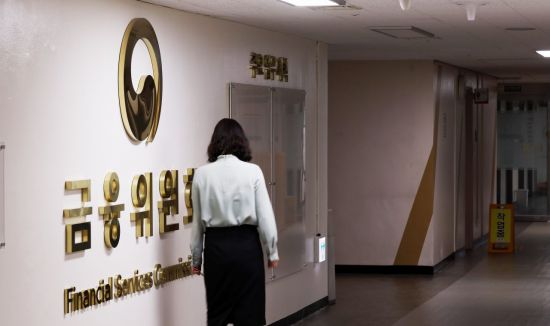 On the 9th, officials were busy moving in the corridor of the Financial Services Commission at the Government Seoul Office in Jongno-gu, Seoul, where financial authorities decided to include mortgage loans (Judaemae) in the 'debt refinancing' infrastructure scheduled to be launched in May by the end of the year. Financial authorities explained that they aim to reduce the interest burden on mortgage loans by building a debt refinancing platform that allows users to compare financial sector loan interest rates at a glance and switch loans easily. Photo by Dongju Yoon doso7@
The financial supervisory authorities imposed fines on three global hedge funds that gained unfair profits through unfair trading practices such as fraudulent trading and naked short selling during block deal (off-hours large volume trading) transactions.
The Securities and Futures Commission announced on the 20th that it reported three global hedge funds to the prosecution for violations of the Capital Markets Act, including fraudulent trading, market order disruption, and naked short selling, related to their stock trading behavior during block deal transactions. Along with this, it decided to impose fines totaling 2.02 billion KRW and other penalties.
Global hedge fund A, around October 2019, entered into a sell swap order worth 11.6 billion KRW of a listed company's stock in Korea during the negotiation of the block deal price, with the intent to cause the stock price to fall. The Securities and Futures Commission judged that A intentionally submitted the sell swap order before agreeing on the block deal price to gain an unfair advantage, earning approximately 3.2 billion KRW in unfair profits.
Additionally, before the block deal transaction information was disclosed, A submitted naked short selling orders while selling the company's stock. The use of phone calls, messengers, and chats to agree on the block deal transaction makes it difficult to consider the possibility of settlement failure low, thus constituting a violation of short selling restrictions.
A Financial Services Commission official stated, "Since naked short selling with the intent to gain unfair profits before the disclosure of material information is recognized as a fraudulent method, it was judged as fraudulent trading," and added, "The Securities and Futures Commission decided that prosecution investigation is necessary as the violation of the Capital Markets Act is recognized."
The Securities and Futures Commission decided to separately impose a fine of 60 million KRW for A's violation of short selling restrictions, as the act occurred before the introduction of criminal penalties and fines in 2021.
© The Asia Business Daily(www.asiae.co.kr). All rights reserved.

















