The Korea Federation of Banks Announces Measures to Support People's Finance in the Banking Sector
The banking sector has announced a record-breaking 2 trillion KRW+α (alpha) scale financial support plan for vulnerable groups such as self-employed individuals and small business owners. Interest costs amounting to a total of approximately 1.6 trillion KRW will be refunded (cashback) to about 1.87 million individual business owners, with an average of 850,000 KRW per person, and an additional 400 billion KRW will be provided to support other vulnerable groups.
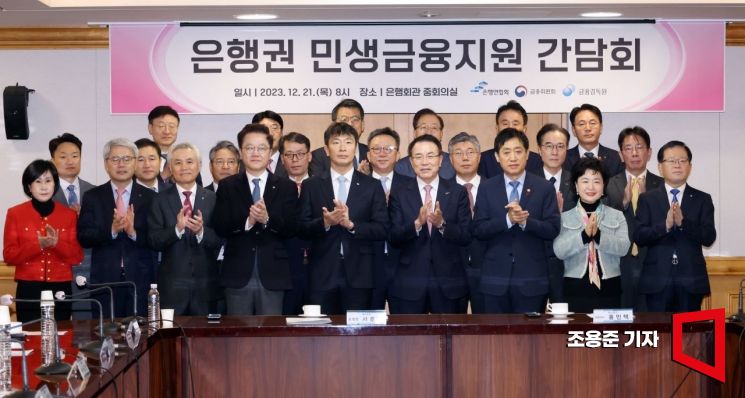 On the 21st, at the Korea Federation of Banks in Jung-gu, Seoul, Kim Joo-hyun, Chairman of the Financial Services Commission, Lee Bok-hyun, Governor of the Financial Supervisory Service, Cho Yong-byeong, Chairman of the Korea Federation of Banks, and heads of 20 major commercial banks are taking a commemorative photo before the meeting of the Banking Sector Livelihood Financial Support Council. Photo by Jo Yong-jun jun21@
On the morning of the 21st, the Korea Federation of Banks announced this 'Banking Sector Livelihood Finance Support Plan' at a meeting attended by Chairman Jo Yong-byeong and the heads of 20 member banks. Financial Services Commission Chairman Kim Ju-hyun and Financial Supervisory Service Governor Lee Bok-hyun also attended the meeting.
The support plan involves all 20 domestic banks (KB Kookmin, Shinhan, Hana, Woori, NH Nonghyup, SC First, Korea Citi, IBK Industrial Bank, Export-Import Bank, sh Suhyup, Busan, Daegu, Gyeongnam, Gwangju, Jeonbuk, Jeju, Kakao, K Bank, Toss), implementing the program on a scale of 2 trillion KRW+α. This is the largest scale ever for a banking sector win-win financial activity.
The banking sector, excluding the policy banks Industrial Bank and Export-Import Bank, will allocate at least 2 trillion KRW based on net income among 18 banks, while the Industrial Bank and Export-Import Bank will participate through additional support (+α) via policy finance programs. The allocation is based on each bank’s net income, annualized as of the end of the third quarter of this year, with major commercial banks expected to bear about 200 billion to 300 billion KRW each.
This program will be implemented through a 'two-track' approach consisting of a common program and a voluntary program. The common program is an interest cashback for individual business owners. As of the previous day (the 20th), the banking sector plans to provide cashback to borrowers holding individual business loans. The method is to pay 90% (reduction rate) of the interest paid exceeding 4% for one year, up to a refund amount limit of 200 million KRW. The refund limit per borrower is 3 million KRW.
For example, a borrower who took out a 300 million KRW loan at an interest rate of 5% and has paid interest for more than one year as of the previous day would receive a cashback amount of 1.8 million KRW. This is calculated by applying the loan limit (200 million KRW) and 90% of the interest paid on the excess rate (1%).
However, considering each bank’s soundness and capacity to bear the burden, banks may autonomously adjust the support criteria. This can be done by reducing the refund limit or the reduction rate. A Korea Federation of Banks official explained, “Applying the same criteria to all banks would be difficult for some to bear, so we leave room for autonomous adjustment considering this.”
Additionally, borrowers with real estate rental business loans are excluded from the support. The Federation explained, “Since real estate rental business is linked to citizens’ asset formation and growth, it is judged not to align with the purpose of this livelihood finance support plan.”
Among the beneficiaries, some borrowers hold multiple debts across several banks and may receive overlapping support, but authorities expect this to be limited. An official stated, “Among about 1.87 million borrowers, around 270,000 are multiple debtors, but if limited to individual business loans and excluding borrowers with loans exceeding the 200 million KRW limit, the number of borrowers who can receive overlapping support is about 87,000. Among these, few have multiple secured loans, and many have both secured and unsecured loans, so the degree of overlap is not expected to be severe.”
Furthermore, after implementing the 1.6 trillion KRW interest refund, the remaining 400 billion KRW will be used to support vulnerable groups. For example, support for small business owners through methods other than cashback such as electricity and rent subsidies, support for vulnerable groups beyond self-employed and small business owners, and contributions to guarantee institutions or the Korea Inclusive Finance Agency.
The banking sector plans to establish detailed execution plans as soon as possible for prompt support. For the common program of interest cashback, the execution plan will be established within next month, and cashback will begin from February next year. The banking sector expects the execution rate to reach about 50% by around March.
For the voluntary program, once the Industrial Bank and Export-Import Bank complete their execution plans in the first quarter of next year, they will proceed with implementation at a brisk pace. The Korea Federation of Banks stated, “We plan to actively support the prompt and effective implementation by collecting, reviewing, and announcing the execution results of each bank according to this livelihood finance support plan on a quarterly basis going forward.”
© The Asia Business Daily(www.asiae.co.kr). All rights reserved.
![User Who Sold Erroneously Deposited Bitcoins to Repay Debt and Fund Entertainment... What Did the Supreme Court Decide in 2021? [Legal Issue Check]](https://cwcontent.asiae.co.kr/asiaresize/183/2026020910431234020_1770601391.png)















