North Korea ICBM Countermeasure Nature Trilateral Air Exercise by South Korea, US, and Japan
US Strategic Weapons Deployed on Korean Peninsula in Response to North Korean Provocations
The Republic of Korea, the United States, and Japan conducted joint air exercises with the deployment of the B-1B strategic bomber, known as the "Death Swan." This joint air training marks the second such exercise this year in response to North Korea's intercontinental ballistic missile (ICBM) provocation on the 18th.
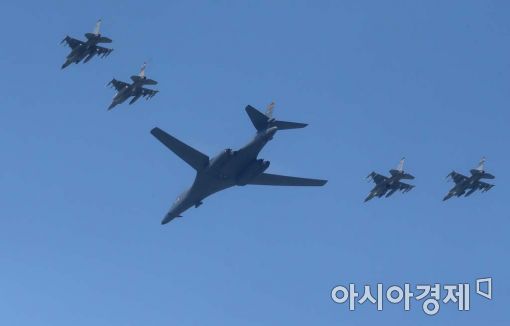
According to the Joint Chiefs of Staff on the 20th, the exercise involved South Korea Air Force's F-15K fighters, U.S. Air Force's F-16 fighters, and Japan Air Self-Defense Force's F-2 fighters, conducted in the overlapping area of the Korea-Japan Air Defense Identification Zone (ADIZ) east of Jeju.
The deployment of U.S. strategic bombers to the Korean Peninsula this year marks the 13th time, with the B-1B having been deployed in February and March in response to North Korea's ICBM provocations. It was also mobilized during the joint air exercises held as part of the U.S.-ROK combined exercise "Ulchi Freedom Shield" in August. The B-1B can fly at a maximum speed of Mach 1.25 and cover up to 11,998 km. When forward-deployed to Guam in the Pacific, it can reach the Korean Peninsula within two hours. Although it does not carry nuclear weapons, it can be armed with up to 57 tons of weapons, boasting a far superior payload compared to other strategic bombers such as the B-2 (22 tons) or B-52 (31 tons).
North Korea Likely to Conduct Additional Provocations Including SLBMs Targeting South Korea’s General Election and U.S. Presidential Election
There is a high possibility that the U.S. strategic weapons will be further deployed to the Korean Peninsula in response to North Korea’s provocations. North Korea is expected to continue provocations aligned with next year’s South Korean general election and the U.S. presidential election. The next card could be submarine-launched ballistic missiles (SLBMs) or new intermediate-range ballistic missiles (IRBMs), according to analyses.
North Korea may resort to SLBMs or IRBMs. Since the 8th Congress of the Workers' Party of Korea in January 2021, which presented the five-year plan for defense development focusing on the "core five tasks," North Korea launched its first tactical nuclear attack submarine, the "Kim Gun-ok Hero" (No. 841), in September. Following the successful launch of reconnaissance satellites, North Korea claimed in November to have successfully tested a solid-fuel engine for a new IRBM.
North Korea may also conduct a seventh nuclear test. The first nuclear test was conducted on October 9, 2006, three months after the launch of the Taepodong-2 missile. The second nuclear test on May 25, 2009, was carried out one month after the launch of the Unha-2 long-range missile carrying the Kwangmyongsong-2 satellite. The third nuclear test was conducted on February 12, 2013, two months after the launch of the Unha-3 carrying the Kwangmyongsong 3-2 satellite in December 2012. The most recent sixth nuclear test was conducted on September 3, 2017, two months after the launch of the Hwasong-14 ICBM in July.
The Joint Chiefs of Staff stated, "This exercise was planned to strengthen the capabilities of the three countries to respond to North Korea’s nuclear and missile threats, including solid-fuel ICBM launches, and to demonstrate a strong joint response will." They added, "Going forward, the Republic of Korea, the United States, and Japan will continue to strengthen cooperation based on close coordination, gradually expanding trilateral security cooperation to deter North Korea’s threats and respond jointly."
© The Asia Business Daily(www.asiae.co.kr). All rights reserved.
















