Inheritance Tax Exemption Up to 30 Billion Won for US Parents Combined
At Least 1.3 Billion Won Required in Australia, 4 Billion Won in New Zealand
The number of wealthy Koreans emigrating ranks 7th worldwide, indicating a high position in the global ranking. When considering the ratio of wealthy emigrants relative to the population, the figure is even higher than that of China, which has the largest number of emigrants.
The main reason behind this wave of wealthy Koreans 'escaping Joseon' is attributed to inheritance tax. South Korea's inheritance tax rate (50%) is much higher than the OECD average of 25%, and the exemption threshold is excessively low compared to other countries, making the cost of investment immigration much less than the inheritance tax.

800 Korean Millionaires Emigrate... More per Capita than China
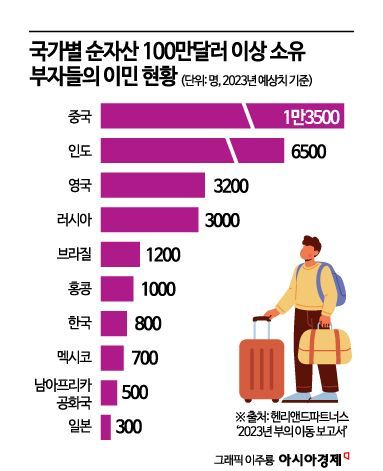
According to the '2023 Wealth Migration Report' released in June this year by Henley & Partners, a UK-based international exchange and immigration specialist firm, among the wealthy worldwide with a net worth of over 1 million USD (approximately 1.3 billion KRW), the country with the highest number of expected emigrants is China (13,500 people). Following China are India (6,500), the United Kingdom (3,200), Russia (3,000), Brazil (1,200), Hong Kong (1,000), and South Korea (800).
Although South Korea ranks 7th overall, considering that its population is nearly 30 times smaller than China's, it is analyzed that a relatively large number of wealthy individuals per capita are emigrating overseas. According to the '2022 World Population Status Report' by the United Nations Population Fund (UNFPA), South Korea's population is 51.3 million, which is 28.23 times less than China's 1.4485 billion. When the number of wealthy emigrants from South Korea (800) is proportionally estimated against China's population, it amounts to 22,584 people, exceeding China's figure.
The total number of emigrants, which had temporarily slowed down after the COVID-19 pandemic, has started to increase again. The Ministry of Foreign Affairs reported that the number of overseas migration notifications decreased from 4,412 in 2019 to 1,941 in 2020 due to the pandemic, but rebounded to 2,015 in 2021 and 2,632 last year.
Among these, the countries most emigrated to by Koreans are the United States (47.9%), Canada (20.1%), and Australia (8.0%). These countries share the common traits of being English-speaking and having significantly lower inheritance tax rates and exemption thresholds than South Korea, or no inheritance tax at all.
US Inheritance Tax Exemption Threshold 30 Billion KRW... Canada and New Zealand Have No Inheritance Tax

The inheritance tax rate in the United States is 40%, lower than South Korea's 50%, and the exemption threshold is much higher. In the US, inheritance up to 11.7 million USD (approximately 15.2 billion KRW) per parent, or 23.4 million USD (approximately 30.4 billion KRW) combined for both parents, is exempt from inheritance tax. In contrast, South Korea's exemption threshold is only 1 billion KRW.
Following the US, Canada and Australia, which are also popular destinations for Korean emigrants, do not have inheritance or gift taxes at all. In Canada, income tax is levied on investment properties if their value has increased significantly since purchase at the time of inheritance. However, no tax is imposed on properties used as primary residences.
Globally, South Korea's inheritance tax rate is considered very high. According to OECD data, South Korea's general top inheritance tax rate (50%) is the second highest after Japan (55%). When the surcharge tax on major shareholders is applied, the inheritance tax rate rises to 60%, the highest level among OECD countries. This is more than twice the OECD average of 25% for countries operating inheritance tax systems.
US Investment Immigration Minimum 1 Billion KRW, Canada and Australia Also Require Over 1 Billion KRW
Due to this high inheritance tax rate, wealthy individuals facing enormous inheritance taxes are increasingly opting for investment immigration, which is relatively less costly, leading to a continuous rise in emigration among Korean wealthy people.
According to the US Citizenship and Immigration Services (USCIS), the minimum investment requirement for the US investment immigration visa EB-5 is 800,000 USD (approximately 1.04 billion KRW). This was raised from 500,000 USD last year following amendments to immigration law. If the investment complies with US government regulations and local employment of Americans is secured, the investment immigration visa can be obtained in about 10 to 12 months.
Minimum investment requirements vary slightly by country but are generally around 1 billion KRW. In Canada, the threshold is 1.2 million Canadian dollars (approximately 1.16 billion KRW), and in Australia, it is 1.5 million Australian dollars (approximately 1.3 billion KRW). However, for investment immigration, in addition to the investment amount, language proficiency and other conditions must be met to obtain permanent residency.
In New Zealand, the language proficiency and other requirements are relatively low, but the investment threshold is significantly higher than in other countries. A minimum investment of 5 million New Zealand dollars (approximately 4.08 billion KRW) is required.
© The Asia Business Daily(www.asiae.co.kr). All rights reserved.
![Clutching a Stolen Dior Bag, Saying "I Hate Being Poor but Real"... The Grotesque Con of a "Human Knockoff" [Slate]](https://cwcontent.asiae.co.kr/asiaresize/183/2026021902243444107_1771435474.jpg)













