Democratic Party Freshmen Group 'The Mincho' Emergency Debate
"Overcoming Regionalism with Parallel System" VS
"Aiming for Coalition Politics with Mixed-Member Proportional Representation"
First-term lawmakers of the Democratic Party of Korea held a debate on the 'proportional representation electoral system.' Those advocating a return to the parallel system cited 'breaking regionalism' as their rationale. Meanwhile, proponents of maintaining the semi-proportional system emphasized political justification and the necessity of 'coalition politics.' There were also remarks pointing out the need to consider the possibility that a third-party 'new party' could sweep up votes from the major parties' splits and the non-affiliated voter base.
The first-term lawmakers' group 'Deomincho' held an urgent debate on the proportional representation electoral system on the morning of the 20th at the National Assembly Members' Office Building, discussing the direction of electoral reform based on expert analysis. Assemblyman Min Byung-duk chaired the debate, with Deomincho's executive committee chair Assemblyman Yoon Young-duk and Assemblyman Lee Tan-hee, who is leading discussions on the 'Satellite Party Prevention Act,' in attendance. Three-term Assemblyman Lee Hak-young and two-term Assemblymen Kim Doo-kwan and Song Gap-seok also participated.
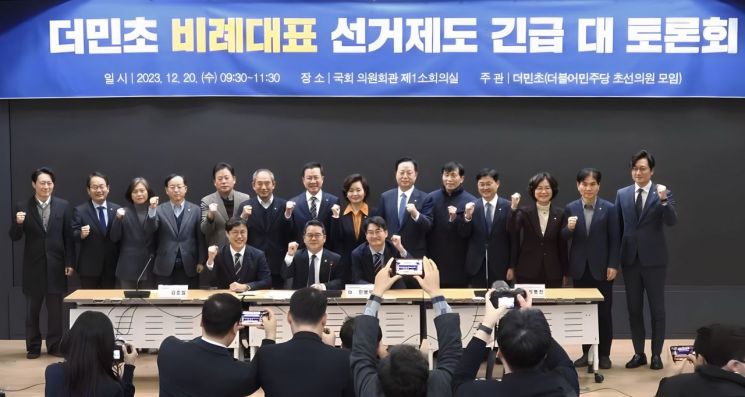 The Democratic Party's first-term members' group, 'Deomincho,' held an urgent debate on the proportional representation electoral system on the morning of the 20th at the National Assembly Members' Office Building, discussing the direction of electoral system reform based on expert analysis.
On the side advocating a 'return to the parallel system,' former Deputy Director Choi Byung-chun of the Democratic Research Institute presented, while Kim Jun-il, CEO of Newstope, spoke for maintaining the semi-proportional system.
Former Deputy Director Choi emphasized 'breaking regionalism' as the reason for needing a regional parallel proportional representation system. He argued, "Through the parallel system, we can break regionalism without disadvantaging minor parties," adding, "Concerns about disadvantages to minor parties can be technically resolved under this system." He explained that dividing the '3% threshold clause' from a nationwide level to regional levels could lower the barrier. For example, all parties would nominate regional proportional representation candidates, and if a party gains 3% of votes in a specific region, one seat would be allocated per region.
Choi predicted, "This could lower the entry barrier," and added, "If the Democratic Party reliably elects proportional candidates in Yeongnam and the People Power Party does so in Honam, 'checks and balances' will function within civil society."
He strongly criticized the forecast that the Democratic Party would achieve a landslide victory even if the semi-proportional system is maintained. He pointed out, "In the history of the People Power Party, the only time they were completely crushed in a general election was in 2020," and said, "Considering this as the default is excessively exaggerated." He argued that it is unreasonable to positively anticipate the upcoming general election based on the Democratic Party's landslide victory in the 21st general election. He emphasized, "Party politics or coalition politics should be done after maximizing our strength; dividing seats is charity."
He also expressed skepticism about the effectiveness of pushing the 'Satellite Party Prevention Act.' Choi said, "If the Satellite Party Prevention Act is made, President Yoon Suk-yeol will definitely exercise his veto," adding, "Making a law with a 100% chance of veto means the actual result is that only the Democratic Party wants to make the Satellite Party Prevention Act." He claimed, "This means losing at least 20 seats, possibly 26 to 27 seats." However, the 'loss' figures Choi presented assumed that only the ruling party would create satellite parties while the Democratic Party would not.
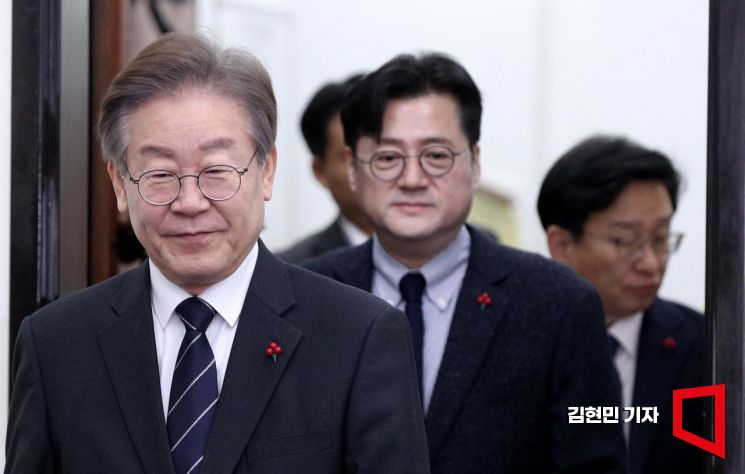 Lee Jae-myung, leader of the Democratic Party of Korea, is attending the talent recruitment ceremony of entrepreneur Lee Jae-sung, a former NCSoft employee, at the National Assembly on the 14th. Photo by Kim Hyun-min kimhyun81@
On the other hand, Kim Jun-il, CEO of Newstope, argued for maintaining the semi-proportional system by emphasizing 'political justification.' Kim cited past interviews of Representative Lee Jae-myung, who had pledged 'political reform,' stating, "Returning to the parallel system would lose both justification and practical benefits." He particularly highlighted that the Democratic Party's support base is concentrated among those in their 40s who cast their 'first vote' for the late former President Roh Moo-hyun, emphasizing, "The Democratic Party's supporters value justification more than any other generation." He stressed the need to consider supporter characteristics when determining the direction of electoral reform.
He presented several public opinion poll results on support for third-party new parties such as the 'Lee Jun-seok New Party' and 'Lee Nak-yeon New Party,' insisting, "(For the Democratic Party's general election victory) we must not give former Representative Lee Nak-yeon and others justification to run, and we must prevent whatever they try to do." He expressed concern that while conservative support for the 'Lee Nak-yeon New Party' might be inflated by phantom votes, voters supporting new parties within the Democratic Party's base are likely to cause vote splitting in actual elections.
He pointed out that conservative support is concentrated in the so-called TK (Daegu and Gyeongbuk), which he cited as a limitation of the ruling party, and argued that unlike presidential elections where nationwide votes matter, the Democratic Party is overwhelmingly advantaged in general elections where 'regional' votes are important. From a long-term perspective, he analyzed that advocating 'coalition politics' is necessary to secure victory not only in the general election but also in the presidential election. He warned that a return to the parallel system would force choosing between the two major parties, causing serious damage to the Democratic Party in competitive constituencies, and reiterated, "Coalition politics is necessary to attract votes from non-Democratic Party supporters."
Kim cited the so-called '1987 system' and the 'four-party coalition' during the establishment of the High-ranking Officials' Crime Investigation Unit (HOCI) as examples of coalition politics. He analyzed, "When multiple parties formed coalitions, the 'political reform' momentum was strongest in elections," adding, "By moving toward the semi-proportional system and discussing political reform, undecided voters will actively cast their votes." He also suggested that creating reasons to vote for the Democratic Party and introducing mechanisms like a 'runoff voting system' in the proportional representation system could effectively enhance political efficacy.
© The Asia Business Daily(www.asiae.co.kr). All rights reserved.
![Clutching a Stolen Dior Bag, Saying "I Hate Being Poor but Real"... The Grotesque Con of a "Human Knockoff" [Slate]](https://cwcontent.asiae.co.kr/asiaresize/183/2026021902243444107_1771435474.jpg)












