Ruling and Opposition Parties Likely to Delay Budget Bill Deadline by One Day, Process on the 21st
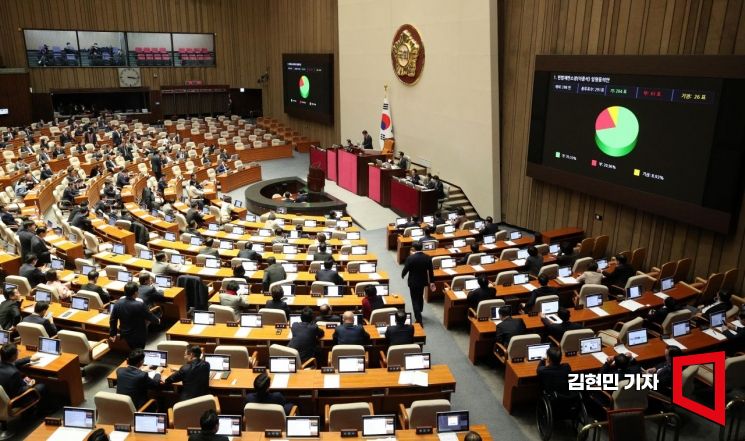
The budget bill for next year is expected to be processed on the 21st. The ruling and opposition parties have agreed to hold a separate plenary session to handle the budget bill.
On the 20th, National Assembly Speaker Kim Jin-pyo, People Power Party Acting Leader and Floor Leader Yoon Jae-ok, and Democratic Party Floor Leader Hong Ik-pyo met to discuss the agenda for the plenary session, including the budget bill. After the meeting, Speaker Kim said, "The budget agreement will be announced at 2 p.m.," adding, "Since we need to do the sheet work ourselves, the processing will take place at 10 a.m. tomorrow." Floor Leader Hong also told reporters after the meeting, "(Processing the budget bill) today is physically difficult," and asked for a little more patience even if an agreement is reached.
Although both parties initially declared they would process the budget bill on this day, it once again turned out to be an empty promise. With the legal deadline (December 2) and the regular National Assembly session (December 9) passing without the budget bill being processed, the ruling and opposition parties had announced their intention to handle it on the 20th.
As Speaker Kim mentioned, even if the parties reach an agreement, the budget bill cannot be processed on the same day. This is because the detailed budget specification work, known as sheet work, requires time. Sheet work typically takes more than 10 hours.
The ruling and opposition parties are expected to conduct final practical negotiations ahead of the final agreement.
So far, the parties have leaned toward cutting the Official Development Assistance (ODA) budget, which has become increasingly necessary due to the failure to attract the 2030 World Expo (Expo) to Busan, and the contingency fund budget of about 5 trillion won. However, the opposition party is demanding a reduction of more than 4 trillion won from the government proposal, making the final reduction amount a key point of interest. Since the National Assembly usually decides on the increase amount based on the reduction scale, how much to cut is also a contentious issue. An official stated, "The amount of budget reduced at the subcommittee level of the Budget and Accounts Committee is not large, so additional areas for cuts will need to be found."
There are significant differences between the ruling and opposition parties regarding how to increase R&D-related budgets by project, special activity expenses for the Ministry of Justice, police, the Presidential Office, and the Board of Audit and Inspection, the increase in the Saemangeum project budget, and local gift certificates. Floor Spokesperson Jang said, "There are disagreements over the budget allegedly directed by Democratic Party Leader Lee Jae-myung, and the Democratic Party still has complaints about the indiscriminate budget cuts for the Ministry of Justice, police, Presidential Office, and Board of Audit and Inspection." In addition, there are hidden issues between the parties, such as the 50% cut last year to the Ministry of Justice's Personnel Intelligence Unit and the Ministry of the Interior and Safety's police bureau operating expenses, which were agreed upon after last-minute compromises between the floor leaders.
As the budget bill processing has long passed the legal deadline (December 2), local governments and others are facing difficulties. Lee Sang-min, senior research fellow at the Nara Salrim Research Institute, pointed out, "Both public enterprises and private companies need to set their plans for next year once the central government budget is finalized, but the later the central government budget is delayed, the harder it becomes to make plans for next year." He added, "Especially local governments are highly dependent on the central government's budget. When they have to prepare budgets without knowing what subsidies the central government will provide, predictability disappears." In particular, Lee criticized, "With next year's local tax revenue decreasing by 10.1%, local allocation tax has also decreased, making subsidies more important for local governments. However, since subsidies have not been finalized, predictability has deteriorated."
© The Asia Business Daily(www.asiae.co.kr). All rights reserved.
![User Who Sold Erroneously Deposited Bitcoins to Repay Debt and Fund Entertainment... What Did the Supreme Court Decide in 2021? [Legal Issue Check]](https://cwcontent.asiae.co.kr/asiaresize/183/2026020910431234020_1770601391.png)















