Ruling and Opposition Parties Still Fail to Resolve Budget Dispute
Budget Approval May Be Delayed Beyond the 21st
The budget bill for next year is likely to miss not only the legal deadline but also the deadline for bipartisan agreement. The ruling and opposition parties are negotiating the budget for next year. However, as key issues remain unresolved, it has become physically difficult to process the budget within the agreed timeframe.
Hong Ik-pyo, floor leader of the Democratic Party of Korea, stated at the Supreme Council meeting on the 20th regarding next year’s budget bill, "A final agreement has not been reached," adding, "We will make further efforts to reach a final agreement on the budget bill through discussions with the ruling and opposition parties and government budget authorities by this morning." Jang Dong-hyuk, spokesperson for the People Power Party floor leaders, also conveyed the atmosphere on KBS Radio that day, saying, "The floor leaders of both parties have shown strong determination to process the budget bill by today," and "I understand they met late into the night yesterday to negotiate."
However, if the ruling and opposition parties fail to present an agreement on the budget bill by this morning, it will be physically difficult to process the budget. Even if the parties agree on the direction of processing, time is needed for the detailed budget specification work known as sheet work. Sheet work typically takes more than 10 hours. Accordingly, it is expected that an agreement on the budget bill between the parties will be reached during the day, and the plenary session will be held around the 21st to process the budget. However, some predict that it could be delayed until the plenary session on the 28th. If the budget bill is processed this late, it will be recorded as the latest budget processing since the introduction of the National Assembly’s advanced legislative procedures.
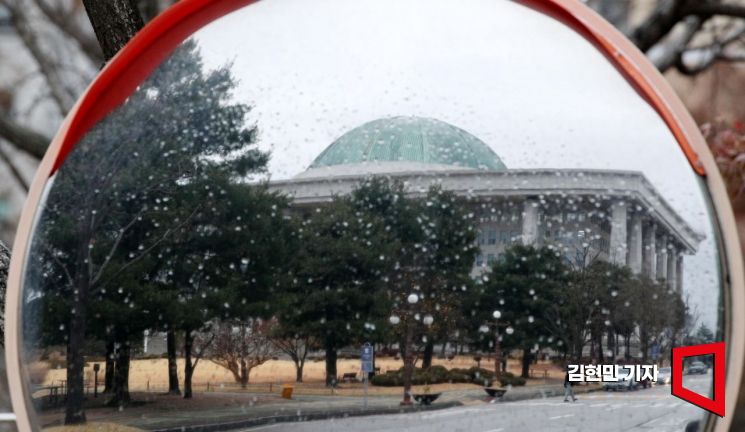 After concluding the 21st regular session of the National Assembly, the ruling and opposition parties will enter a temporary session on the 11th. The temporary session, which will continue for 30 days until the 9th of next month, is expected to see confrontations between the parties over the handling of next year's budget bill, which has exceeded the legal deadline, the confirmation hearings for the second-term cabinet of the Yoon Seok-yeol administration, and the Democratic Party's push for dual special investigations. The photo shows the main building of the National Assembly reflected in a convex mirror on the day. Photo by Kim Hyun-min kimhyun81@
For now, the floor leaders of both parties and the secretaries of the Special Committee on Budget and Accounts are expected to engage in final coordination of next year’s budget bill. Between the parties, the direction has been set toward cutting the Official Development Assistance (ODA) budget, which requires reduction due to the failure to host the 2030 World Expo in Busan, and the contingency fund budget, which is set at around 5 trillion won. However, the opposition party is demanding a reduction of more than 4 trillion won from the government’s proposal. Since the National Assembly usually decides the scale of increases based on the scale of cuts, how much to reduce remains a key issue. An official said, "The amount of budget cut at the subcommittee level of the Budget Committee is not large, so additional cuts need to be found," explaining the situation.
There are also significant differences between the parties regarding how to increase R&D-related budgets by project, special activity expenses for the Ministry of Justice, police, the Presidential Office, and the Board of Audit and Inspection, increases in the Saemangeum project budget, and local love gift certificates. Spokesperson Jang said, "There are disagreements over the budget allegedly directed by Lee Jae-myung, the Democratic Party leader, and the Democratic Party still has complaints about indiscriminate budget cuts for the Ministry of Justice, police, Presidential Office, and Board of Audit and Inspection." In addition, there are hidden issues between the parties, such as the Ministry of Justice’s Personnel Intelligence Unit and the Ministry of the Interior and Safety’s police bureau operating expenses budget, which were cut by 50% after last year’s last-minute compromise between floor leaders.
As the budget bill processing has long passed the legal deadline (December 2), local governments and others are facing difficulties. Lee Sang-min, senior research fellow at the Nara Salrim Research Institute, pointed out, "Both public enterprises and private companies need to set their plans for next year once the central government budget is finalized, but the later the central government budget is finalized, the more difficult it becomes to set plans for next year," adding, "Especially local governments are highly dependent on the central government’s budget. If they prepare their budgets without knowing what subsidies the central government will provide, predictability disappears." In particular, Lee criticized, "With next year’s local tax revenue decreasing by 10.1%, local allocation tax has also decreased, making subsidies more important for local governments. However, since subsidies have not been finalized, predictability has deteriorated."
© The Asia Business Daily(www.asiae.co.kr). All rights reserved.

















